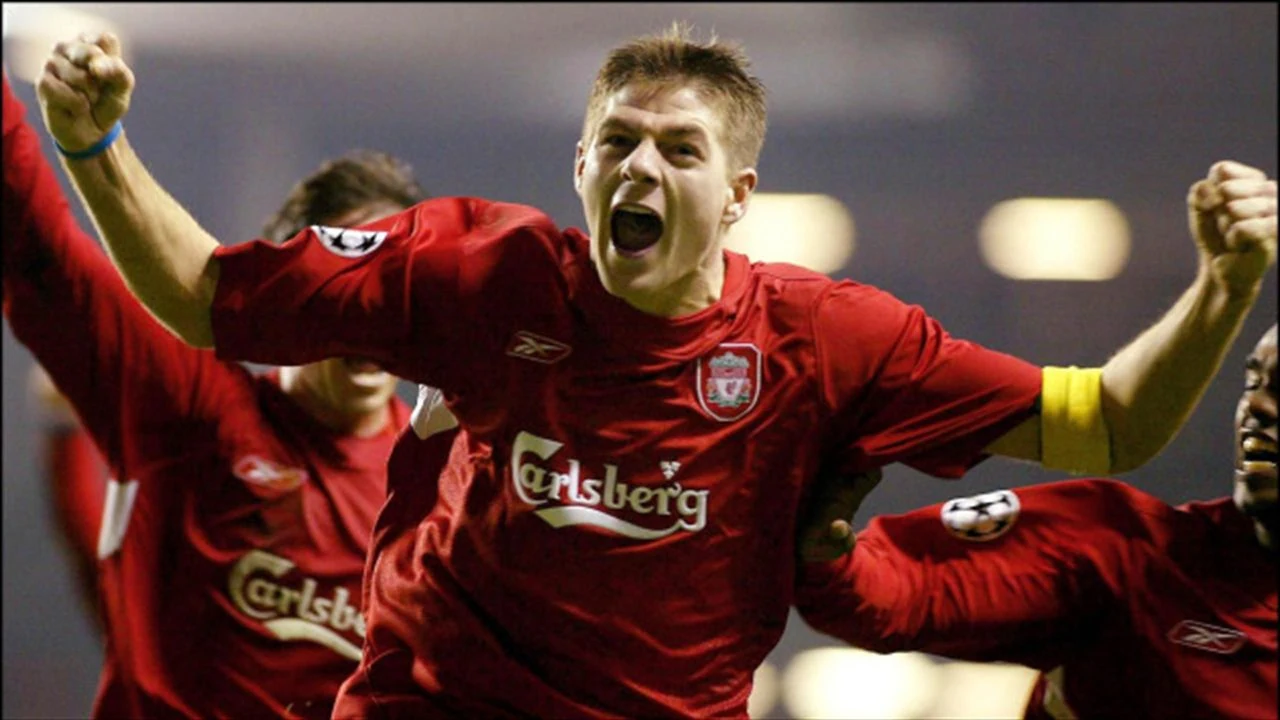
At half-time in the 2005 Champions League final, Liverpool were three goals behind AC Milan. Steven Gerrard’s header began a second-half comeback that took the match to penalties and gave Liverpool the trophy. It was the most famous expression of qualities that had defined his career: the ability to influence a match from midfield, to adapt to different roles and to lead through difficult moments.
Gerrard spent most of his playing career at Liverpool, the club he joined as a nine-year-old, and captained both Liverpool and England. His story also extends beyond Anfield: after leaving Liverpool, he played for LA Galaxy, then moved into coaching and management. In 2021 he led Rangers to an unbeaten Scottish Premiership title campaign.
From Whiston to Liverpool’s first team
Steven George Gerrard was born in Whiston, Merseyside, on 30 May 1980. He began playing for Whiston Juniors, where Liverpool scouts noticed him, and joined the club’s academy in 1989. He signed his first professional contract in November 1997. His first-team debut came on 29 November 1998, when he entered a Premier League match against Blackburn Rovers as a late substitute.
Gerrard initially played in central midfield alongside Jamie Redknapp, and sometimes on the right. His first senior goal came in a 4–1 win over Sheffield Wednesday in December 1999. Injuries also became part of his early career: persistent back problems were followed by groin injuries that required four operations. He established himself in Liverpool’s team nonetheless, and in 2000–01 made 50 appearances in all competitions as the club won the FA Cup, League Cup and UEFA Cup. He scored in the UEFA Cup final and was named PFA Young Player of the Year.
Appointed vice-captain before the 2002–03 season, Gerrard became captain in October 2003, replacing Sami Hyypiä. The role suited a player whose contribution was not confined to one position. He developed from a more defensive midfielder into a box-to-box presence, capable of breaking up attacks, carrying the ball forward and scoring from distance. At different stages he was also used in attacking midfield and as a deeper playmaker.
Istanbul, Cardiff and the cup finals
The 2005 Champions League final became the defining match of Gerrard’s Liverpool career. After Milan took a 3–0 half-time lead, Gerrard scored Liverpool’s first goal with a header from a John Arne Riise cross. Liverpool drew level and won the penalty shoot-out. Gerrard was named man of the match and later received the UEFA Club Footballer of the Year award. He also scored a crucial long-range goal against Olympiacos in the group stage, helping Liverpool reach the knockout rounds.
His future at Liverpool was uncertain in the weeks after the final, with Chelsea pursuing him, but he signed a new four-year deal. The next season brought another defining cup performance. Against West Ham United in the 2006 FA Cup final, Gerrard scored twice, including a 35-yard equaliser in injury time. Liverpool won on penalties. His goals meant he had scored in the finals of the FA Cup, League Cup, UEFA Cup and Champions League.
In 2012, he helped Liverpool reach the League Cup final by scoring a penalty in each leg of the semi-final against Manchester City. Liverpool beat Cardiff City on penalties. Across his Liverpool career he won two FA Cups, three League Cups, the Champions League, the UEFA Cup, the UEFA Super Cup and the 2006 Community Shield. A further Champions League final, in 2007, ended in defeat to Milan.
England captain and a versatile midfielder
Gerrard made his England debut against Ukraine in May 2000 and earned 114 senior caps between 2000 and 2014, scoring 21 goals. He played at three European Championships and three World Cups. At Euro 2004, he scored against Switzerland; at the 2006 World Cup, he scored twice in the group stage. England went out to Portugal on penalties in both tournaments’ knockout stages.
He captained England at the 2010 World Cup after Rio Ferdinand was injured. In 2012 he was appointed permanent captain for the European Championship, where he supplied three assists and was named in the tournament’s team. England again lost to Italy on penalties in the quarter-final. Gerrard’s final major tournament was the 2014 World Cup, where England were eliminated in the group stage. He announced his international retirement in July 2014.
His influence came partly from the range of tasks he could perform. At his peak, Gerrard was a dynamic central midfielder, able to defend, make late runs into the penalty area and create chances. Later, he was used more often in a deeper role, where his passing and reading of the game could shape Liverpool’s attacks. He also played as an attacking midfielder, a second striker and, at times, in wider or defensive positions.
Leaving Liverpool and moving into management
Gerrard announced in January 2015 that he would leave Liverpool at the end of the season. His final appearance for the club came in May, after 17 seasons in the first team. He then joined LA Galaxy in Major League Soccer, making 34 league appearances and scoring five goals. He announced his retirement from professional football in November 2016, aged 36.
In 2017 he returned to Liverpool as a youth coach, taking charge of the under-18 team and later the under-19s. The following year he became manager of Rangers. His first senior managerial post brought a title in his third full season: in 2020–21, Rangers won the Scottish Premiership without losing a league match, finishing with 102 points and conceding 13 goals in 38 games. It was the club’s first league title in ten years and Gerrard’s first as a manager.
In November 2021 he left Rangers to manage Aston Villa. He was dismissed in October 2022 after Villa won two of their first 12 league matches that season. In July 2023 he became manager of Saudi Arabian club Al-Ettifaq, leaving by mutual consent in January 2025. His career in management therefore continued beyond the Rangers title, with contrasting spells in the Premier League and Saudi Pro League.
Recognition and a lasting record
Gerrard’s individual honours include the PFA Players’ Player of the Year award in 2006, the Football Writers’ Association Footballer of the Year award in 2009 and the UEFA Club Footballer of the Year award in 2005. He was selected eight times for the PFA Premier League Team of the Year and was inducted into the Premier League Hall of Fame in 2021. In 2007 he was appointed a Member of the Order of the British Empire for services to sport. Liverpool John Moores University awarded him an honorary fellowship in 2008.
His career also included disappointments: Liverpool did not win the Premier League title during his playing years, and England did not progress beyond the quarter-finals at the major tournaments in which he featured. Those limits belong in the account alongside the trophies. Gerrard’s record is not a story of unbroken success, but of sustained importance to Liverpool and England, and of a playing career that gave way to a notable managerial achievement in Scotland.
Why Steven Gerrard deserves a place in British Legacy
Gerrard’s place in British Legacy rests first on what he achieved for two central institutions in English football. For Liverpool, he was captain for more than a decade and a leading figure in a team that won the Champions League, two FA Cups, three League Cups and the UEFA Cup. The 2005 final in Istanbul remains a particularly clear example of his influence: his goal helped start Liverpool’s recovery from a three-goal deficit, and his performance earned him the match’s player award. His other defining cup performance, two goals in the 2006 FA Cup final, demonstrated that his contribution was not limited to one famous night.
His England career adds a national dimension to that record. Gerrard won 114 caps, captained the side and represented it at European Championships and World Cups. He later carried his leadership into management, guiding Rangers through an unbeaten league season to their first Scottish title in ten years. That achievement shows a different kind of contribution from his playing career: building a team able to sustain results over a full campaign. Taken together, his Liverpool and England service, his adaptability as a midfielder and his work at Rangers make his legacy specific and substantial. His career also offers a fuller picture of sporting achievement: it contains major trophies and celebrated comebacks, but not a Premier League title or an England tournament breakthrough.
Sources
Steven Gerrard — Wikipedia revision 1377860469 · Steven Gerrard — Wikipedia
Adapted in part from Steven Gerrard by Wikipedia contributors, under CC BY-SA 4.0. Text has been edited and combined with the existing article; this adapted text is shared under the same licence. Contributor history.