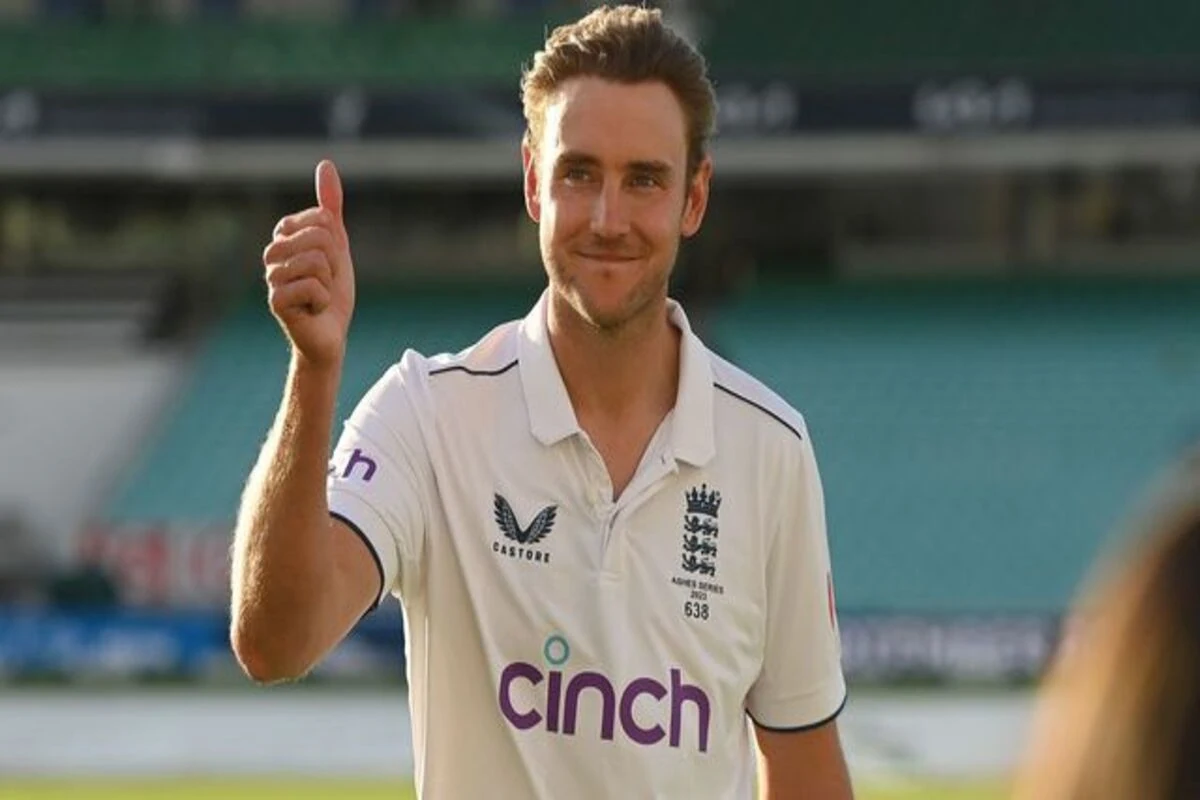
Stuart Broad’s Test career ended with a flourish worthy of its most dramatic passages: a six from the last ball he faced, followed by a wicket with the last ball he bowled. It was July 2023, the final day of the Ashes at The Oval, and England had won the match. Broad had announced his retirement two days earlier. His farewell condensed a career of 167 Tests, 604 wickets and repeated interventions in the contest that shaped his reputation: England against Australia.
From Leicestershire to England
Born in Nottingham on 24 June 1986, Broad grew up in a cricketing family. His father, Chris Broad, was an England opening batsman. Stuart initially followed him as a batter, but after a growth spurt at 17 he began to consider fast bowling. He had been associated with Leicestershire from childhood, played for the county’s youth sides and made his first-class debut in 2005.
Broad attended Brooke Priory School and Oakham School. At 16, he was also playing hockey as a goalkeeper, representing Leicestershire and the Midlands and having a trial with an England age-group team. Cricket ultimately offered a choice between Durham University and a professional contract with Leicestershire. He made his international debut in 2006, first in a Twenty20 international against Pakistan and then in a one-day international. His Test debut followed against Sri Lanka in Colombo in December 2007.
In 2008 he moved from Leicestershire to Nottinghamshire, the county of his birth and the team for which his father had played. The shift brought him into a long domestic career with his home county, alongside the demands of international cricket. He became a regular in England’s Test side while also captaining the national team in One Day and Twenty20 Internationals.
Learning to win the hard moments
Broad’s career was not a simple march from promise to success. Early international cricket brought uneven spells and difficult days. In the 2007 World Twenty20, India’s Yuvraj Singh hit six sixes from one of Broad’s overs, a costly and highly visible episode in the young bowler’s career. Broad continued to develop, and his ability to recover from setbacks became part of the record as much as his best performances.
The 2009 Ashes established his capacity to change a Test. At The Oval, with the series level and England needing a win to regain the urn, Broad took five wickets for 37 in the afternoon session. Australia fell from 73 without loss to 111 for seven, and were eventually dismissed for 160. Broad also contributed runs and took Shane Watson’s wicket on the final day. England won by 197 runs and the series 2–1; Broad received the match award.
He continued to contribute with the bat as well as the ball. In 2010, against Pakistan at Lord’s, he arrived with England at 102 for seven and made 169, sharing a 332-run eighth-wicket partnership with Jonathan Trott. The innings was his first Test century and remains the highest Test score by a number nine at the time recorded in the source. He also took three wickets in the match and was named player of the match.
Broad’s bowling could be especially potent when conditions or momentum gave him an opening. In 2011, against India at Trent Bridge, he took a Test hat-trick and finished with figures of six for 46. In 2012, against West Indies at Lord’s, he took seven for 72 in the first innings and went on to claim 11 wickets in the match. That performance included a second-innings haul of four and earned him another match award.
The Ashes and a spell for the ages
Broad’s record against Australia became central to his standing. The 2013 Ashes brought a telling performance at Chester-le-Street: 11 wickets in the match, including a second-innings six for 20, as England secured the series. His career also included controversy. In the first Test at Trent Bridge that year, he stood his ground after edging a delivery, with Australia having used all their review challenges. He was not required by the rules to leave, but the decision drew criticism. The episode remains part of the more complicated story of an Ashes career defined by intense scrutiny as well as decisive results.
In 2015, back at Trent Bridge, Broad produced his most famous spell. He took eight wickets for 15 runs in Australia’s first innings, which ended at 60. England won the fourth Test and regained the Ashes; the series finished 3–2. The figures were the best of Broad’s Test career, and the spell was later named Wisden’s men’s Test spell of the decade. It captured the qualities that made him dangerous: pace, accuracy and the ability to turn a match sharply in England’s favour.
His work was not limited to Ashes summers. Broad played in England’s 2010 World Twenty20-winning side and was player of the match in the semi-final against Sri Lanka. He and James Anderson formed one of Test cricket’s most productive bowling partnerships, eventually taking 1,009 wickets together across 133 Tests. Broad passed 500 Test wickets in 2020 and became the second England bowler to reach 600 during the 2023 Ashes. He retired with 604.
The last Test and life beyond playing
Broad’s final international appearance came in the fifth Test of the 2023 Ashes at The Oval. England won by 49 runs, drawing the series 2–2. In his last innings with the bat, Broad hit a six from his final delivery; with the ball, he took the final wicket of the match. The ending was striking, but it capped a career built across different formats, county cricket and more than fifteen years in the England Test side.
His achievements also brought formal recognition. Broad was appointed an MBE in 2016 for services to cricket and a CBE in the 2024 New Year Honours. He finished runner-up in the BBC Sports Personality of the Year award for 2023. His career statistics include 167 Test matches, 604 Test wickets and 3,662 Test runs; he also played 121 One Day Internationals and 56 Twenty20 Internationals. After retirement he became a cricket commentator, taking his experience of the international game into a different role in the sport.
Why Stuart Broad deserves a place in British Legacy
Broad’s place in British Legacy rests first on achievements that can be measured: 604 Test wickets, two major Ashes spells at The Oval and Trent Bridge, and a place in England’s 2010 World Twenty20-winning team. His eight for 15 against Australia in 2015 is not merely a memorable set of figures; it was a decisive contribution in a Test England won to regain the Ashes. His 2009 performance at The Oval helped England win back the urn, while his 11-wicket match against West Indies at Lord’s showed that his impact extended well beyond one rivalry.
His long partnership with James Anderson is another substantial part of the story. Together they took more than a thousand Test wickets, sustaining an England bowling attack across years of changing teams and opponents. Broad’s career also included setbacks, public criticism and moments when the game went against him. His return to the highest level, and his eventual record of more than 600 Test wickets, give the achievement its proper context: longevity in international sport is earned through repeated performance, not a handful of famous days. His final Test at The Oval, ending with a six and the last wicket, supplied an unforgettable close to a career whose wider contribution was built over 167 matches.
Sources
Stuart Broad — Wikipedia revision 1371739827
Adapted in part from Stuart Broad by Wikipedia contributors, under CC BY-SA 4.0. Text has been edited and combined with the existing article; this adapted text is shared under the same licence. Contributor history.