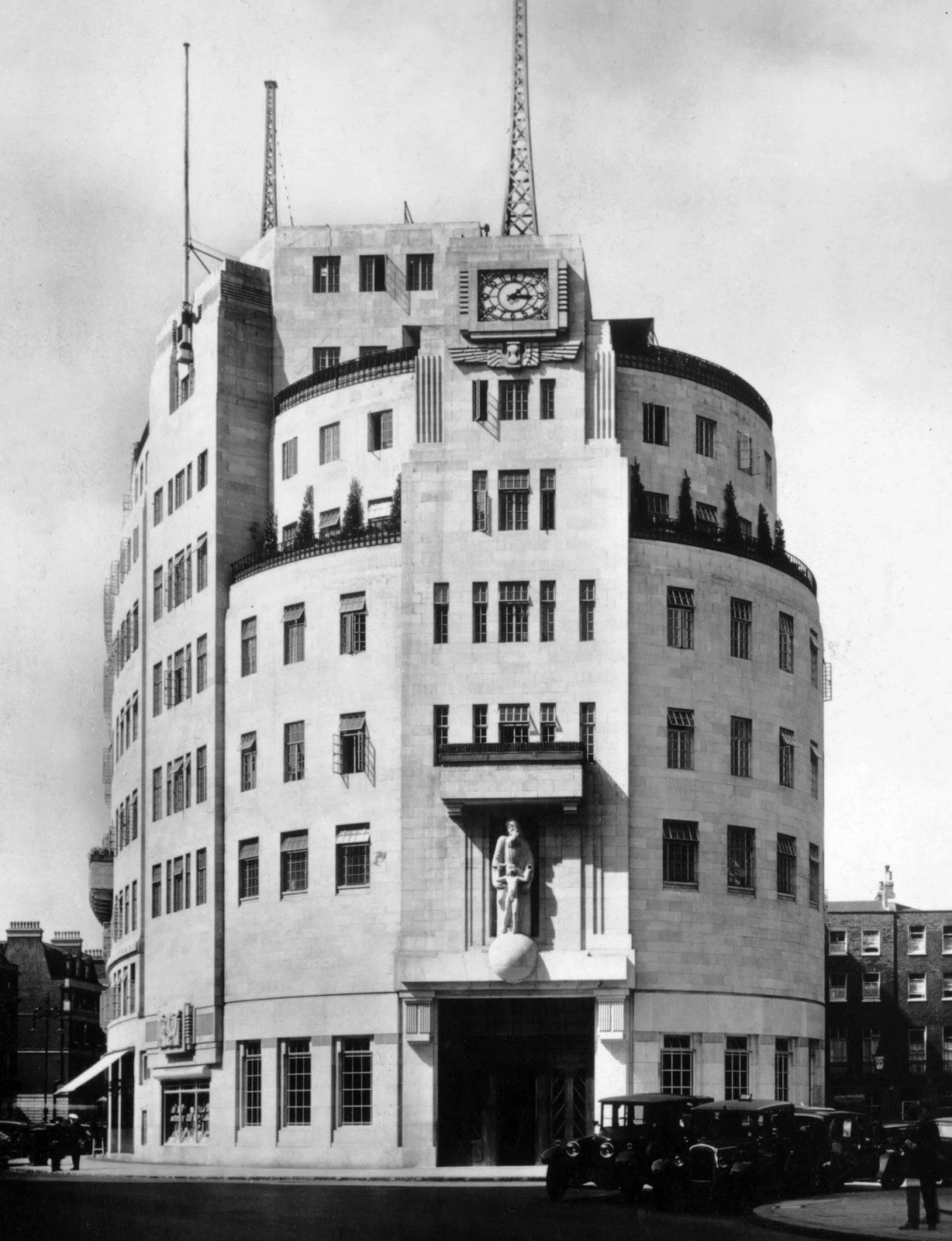
The BBC began with a practical ambition: to bring wireless broadcasting into British homes. Founded in 1922 as a company owned by a consortium of radio manufacturers, it became a chartered public corporation on 1 January 1927. In the century since, it has moved from radio into television and online services, while its programmes, news and regional operations have made it a familiar part of public life in the UK. Its history is also a history of argument: over who broadcasting should serve, how it should be funded and what impartiality means.
A wireless company becomes a public corporation
The British Broadcasting Company was formed on 18 October 1922, after the General Post Office proposed that a single company, jointly owned by leading wireless manufacturers, should hold a broadcasting licence. Earlier public broadcasts had shown the medium’s possibilities, but official concern about interference with military and civil communications had led to restrictions. The new company was financed through a royalty on the sale of approved wireless receivers.
John Reith became general manager in December 1922, shortly after the company’s first official broadcast. He helped establish an approach intended to serve more than the pursuit of popularity. The phrase “inform, educate and entertain” remains associated with the BBC’s purpose. Reith favoured a national service and resisted paid advertising, though the early financial arrangements proved inadequate and the company faced difficulties as listeners bought unlicensed sets or made their own receivers.
In 1926, the general strike gave the BBC an unexpected and consequential role. With newspaper production interrupted, its broadcasts became a major source of news. The corporation had to navigate pressure from a government that could take control of broadcasting, while trying to retain public trust. The episode exposed the difficulty of appearing independent while operating within a political crisis. The following year, the company was replaced by the British Broadcasting Corporation, established under a royal charter.
From radio to television
Radio helped create a shared national audience, but the BBC’s remit and influence changed as new forms of broadcasting developed. Experimental television broadcasts began in 1929. A limited regular service followed in 1932; in November 1936 the BBC Television Service began broadcasting from Alexandra Palace, using two competing systems. The mechanical Baird system was soon dropped in favour of the fully electronic system developed by an EMI research team. This was the first fully electronic television system used in regular broadcasting.
The BBC’s monopoly over television ended when ITV began in 1955, and its radio monopoly was challenged by independent local radio in 1973. Competition changed the organisation as well as its programmes. BBC2 launched in 1964, giving the corporation another channel; colour broadcasting followed on BBC2 in 1967 and on BBC1 in 1969. In 1967, the BBC reorganised its radio services, creating Radio 1 for popular music and Radio 2 for easy listening, alongside Radio 3 and Radio 4. Later services included Radio 5 Live, launched in 1994 for news and sport.
In 1974 the BBC introduced Ceefax, a teletext service that offered news, sport and weather information. It ended in 2012 as Britain completed the move from analogue television. The BBC’s Research and Development work also contributed to broadcasting and recording technology, including the development of the NICAM stereo standard. These changes show a broadcaster repeatedly adapting its means of delivery, even as newer services brought greater competition from commercial television, radio, satellite and digital platforms.
News, culture and education
During the Second World War, television broadcasts were suspended, but radio remained central to the BBC’s work. The corporation moved much of its radio operation out of London, first to Bristol and then to Bedford. Its broadcasts carried major wartime speeches, including Winston Churchill’s addresses and Charles de Gaulle’s appeal to the French people in June 1940. The BBC also broadcast Princesses Elizabeth and Margaret speaking to children evacuated from cities. Its wartime role was not simply a matter of relaying information: decisions about censorship and what could be broadcast were part of the service’s complicated relationship with government and public trust.
After the war, the BBC continued to build programmes that reached different audiences. Its output includes drama, comedy, documentaries, sport and music, alongside news and current affairs. Top of the Pops, first broadcast in 1964, became a prominent platform for popular music. The Proms, a festival that began in 1895, have been produced by the BBC since 1927; the corporation’s orchestras and choirs remain closely involved. Long-running programmes such as The Archers, which began in 1951, show the reach of radio drama, while BBC2 created room for work aimed at interests beyond mass entertainment.
Education has also been part of the BBC’s work, from programmes and services designed for learners to the BBC Computer Literacy Project, which accompanied the BBC Micro in the 1980s. The corporation’s digital learning services include BBC Bitesize. Its online presence has expanded through services such as BBC Online and BBC iPlayer, which allows audiences to stream programmes. These developments extend broadcasting beyond a scheduled radio or television transmission, while continuing the BBC’s educational role through new formats.
A national institution with an international audience
The BBC’s work is organised across the UK’s nations and regions, as well as internationally. Its radio, television and online services include output from Scotland, Wales, Northern Ireland and the English regions. Production centres beyond London, including Cardiff, Belfast, Glasgow and Salford, contribute to programmes and services. Regional broadcasting is more than a change of location: it creates ways for local news and distinct national perspectives to be part of a corporation with a UK-wide audience.
The World Service began in 1932 as the BBC Empire Service. It now broadcasts in dozens of languages, bringing the corporation’s news and other output to audiences abroad. The BBC also distributes programmes internationally through its commercial activities. Natural-history documentaries such as Planet Earth and Blue Planet have travelled well beyond the UK, as have drama and entertainment formats. This international presence offers audiences a route into British-made programmes, but the BBC’s standing abroad is closely tied to the credibility of its journalism, not just the reach of its productions.
The BBC’s public-service structure sits alongside commercial operations, including BBC Studios, which sells programmes and services internationally. Its principal public funding has traditionally come from the television licence fee, with income also generated through commercial activity. The funding model and the corporation’s independence are subjects of continuing debate. So, too, is impartiality: the BBC has faced criticism and allegations of political bias from different sides. These disputes are part of the institution’s history, rather than a reason to treat its reputation for reliability as an unquestioned fact.
Why The BBC deserves a place in British Legacy
The BBC deserves a place in British Legacy because it has helped shape how people in the UK share information and culture. Its development from a wireless company into a chartered public broadcaster brought questions of access, public purpose and editorial independence into the centre of British broadcasting. In moments such as the 1926 general strike and the Second World War, radio became a crucial source of news for audiences facing disruption and uncertainty. The record is not a simple story of impartiality achieved once and for all: the BBC’s choices, constraints and claims to independence have repeatedly been contested. That tension is part of what makes its history important.
Its legacy is also practical and creative. The BBC built services across radio, television and online platforms; supported music, drama, comedy and documentary production; and provided educational resources from computer literacy to digital learning. Its regional operations have helped bring the nations and regions of the UK into a shared broadcasting system, while the World Service and international distribution have carried British-made journalism and programmes to audiences abroad. The benefits are not only the most famous programmes. They include the infrastructure, skills, audiences and habits of public communication that broadcasting has sustained. Remembering the BBC means considering both its cultural contribution and the arguments over how a public broadcaster should serve a changing society.
Sources
BBC — Wikipedia revision 1378615061
Adapted in part from BBC by Wikipedia contributors, under CC BY-SA 4.0. Text has been edited and combined with the existing article; this adapted text is shared under the same licence. Contributor history.