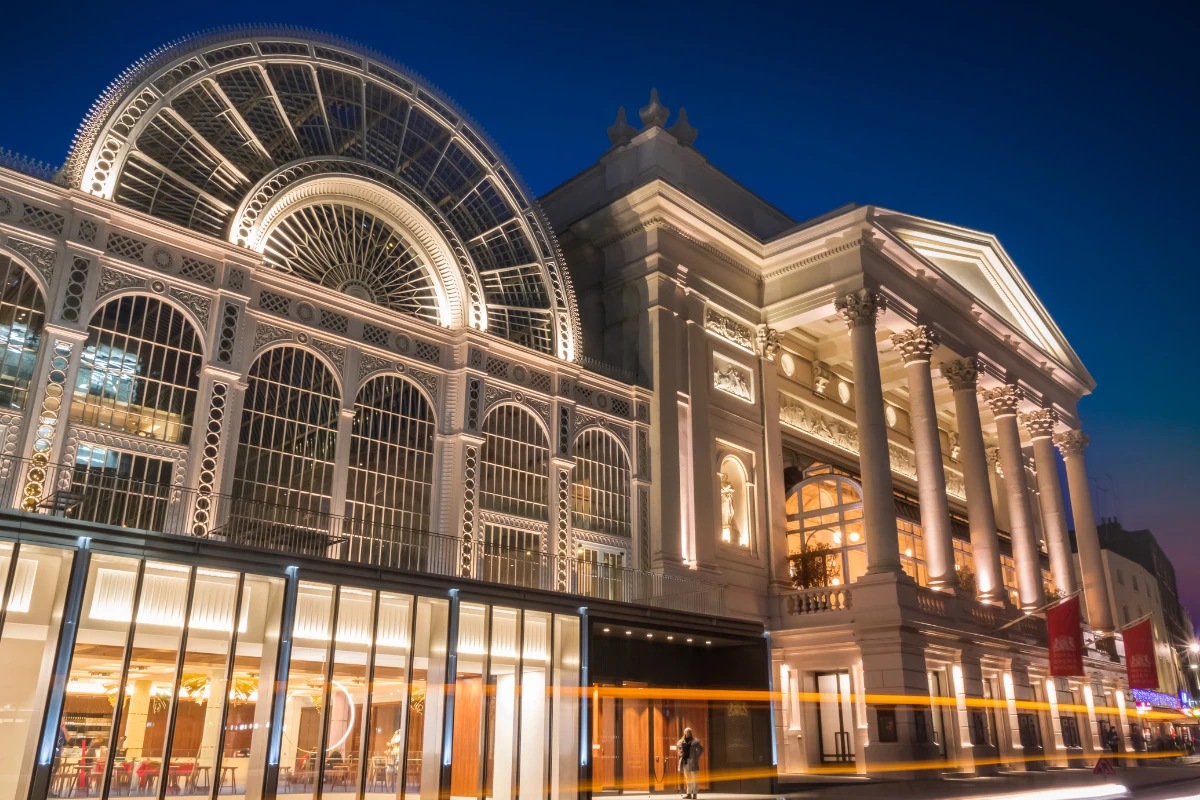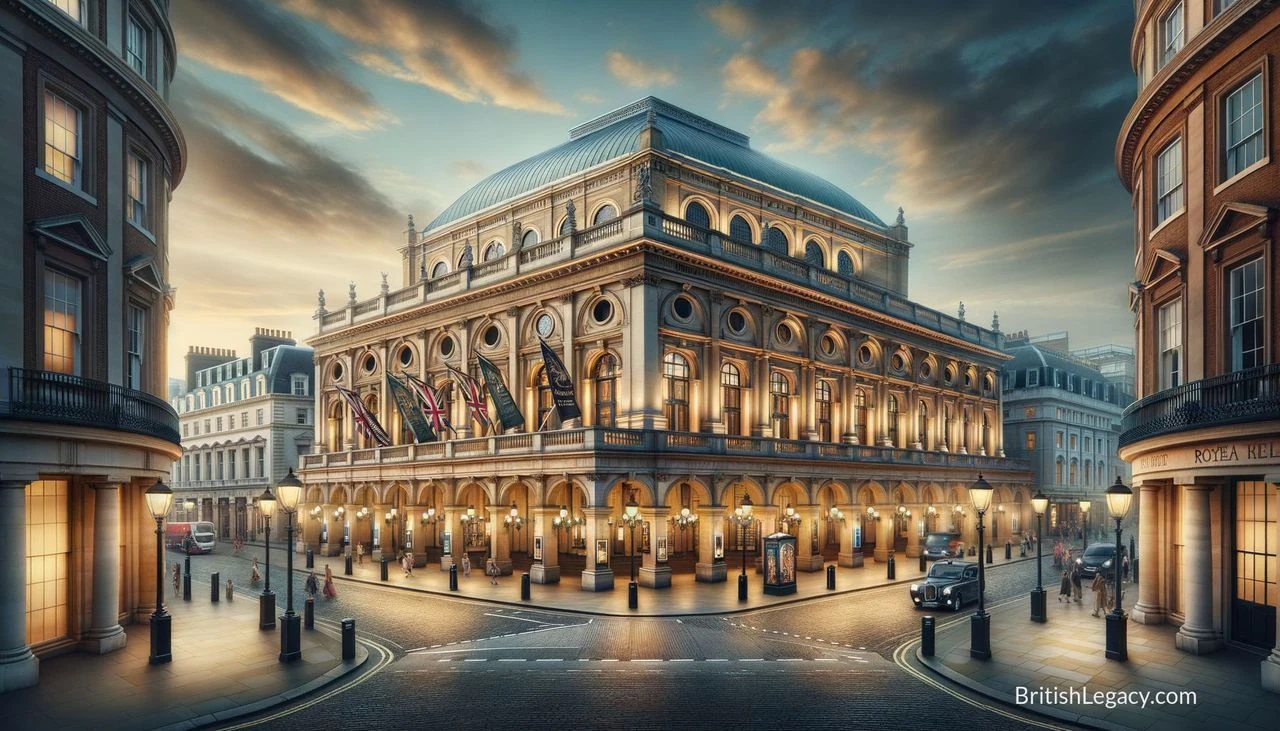
At Covent Garden, the Royal Opera House is both a working theatre and the latest chapter in a story that began in 1732. Its stages have hosted plays, pantomimes, opera and ballet; its buildings have burned and been rebuilt; and a major reconstruction in the 1990s transformed much of the complex while preserving the main auditorium. The result is not simply a monument to performance, but an institution repeatedly adapted to make performance possible.
A theatre takes root at Covent Garden
The first Theatre Royal on the site was built for John Rich, the actor-manager whose success with John Gay’s The Beggar’s Opera helped provide the capital. Designed by Edward Shepherd, it opened on 7 December 1732 with William Congreve’s The Way of the World. For its first century, it was chiefly a playhouse. Its programme also changed with the tastes and talents of the time: the first ballet was presented in 1734, and a year later George Frideric Handel’s operas began a long association with the theatre. Handel wrote works for Covent Garden and gave some of their first performances there.
Fire repeatedly altered the site. The first theatre was destroyed in 1808. Robert Smirke’s replacement opened in 1809, but it too was lost to fire in 1856. The third theatre, designed by Edward Middleton Barry and built by Lucas Brothers, opened on 15 May 1858. Its façade, foyer and auditorium remain at the heart of the present building, although much of the surrounding complex was later rebuilt.
The theatre’s history was never confined to one art form. Opera and ballet shared its stages with spoken drama, pantomime, concerts and other events. In the nineteenth century, opera was presented in Italian, even when originally written in another language. That practice ended in 1892, when Gustav Mahler presented Wagner’s Ring cycle and “Italian” was dropped from the theatre’s name. The Royal Opera House has since remained a home for opera and ballet, but its changing programmes reflect a longer history of adaptation.
Rebuilding a national home for opera and ballet
The theatre’s route to its post-war role was not straightforward. During the First World War, it was requisitioned for use as a furniture repository; during the Second, it became a dance hall. After the war, negotiations secured the building for performance. The Covent Garden Opera Trust planned to establish a national centre for opera and ballet, with British artists employed wherever compatible with maintaining high standards. David Webster became general administrator, and the Sadler’s Wells Ballet was invited to become the resident ballet company.
The Royal Opera House reopened on 20 February 1946 with The Sleeping Beauty, in a production designed by Oliver Messel. The new management, led by Webster and musical director Karl Rankl, set about building a resident company. The opera company’s first performance followed on 14 January 1947: Bizet’s Carmen. The sequence matters: 1946 marked the reopening and the beginning of the new post-war arrangement, rather than the date of that first opera-company performance.
In the decades that followed, the building’s facilities struggled to keep pace with the demands of performance and production. Extensions in the early 1980s added studios, offices and rehearsal rooms. A much larger reconstruction followed between 1997 and 1999, after funding had been assembled through the Arts Lottery and private fundraising. Led by architects Jeremy Dixon and Edward Jones, the project demolished much of the site, including adjacent buildings, while retaining the auditorium. It added technical, rehearsal, office and educational facilities, as well as the Linbury Studio Theatre and more public space.
More than a main auditorium
The main auditorium, a Grade I listed building, has four tiers of boxes and balconies above an amphitheatre gallery and seats 2,256 people. The post-1990s complex gives the companies room to rehearse and make work as well as perform it. The reconstructed Floral Hall, now the Paul Hamlyn Hall, is a large iron-and-glass public space beside the auditorium. Designed by Barry and opened in 1860 as a flower market, it later became part of the Covent Garden Market and then a storage space. Its inclusion in the redevelopment created an atrium and gathering place for audiences.
Below ground, the Linbury Studio Theatre offers a more flexible performance space. Built as part of the 1990s reconstruction and opened in 1999, it can be configured with a raised stage, an orchestra pit or a level studio floor. It has hosted experimental and independent dance and music, as well as work by the Royal Ballet School and events for educational and community audiences. Together, the main auditorium and smaller studio spaces allow the house to support both large-scale productions and work that needs a different relationship between performers and audience.
The Royal Opera House’s production work also extends beyond Covent Garden. At High House, Purfleet, it opened a scenery-making facility in 2010. A costume centre followed in 2015, providing facilities for costume-making and training, alongside a collection of historically important costumes. These sites make visible the specialist work behind a performance: scenery and costumes must be designed, built and maintained as well as presented on stage.
Companies, artists and changing identities
Opera and ballet at Covent Garden have been shaped by the people who make and perform them. The post-war theatre became home to the Royal Opera and the Royal Ballet. The ballet company’s history is associated with figures including Ninette de Valois, Frederick Ashton and Kenneth MacMillan; Margot Fonteyn and Rudolf Nureyev are among the celebrated dancers who performed there. Its repertory has joined established works such as Swan Lake with newer creations.
The opera house has likewise presented works from the established repertory and newer pieces. Handel’s early seasons at the first theatre linked Covent Garden to the development of opera in London; later, the arrival of Wagner’s Ring cycle accompanied a change in the institution’s name and operatic identity. The post-war return of resident companies gave the building a distinct role as a continuing base for opera and ballet, rather than solely a venue hired for individual performances.
Institutional names have continued to change. In 2024, the companies’ public branding became Royal Ballet and Opera, while the physical building retained the title Royal Opera House. The distinction reflects the relationship between an historic place and the organisations based there: a venue can keep its familiar name even as the companies’ public identity evolves.
Why The Royal Opera House deserves a place in British Legacy
The Royal Opera House deserves a place in British Legacy because its history connects a London theatre to the wider development of performance in Britain. From its opening in 1732, the Covent Garden site moved between spoken drama, pantomime, ballet and opera. Handel’s seasons, the presentation of ballet from 1734 and the later arrival of Wagner’s Ring cycle show how the theatre’s identity grew through successive artistic choices, not through a single founding moment. After the Second World War, the building became a planned national centre for opera and ballet, with resident companies and a stated intention to employ British artists wherever standards permitted.
Its legacy also lies in the practical conditions that sustain art. Fire destroyed two earlier theatres; the present building required extensions and a major reconstruction to serve changing demands. That work preserved the auditorium while adding rehearsal, educational and technical facilities, a studio theatre and new public space. Production facilities at Purfleet extend the story beyond the stage, supporting the making of scenery and costumes and training in costume-making. These are specific, enduring contributions to British cultural life: keeping performance in active use, enabling different forms of work, and supporting the skilled labour that audiences may not see. The Royal Opera House is therefore both a historic Covent Garden landmark and a working cultural institution whose buildings and organisations have repeatedly adapted to carry performance forward.
Sources
Royal Opera House — revision 1372226611
Adapted in part from Royal Opera House by Wikipedia contributors, under CC BY-SA 4.0. Text has been edited and combined with the existing article; this adapted text is shared under the same licence. Contributor history.