Imperial War Museums began as a record of a war still being fought. Established in 1917, it was intended to preserve evidence of the United Kingdom’s and Empire’s civil and military effort in the First World War. Its remit now covers conflicts involving British or Commonwealth forces since 1914, and its collections bring together official records, personal testimony, film, photographs, art and military objects. The institution’s history is also one of changing sites and purposes: from a new museum at the Crystal Palace to a national group of five branches in England.
A museum founded during the war
The proposal came from Sir Alfred Mond, First Commissioner of Works and a Liberal MP. On 27 February 1917 he wrote to Prime Minister David Lloyd George proposing a National War Museum. The War Cabinet accepted the idea on 5 March, and a committee began gathering material to represent the war effort. Its work was divided among subject areas including the Army, Navy, munitions production and women’s war work.
The organisers wanted more than a collection of equipment. The museum’s first director-general, Sir Martin Conway, argued that objects should be brought to life by evidence of individual action, experience, courage and endurance. That principle is visible in the range of material the museum collects: official documents sit alongside letters, diaries and other records of people who experienced war.
The institution was renamed the Imperial War Museum in December 1917. King George V opened it at the Crystal Palace on 9 June 1920. In his address, Mond described its intended character not as a monument to military glory but as a record of toil and sacrifice. The Imperial War Museum Act 1920 established a board of trustees to govern it. The museum moved to the Imperial Institute in South Kensington in 1924, before acquiring its permanent London home at the former Bethlem Royal Hospital in Southwark in 1936.
From a London museum to five branches
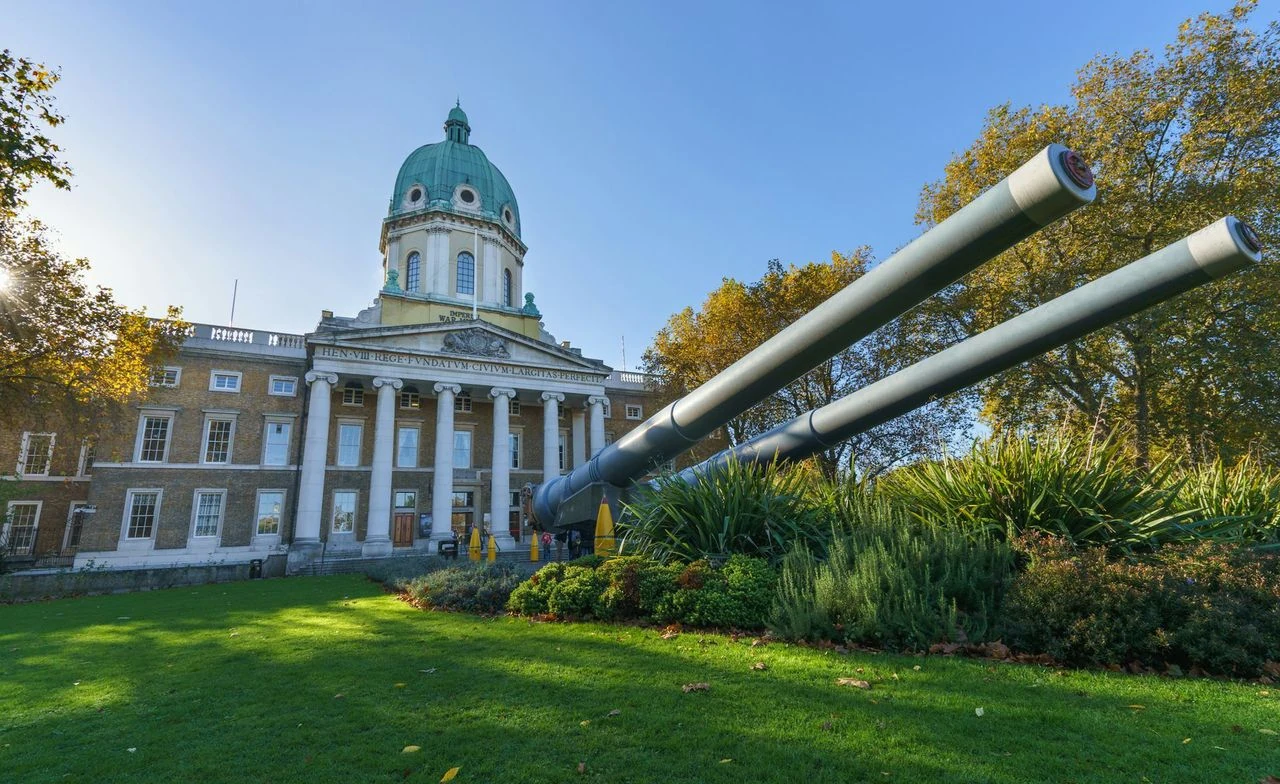
The Southwark building remains the museum’s headquarters. Its earlier life as a hospital gives the London site a history beyond its galleries: the museum took over the former Bethlem Royal Hospital building after the hospital moved, retaining the central portion of the building while its wings were removed. The museum reopened there in 1936. During the Second World War it gathered material about the new conflict, but the building was closed to the public during the Blitz and damaged by a bomb in January 1941. Some of its equipment was returned to government use as the military faced shortages.
In 1953, while Commonwealth forces were engaged in Korea and Malaya, the museum adopted its continuing policy of collecting material from modern conflicts involving British or Commonwealth forces. Its expansion beyond London followed in stages. IWM Duxford, in Cambridgeshire, became its first branch in 1976; HMS Belfast, the preserved Royal Navy cruiser on the Thames, followed in 1978. The Churchill War Rooms, the underground wartime government command centre in Westminster, opened to the public as a museum branch in 1984. IWM North opened in Trafford, Greater Manchester, in 2002, becoming the first branch outside south-east England.
These sites preserve different kinds of evidence. Duxford is an aviation museum on a former RAF airfield, with aircraft, military vehicles and historic buildings. HMS Belfast makes a serving warship’s history accessible aboard the vessel itself. The Churchill War Rooms preserve a government command centre used during the Second World War, while IWM North presents collections in a purpose-built building by the Manchester Ship Canal. Together with IWM London, they form a five-branch institution, all based in England.
Collections that connect objects with experience
The museum’s collections are not limited to weapons and vehicles. They include archives of official and personal papers, photographs, films, video, oral-history recordings, a library and a substantial art collection. These records make it possible to approach war through military operations, public life, work, family experience and the ways people represented conflict.
Its film holdings include The Battle of the Somme, the 1916 documentary film later inscribed on UNESCO’s Memory of the World register, as well as records made by British military cameramen during the Second World War. The photograph archive preserves images from official, professional and amateur photographers, while the Sound Archive holds interviews with people who experienced conflicts. The art collection includes work made during the two world wars and commissions responding to later conflicts, including Northern Ireland, the Falklands, the Persian Gulf, Bosnia, Iraq and Afghanistan.
Objects add another dimension to those documentary records. The museum collects uniforms, medals, weapons, vehicles and aircraft, among many other things. Its holdings include the Néry gun, used in the 1914 action at Néry, and a rifle used by T. E. Lawrence. At IWM London, the Holocaust Exhibition opened in 2000 as the first permanent exhibition devoted to the Holocaust in a UK museum. In 2021, new Holocaust galleries opened, replacing the earlier permanent exhibition. These examples show the breadth of the institution’s work: preserving objects matters, but so does placing them within histories that explain their significance.
The museum has also developed resources beyond its galleries. Its online collections database makes information about objects available for research, and its War Memorials Register records memorials across the United Kingdom. The register’s scope extends across conflicts, not only the world wars. A separate project, Lives of the First World War, invited members of the public to help build records of people who served or were affected by the conflict; material from the project was to become part of the museum’s archive.
Expansion, interpretation and change
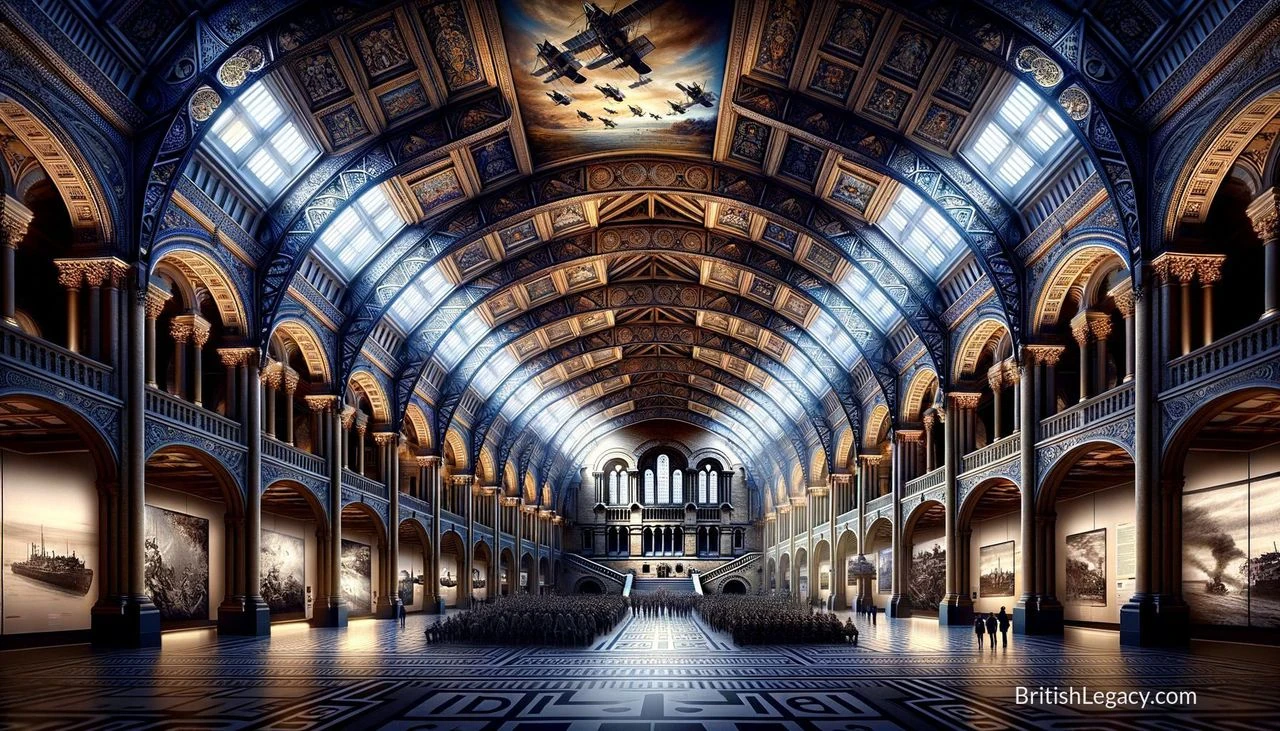
The Southwark museum has been repeatedly redeveloped to improve its galleries and care for its collections. A major programme completed in 1989 created a large exhibits gallery, and later work added exhibition and educational space. For the First World War centenary, a £40 million redevelopment provided new galleries, a central hall and improved visitor facilities. IWM London formally reopened in July 2014. The project placed the museum’s founding conflict at the centre of a renewed account of the war, while its wider remit continued to encompass later conflicts.
Interpretation has changed along with the buildings. In 2011, the institution adopted the public-facing name Imperial War Museums, reflecting its multiple branches. Its galleries and collections do not make war a simple story of military achievement: the museum’s remit includes the causes, course and consequences of conflict and the experiences of civilians as well as service personnel. Its archives are used by historians, scholars and media organisations, and its educational work includes material intended for schools and other learners.
The organisation has also had to make choices about what its public displays emphasise. In 2025 it announced the closure of the Lord Ashcroft Gallery; around 200 Victoria Crosses associated with its Extraordinary Heroes exhibition were placed in storage. The museum said it planned to expand coverage of post-Second World War conflicts, including the Cold War, the Falklands, Afghanistan and Iraq. In 2026 it announced a rebranding project intended to give less emphasis to the Second World War and more to later conflicts. These decisions form part of the continuing question facing a museum with a broad remit: how to represent the changing history of war without allowing one period to stand for all the rest.
Why Imperial War Museums deserves a place in British Legacy
Imperial War Museums deserves a place in British Legacy because it preserves evidence of conflict in forms that bring institutional history and individual experience together. Founded while the First World War was still under way, it set out to record not only military equipment but also the work, sacrifice and experiences behind the war effort. Its collections now span official papers, private diaries, photographs, films, art, oral histories and objects. That range lets researchers and visitors encounter conflict through more than campaigns and commanders: it also records the lives of civilians, service personnel and communities affected by war.
The museum’s British connection is specific and substantial. Its remit concerns conflicts involving British or Commonwealth forces since 1914; its founding purpose was to document the United Kingdom’s and Empire’s First World War effort; and its five English branches make this history accessible through distinct places, from the Southwark headquarters to Duxford, HMS Belfast, the Churchill War Rooms and IWM North. The War Memorials Register and public research resources extend that work beyond the galleries. By preserving testimony and material evidence, and by presenting difficult subjects such as the Holocaust and later conflicts, the institution supports education, remembrance and historical inquiry. Its legacy lies not in celebrating war, but in making its records available for people to study and understand.
Sources
Imperial War Museum — revision 1377619236 · Imperial War Museum
Adapted in part from Imperial War Museum by Wikipedia contributors, under CC BY-SA 4.0. Text has been edited and combined with the existing article; this adapted text is shared under the same licence. Contributor history.