The Royal Botanic Gardens, Kew, brings together a historic landscape and a working botanical institution. Its roots lie in a garden established by Princess Augusta in 1759; the formal foundation of the Royal Botanic Gardens followed in 1840. Today, Kew’s living plants, preserved specimens and seed collections support research and conservation, while its gardens welcome visitors to encounter plant life at close quarters.
A royal garden takes shape
Princess Augusta, mother of King George III, established a garden at the royal estate of Kew Palace in 1759. Sir William Chambers assisted with its development, and the pagoda associated with his work remains a recognisable feature of the gardens. The botanist Sir Joseph Banks later became Kew’s first unofficial director. Under his guidance, the garden began to develop as a place for botanical research and exploration.
The two dates mark different stages in Kew’s history: the beginnings of the garden in the eighteenth century and the formal establishment of the institution in 1840. That distinction helps explain why Kew is both a historic garden and a centre for science. Its landscape and collections have developed together, bringing the public into contact with plants while providing resources for botanical study.
Living collections and glasshouses
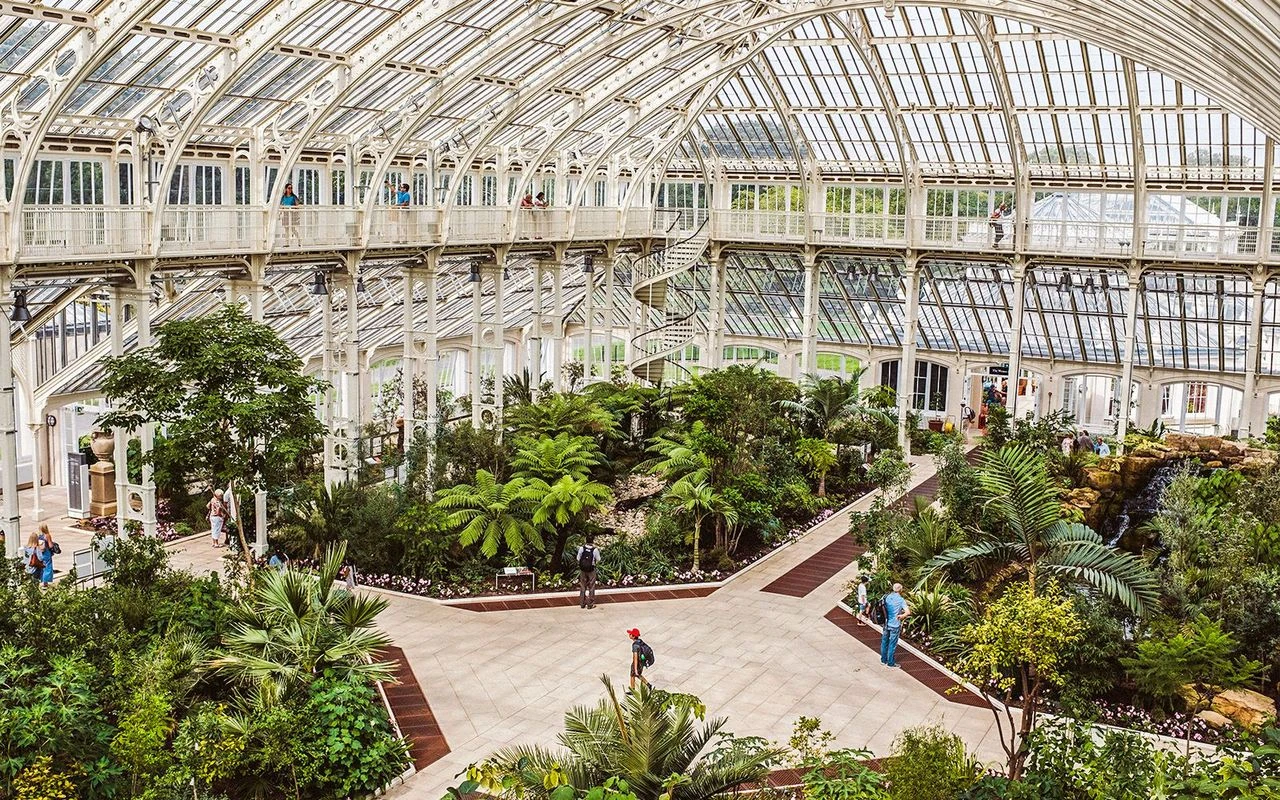
Kew covers 326 acres and holds more than 50,000 living plant species. Its glasshouses create distinct environments for different collections. The Temperate House is described as the largest Victorian glasshouse in the world; the Palm House shelters tropical plants. These structures make the cultivation of plants from different regions part of the visitor experience, while also forming a visible part of Kew’s specialised collections.
The arboretum covers more than half the gardens and contains 14,000 trees from temperate regions around the world. Together, the trees, glasshouses and wider living collections give Kew a broad range of plants to conserve and study. They also make the garden more than a collection of individual attractions: its grounds bring different botanical environments and forms of plant life into one place.
Seeds, specimens and research
Kew’s conservation work also extends to Wakehurst, its satellite site, where the Millennium Seed Bank Partnership conserves wild plant seeds. The project is described as a gene bank for the preservation of plant species in the face of climate change and habitat loss. By preserving seeds as well as maintaining living collections, Kew’s work draws on more than one way of safeguarding plant diversity.
At Kew, the Herbarium holds more than eight million preserved plant and fungal specimens. The collection supports research in taxonomy, systematics, ecology and conservation biology. The account of Kew’s work also identifies research connected with pharmaceuticals and sustainable agriculture. These activities show how a botanical collection can serve as a basis for classifying plants, studying their relationships and informing work concerned with conservation and practical uses.
Collections are central to this work in different ways. Living plants can be observed as they grow; seeds can be conserved for future use; and preserved specimens provide a record for scientific study. Kew’s combination of these resources gives its researchers several ways to investigate plant life. Its work in research and conservation connects the historic garden to questions about biodiversity and the protection of species.
Visitors, learning and international work
Kew’s public role includes welcoming visitors and offering opportunities to learn about horticulture and botany. The existing account reports more than 1.5 million visitors a year and describes family activities, workshops and courses. The gardens therefore serve not only as a place to see plant collections, but also as a setting for education about the natural world.
Its conservation activity extends beyond the UK through partnerships with organisations around the world. Kew works with networked partners on conservation strategies and provides training for international scientists and conservationists. In 2003, Kew was recognised as a UNESCO World Heritage Site. These strands—public access, education, research and conservation—give the institution a reach beyond its London grounds.
Why the Royal Botanic Gardens, Kew deserves a place in British Legacy
Kew deserves a place in British Legacy because its history and present-day work are closely connected. A garden established by Princess Augusta in 1759 grew into a formal institution in 1840, with figures including Sir William Chambers and Sir Joseph Banks part of its early story. Its significance is not confined to that past. The gardens bring living plants and trees together with a herbarium of preserved specimens and a seed-conservation project at Wakehurst. These collections support research across fields including taxonomy, ecology and conservation biology.
Kew’s contribution also reaches people beyond those who work with its collections. Visitors, family activities, workshops and courses make learning about plants part of its public role; international partnerships and training extend conservation work beyond Britain. That combination of heritage, scientific resources, education and practical conservation makes Kew an enduring British institution with an international outlook. Its place in the national story rests on the specific work it undertakes: cultivating and recording plant diversity, supporting study, and sharing knowledge about the natural world.