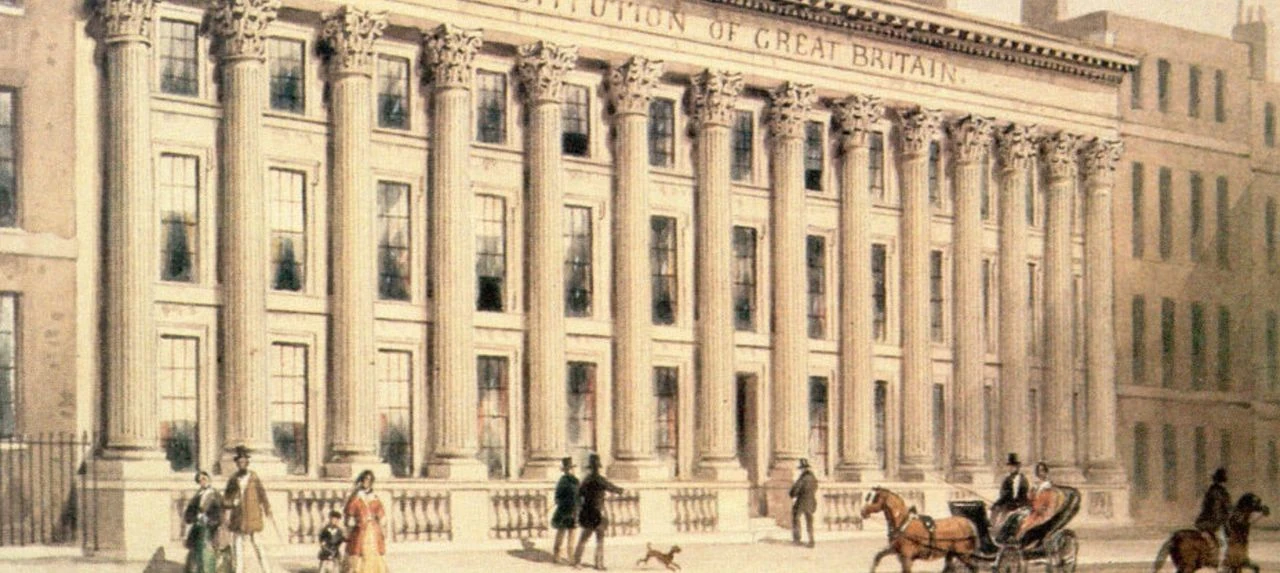
Founded in London in 1799, the Royal Institution set out to make scientific knowledge useful beyond the laboratory. Its history brings together research, practical applications and public education: work associated with Humphry Davy and Michael Faraday sits alongside the Christmas Lectures, a tradition begun by Faraday in 1825 to introduce young audiences to science.
A foundation for useful knowledge
The Royal Institution was established to disseminate scientific knowledge and encourage advances that could benefit society. Its founders included Sir Joseph Banks and Count Rumford. The institution’s early purpose was practical as well as intellectual: applying scientific discoveries to problems, rather than treating science as a subject reserved for a small, specialist audience.
That founding ambition gives the Royal Institution a distinct place in British scientific life. It brought research and public explanation into the same institutional setting. The emphasis on useful discovery and accessible learning would recur in its work, from experiments with materials and electricity to lectures intended to make scientific ideas intelligible to younger listeners.
Davy, Faraday and experimental science
Humphry Davy was among the Royal Institution’s best-known early figures. His scientific contributions included the discovery of sodium and potassium, and he invented the Davy lamp, designed to improve safety in coal mines. These examples connect laboratory investigation with practical consequences: chemical research expanded knowledge of the elements, while the lamp addressed a serious hazard in mining.
Michael Faraday became another defining figure in the institution’s history. His work on electromagnetism and electrochemistry helped lay foundations for modern electrical engineering. Faraday had little formal education, but his career at the Royal Institution placed experimental science and communication side by side. His influence is apparent not only in the research associated with his name but also in the educational tradition he helped establish.
The Christmas Lectures
Faraday initiated the Royal Institution’s Christmas Lectures in 1825, seeking to engage young people with scientific subjects. The lectures present complex ideas in an accessible format and have become one of the institution’s most recognisable public activities. Their purpose is not simply to report research, but to demonstrate and explain it for an audience beyond professional scientists.
Lecturers have included David Attenborough, Carl Sagan and Richard Dawkins. Television broadcasts have extended the lectures’ audience beyond the institution’s London home. The series illustrates the Royal Institution’s longstanding role as an intermediary between scientific work and the public: an established platform where experiments and explanations can reach people who might not otherwise encounter them.
Research and public engagement
The Royal Institution’s activities are not confined to its historical figures or lecture series. Its programme has included research in areas such as nanotechnology, materials science and biochemistry, as well as public events, lectures and exhibitions for people of different ages. Digital platforms, educational programmes and collaborations with schools and other institutions extend this work beyond its building.
Research associated with the institution has contributed to scientific and technological developments, including the electric motor and advances in chemical safety. Its public-facing work, particularly the Christmas Lectures, has also carried scientific ideas to audiences outside Britain. These activities give the Royal Institution two connected roles: supporting research and helping people encounter the ideas and applications that research produces.
Why the Royal Institution deserves a place in British Legacy
The Royal Institution deserves a place in British Legacy because its history shows how a British institution can connect scientific investigation with public benefit. Established in London in 1799 with a commitment to applying discovery to practical problems, it became associated with work by Davy, including the Davy lamp, and Faraday’s research in electromagnetism and electrochemistry. Those examples give substance to its scientific reputation: they link research with developments relevant to industry, safety and technology.
Its legacy also rests on the means it created for sharing science. Faraday’s Christmas Lectures, begun in 1825, made education part of the institution’s purpose, and the continuing lecture tradition, broadcasts and wider public programmes have carried that aim to audiences well beyond its premises. The Royal Institution’s combination of research, practical application and explanation is a specifically evidenced contribution to British intellectual and cultural life. It offers a history not only of scientific achievement, but of sustained efforts to make science visible and accessible to the public.