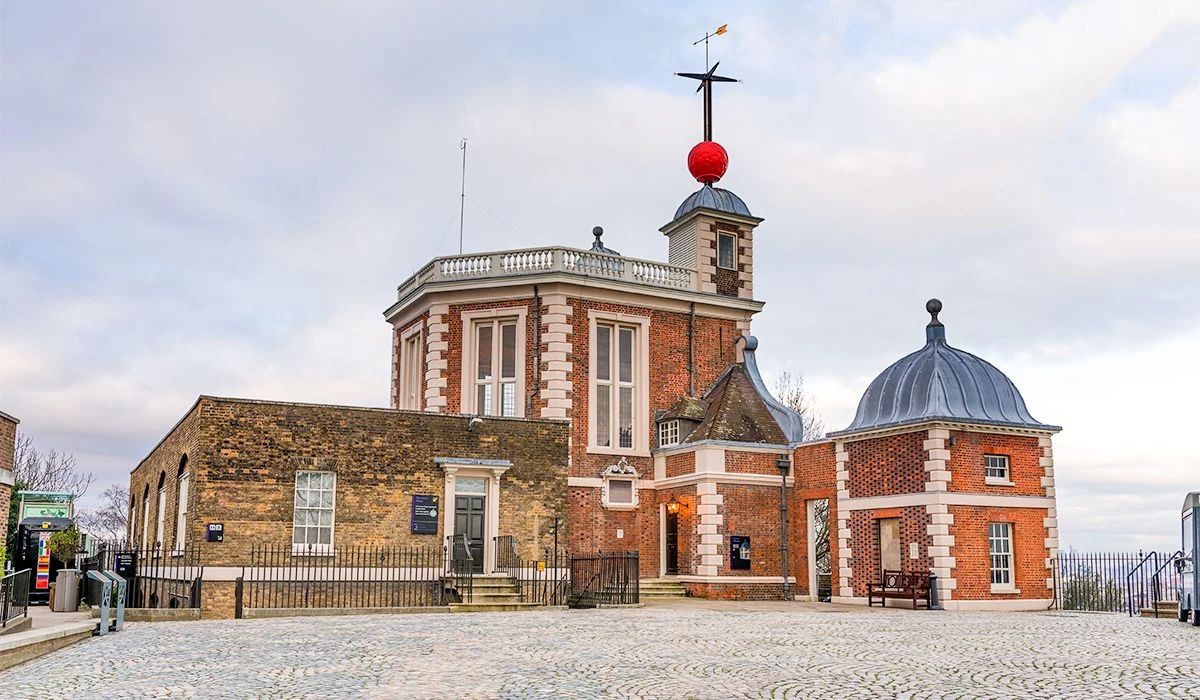
For centuries, the Royal Observatory at Greenwich linked observations of the sky with the practical demands of navigation. Founded in 1675 to improve the measurement of longitude, it became a place where astronomers charted stars, time signals were sent to mariners and a meridian line acquired worldwide significance. The Greenwich site is now principally a museum, but its buildings and instruments preserve the story of how astronomy, navigation and public timekeeping developed together.
An observatory for navigation
King Charles II commissioned the observatory in 1675, and John Flamsteed was appointed its first Astronomer Royal. The position was created to improve knowledge of the heavens and help solve the problem of determining longitude at sea. The building, designed by Sir Christopher Wren, with Robert Hooke probably assisting, was constructed on Greenwich hill and completed in 1676. It was Britain’s first purpose-built scientific research facility.
Flamsteed House, as the original building became known, combined a residence for the Astronomer Royal and his family with the instruments and working rooms required for observation. The Octagon Room held two clocks made by Thomas Tompion, supplied by Sir Jonas Moore, an advocate of the observatory’s creation. Their long pendulums and unusual arrangement reflected the importance attached to accurate timekeeping from the institution’s earliest days.
Flamsteed’s work included making more accurate star charts, a necessary foundation for astronomical navigation. The observatory’s remit grew over time. It published The Nautical Almanac, advised government on technical questions, distributed time, and undertook meteorological, magnetic and astronomical work. The institution was not simply a building in which to watch the stars: it developed into a working centre with responsibilities extending across science and maritime administration.
Measuring the sky and the meridian
Successive Astronomers Royal developed Greenwich’s work in positional astronomy. James Bradley, whose tenure began in 1742, charted 60,000 stars between 1750 and 1762; his catalogues remained in use well into the twentieth century. George Biddell Airy, appointed in 1835, pursued more precise observation and installed a transit circle in 1851. For roughly a century, the instrument served in measuring the positions of stars, including the times at which they crossed its line of sight.
The meridian defined by the Airy Transit Circle was adopted as the international Prime Meridian at the International Meridian Conference in Washington, DC, in 1884. The choice made Greenwich longitude zero for the international system then in use, and linked the observatory’s name with global mapping and timekeeping. A metal strip in the courtyard marks the historic meridian. Since 1999, a green laser has also projected north from the site to indicate its line.
There is an important distinction between that historic line and the modern reference used for global coordinates. In 1984, the IERS Reference Meridian replaced the Greenwich Meridian as the world’s Prime Meridian. It lies about 102 metres east of the Airy meridian marked at the observatory. Greenwich’s international importance remains part of the site’s history, but the line in the courtyard is not the zero meridian used by today’s global reference systems.
Time signals for ships and the public
In 1833, Astronomer Royal John Pond established a time ball at the observatory. Dropping at 1pm, it gave a visible signal to mariners on the Thames and others within sight of Greenwich, allowing them to set or check their clocks and chronometers. From 1852, time signals could also be distributed by telegraph. The ball continues to drop daily, with the local time signal following Greenwich Mean Time in winter and British Summer Time in summer.
Greenwich Mean Time became closely associated with the observatory, but it is not the basis of modern civil time. The Observatory’s time-measuring operations ended after the working institution moved away from Greenwich; Coordinated Universal Time is now the basis of civil time. The familiar name GMT nevertheless remains widely used. Understanding that change helps separate Greenwich’s historical role in timekeeping from the systems used today.
The search for longitude also belongs to a wider history than the observatory alone. John Harrison’s H4 marine timekeeper was a major development in determining longitude at sea and is displayed at Greenwich with his earlier timekeepers. Harrison’s achievement and the Observatory’s astronomical work address the same navigational problem by different means: a reliable timekeeper could be carried on a ship, while observations and time standards were maintained on land.
From working institution to museum
Scientific work gradually left Greenwich during the twentieth century. The office of the Astronomer Royal moved to Herstmonceux in 1948, and the observatory completed its move there in 1957, becoming the Royal Greenwich Observatory. The institution later moved to Cambridge in 1990 and closed in 1998. The Greenwich site returned to the name Royal Observatory, Greenwich, and became part of the National Maritime Museum.
The change of use has not erased the site’s scientific character. Its museum displays include Harrison’s marine timekeepers, astronomical instruments used for meridian observations and the 28-inch equatorial refracting telescope installed in 1893. The observatory is part of Royal Museums Greenwich, alongside the National Maritime Museum, the Queen’s House and the Cutty Sark.
Greenwich has also returned to active astronomical research on a smaller scale. The Annie Maunder Astrographic Telescope became operational at the site in 2018. Its instruments are intended for research, including observations of the Sun, Moon, planets and more distant objects. The observatory therefore connects present-day visitors not only with a past institution but also with continuing astronomical work.
Its public role has grown through displays and education. A redevelopment begun in 2005 added galleries, educational facilities and the 120-seat Peter Harrison Planetarium, which opened when the Observatory reopened in 2007. Visitors can explore the instruments and buildings, see the historic meridian and learn how measurements of time and position were made. The observatory’s blend of scientific history and public interpretation gives Greenwich a role beyond that of a preserved landmark.
Why the Royal Observatory, Greenwich deserves a place in British Legacy
The Royal Observatory deserves recognition in British Legacy because it turned a national need into sustained scientific work with consequences far beyond its hilltop site. Founded to help improve navigation, it gave generations of Astronomers Royal a base for charting stars, refining positional astronomy and maintaining time standards. The meridian established through the Airy Transit Circle became the international reference in 1884, shaping mapping and timekeeping around the world for a century. That history should be told accurately: the modern global reference has since moved east, but Greenwich’s part in establishing the earlier standard remains substantial.
Its legacy is also practical and accessible. The time ball made a scientific time signal visible to mariners and the public; telegraph distribution extended the reach of that signal. Today, the historic buildings, instruments and planetarium help visitors understand how observation and precise measurement served navigation, while the Annie Maunder Astrographic Telescope marks a return to research at Greenwich. Together, these contributions show British science as both inquiry and public service: the Observatory produced knowledge, supported the work of navigation and timekeeping, and now makes that history available to a broad audience. Its importance rests not on a claim to define time forever, but on the specific work through which Greenwich helped make time and position measurable and widely usable.
Sources
Royal Observatory, Greenwich (revision 1373316877)
Adapted in part from Royal Observatory, Greenwich by Wikipedia contributors, under CC BY-SA 4.0. Text has been edited and combined with the existing article; this adapted text is shared under the same licence. Contributor history.