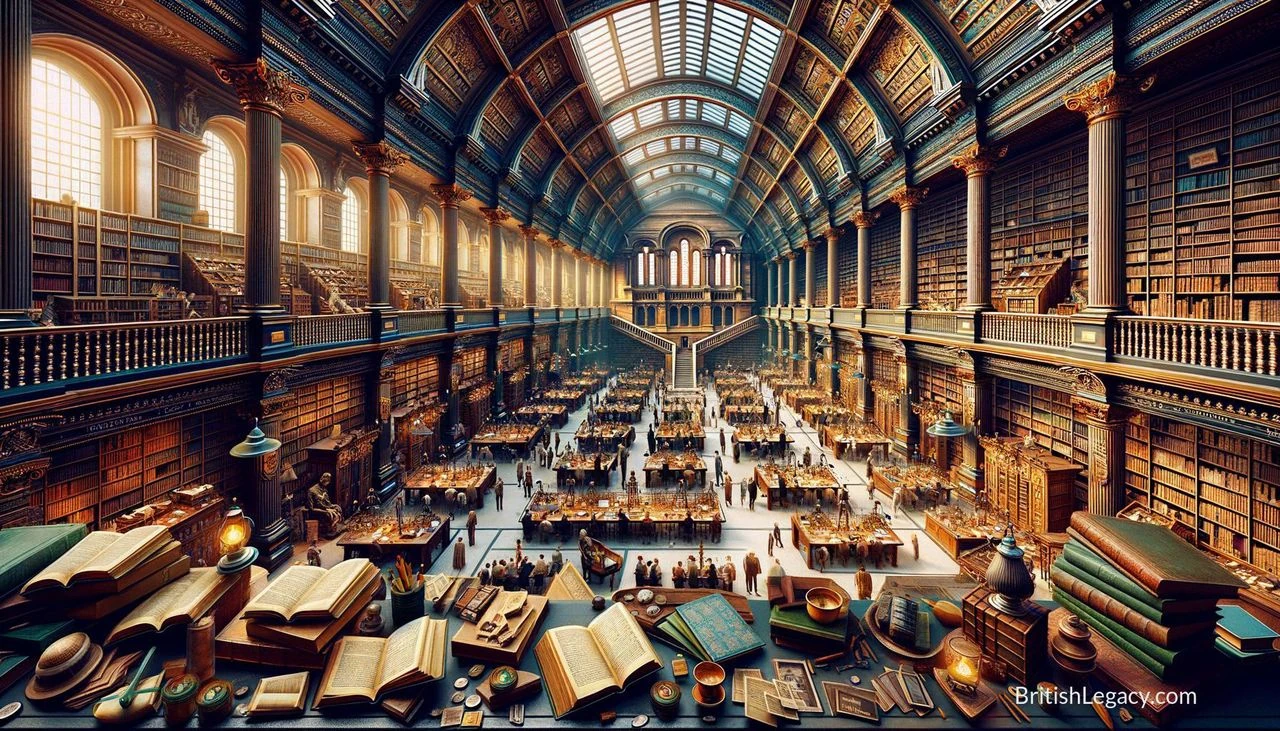
The British Library is the United Kingdom’s national library and a large, varied record of human knowledge. Established as an independent institution in 1973, it holds more than 170 million items, from books and manuscripts to newspapers, maps, music scores and sound recordings. Its work brings together the preservation of written heritage, research using the collections and efforts to make material accessible to readers and wider audiences.
From the British Museum to St Pancras
The British Library took its present institutional form in 1973, when it was separated from the British Museum. Its collections draw on older libraries, including the Cottonian Library, the Royal Library and the Old Royal Library. The modern institution therefore has a history that reaches further back than its foundation as a separate organisation: it brings together collections with earlier origins under a national library established in the twentieth century.
Based in St Pancras, London, the Library is described as holding more than 170 million items, with around three million new items added each year. Its holdings include books, manuscripts, newspapers, maps, stamps, prints, drawings, patents, music scores and sound recordings. The range matters as much as the headline total. The collection encompasses different kinds of written, visual and recorded material, gathered across subjects and languages, and continues to grow through new additions.
Collections for study and discovery
Among the named holdings are Magna Carta, notebooks by Leonardo da Vinci, and original manuscripts by Charles Dickens and Virginia Woolf. These celebrated examples sit within collections that cover a broad range of subjects and languages. The Library’s reading rooms and research facilities allow scholars and students to consult material, whether they are studying a rare manuscript or using academic journals. The institution thus serves research not only through individual historic objects, but also through the breadth of material available for study.
For visitors, exhibitions, events and workshops offer other ways into the collections. Displays can bring historical material to public attention, while events and workshops create opportunities to explore subjects through learning programmes. The Library’s activities extend beyond preserving and storing its holdings: they also include presenting collections and providing settings in which people can encounter them.
Preservation, access and international work
Preservation and access are closely connected in the Library’s work. Conservation helps safeguard fragile material for the future, while digital archives and online resources make collections available beyond the building. Reading rooms provide access in person; digital resources offer another route for people who cannot consult items on site. Exhibitions and public programmes add further ways of encountering material, alongside the Library’s research facilities.
The Library’s reach also extends beyond London and the United Kingdom. It shares expertise with libraries and other institutions internationally and participates in collaborations concerned with cultural preservation and the dissemination of knowledge. Its outreach initiatives and accessible services are intended to serve people with different interests and needs. Taken together, these strands describe an institution that collects, cares for and presents material, while supporting both specialist research and public engagement.
Why the British Library deserves a place in British Legacy
The British Library deserves a place in British Legacy because it preserves an extensive record of written and recorded culture and makes that record available for study. Its holdings range across books, manuscripts, newspapers, maps, prints, music and sound recordings; named treasures such as Magna Carta and the manuscripts of Dickens and Virginia Woolf give particular points of connection with the past. The collection’s range of subjects and languages also means its importance is not confined to a handful of famous objects. Reading rooms and research facilities support scholars and students working with material across the collections.
Its contribution also lies in linking care for the past with continuing access. Conservation protects fragile material, digital resources extend access beyond the St Pancras building, and exhibitions, events and workshops invite public engagement. International collaborations share expertise in cultural preservation and knowledge. Founded as an independent institution in 1973 but drawing on older library collections, the British Library connects those inheritances with present-day research and public use. That combination gives it a specific role in the United Kingdom’s cultural life: preserving material, enabling people to work with it and creating ways for wider audiences to encounter it.