The British Museum began with a collection assembled by the physician and naturalist Sir Hans Sloane. Established by Act of Parliament in 1753 and opened to the public at Montagu House in Bloomsbury in 1759, it was the first national museum of its kind: intended to belong neither to church nor monarch, and to be open to the public. Its collections now encompass about eight million objects, while the institution’s history raises questions about who collected them, under what circumstances, and who should have them today.
A public museum takes shape
Sloane bequeathed his collection to the nation. It comprised around 71,000 objects, including books, manuscripts, natural-history specimens, prints, drawings and antiquities from many regions. The 1753 Act added two other major libraries, the Cottonian and Harleian collections; the Old Royal Library followed in 1757. These foundation collections helped establish the museum as both a centre for objects and a national library.
The first galleries and a reading room for scholars opened on 15 January 1759 in Montagu House. The museum’s early range reflected its ambition to collect widely: it displayed natural-history specimens and books as well as antiquities. Over the following decades, gifts and acquisitions enlarged its holdings. In 1772 it acquired its first major collection of antiquities, Greek vases from Sir William Hamilton; in 1800 the bequest of collector Clayton Mordaunt Cracherode added books, prints, drawings, coins and other objects.
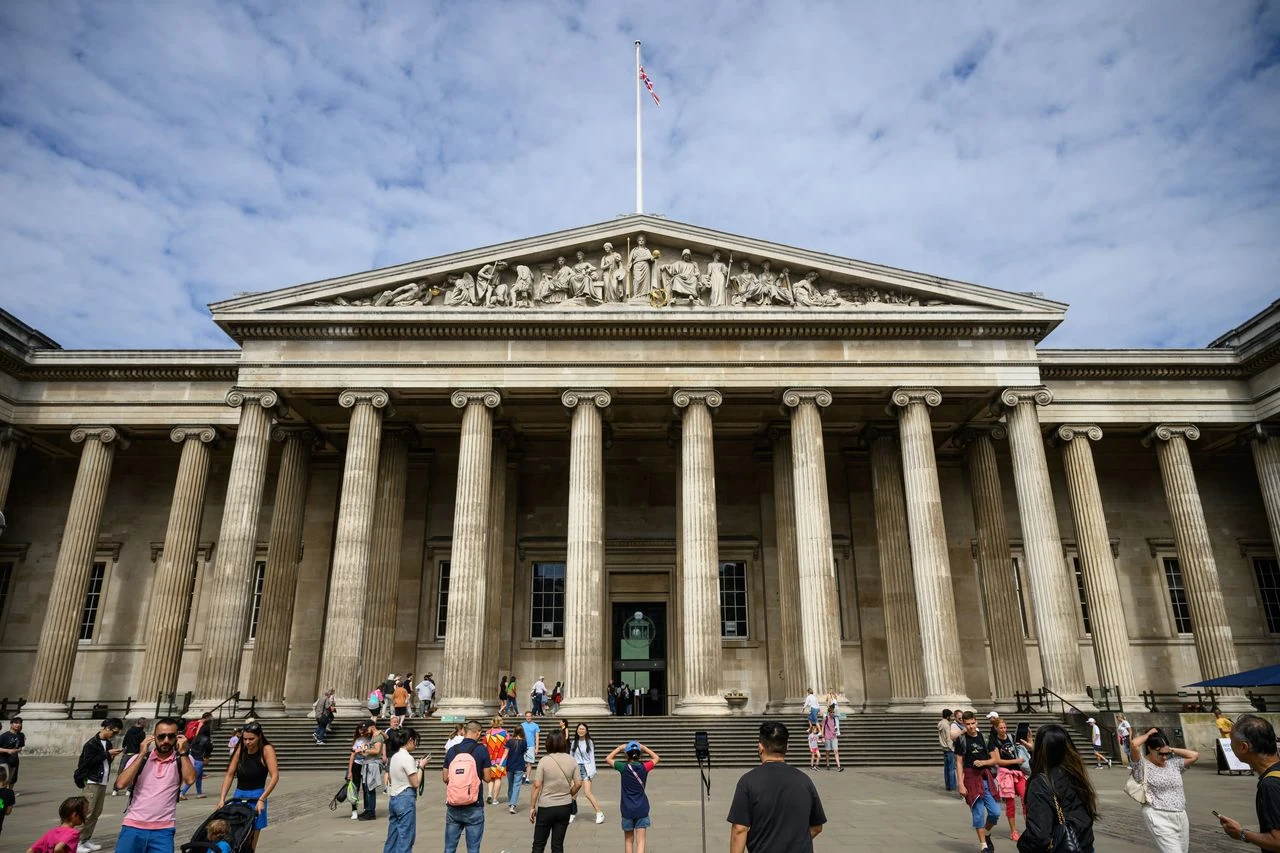
The museum’s growth soon outstripped its home. Work on a new building began in the 1820s to designs by Robert Smirke, whose Greek Revival scheme still gives the Great Russell Street frontage its distinctive colonnade. The East Wing, built to house George III’s library, was followed by further wings and galleries. Sydney Smirke, Robert’s brother, designed the Round Reading Room, which opened in 1857. In the 19th century the museum also supported excavations abroad, including work at Xanthos, Nimrud and Nineveh; discoveries from these projects enlarged its collections and helped make it a centre for archaeological study.
Collections, scholarship and a changing institution
The museum’s collections range across human history, art and culture. The Rosetta Stone is one of its best-known objects: a decree inscribed in three scripts, including hieroglyphs, that became a key to deciphering ancient Egyptian writing. The museum received it in 1802 after the British army took possession of antiquities collected by French forces in Egypt. Its Egyptian collections also include mummies and coffins, alongside objects that illuminate religious practice, burial customs and daily life.
Greek and Roman antiquities form another major part of the collection. The Parthenon sculptures, often called the Elgin Marbles, were removed from the Acropolis by agents of the Earl of Elgin between 1801 and 1812 and acquired by the museum in 1816. They are now at the centre of a continuing dispute over cultural property and restitution. The museum also holds collections from the ancient Near East, including Assyrian palace reliefs and cuneiform tablets, and objects from Africa, Asia, Oceania, the Americas and Britain. British and European holdings include the Sutton Hoo finds and the Mildenhall Treasure.
Its institutional shape has changed as well. The natural-history collections moved to a separate building in South Kensington in the 1880s; that institution became the Natural History Museum. In 1972, legislation separated the museum’s books and manuscripts into the British Library, although the library remained at the Bloomsbury site until its move to St Pancras in 1997. The vacated central courtyard made possible the Queen Elizabeth II Great Court, designed by Foster and Partners with engineers Buro Happold and opened in 2000. Its glass roof covers the former courtyard and the Round Reading Room.
The museum combines public displays with research, conservation and access to collections. It is a non-departmental public body sponsored by the Department for Culture, Media and Sport and overseen by a board of trustees. Admission to its permanent galleries is free, though loan exhibitions may charge. Its online collection database extends access beyond the galleries: at the start of 2023, it contained nearly 4.5 million object entries in two million records.
Acquisition, restitution and public trust
The museum’s global reach is inseparable from the history of British imperial power, collecting and excavation. Its holdings include objects acquired in circumstances that remain disputed. The Parthenon sculptures are claimed by Greece; the Rosetta Stone is among the objects Egypt has sought to recover; and the Benin Bronzes, taken during the 1897 British expedition to Benin, are the subject of claims by Nigeria. These cases are not identical, and the histories and legal circumstances of individual objects matter. Together, however, they place the museum’s collecting history in public view and make questions of ownership part of its present-day role.
Other episodes have tested its stewardship. The museum has faced criticism over provenance and the return of objects, including Nazi-looted drawings whose return was once barred by law. In 2023, after reports that gold, jewellery and gems had been stolen over a significant period, the museum announced a plan to digitise its collection. The episode underlined the practical responsibilities that accompany a large collection: objects must be documented, cared for and made accountable to the public.
These debates sit alongside the museum’s work in scholarship, conservation and public interpretation. Its conservation and scientific teams study materials and help establish how objects were made and altered. Its galleries and publications present objects from different places and periods, while its research collections support specialist study. Such work does not settle every dispute over ownership, but it gives the institution an obligation to explain provenance and acquisition histories with care.
Why the British Museum deserves a place in British Legacy
The British Museum belongs in British Legacy not simply because it is a prominent London institution, but because its history shows how Britain has built, organised and presented a public collection on an international scale. Its 1753 foundation created a national museum intended to be open to the public, and its later development brought together collections that support research into human history across continents and centuries. The Rosetta Stone, the Parthenon sculptures, the Sutton Hoo finds and the Assyrian reliefs are very different objects, but their presence in one institution has made comparison, study and public encounter possible.
That contribution carries responsibilities. Some collections grew through imperial power, contested removals and excavations whose terms are now questioned. A legacy account should acknowledge both the museum’s work in preservation, scholarship and access and the disputes surrounding ownership. Its free permanent galleries and growing online catalogue extend access to objects and research; conservation and documentation help keep collections available for future study. Yet public trust also depends on careful provenance work and an honest account of how objects came to Bloomsbury. The museum’s place in British history is therefore not a simple story of national achievement: it is a record of public learning, global exchange and unresolved claims that continue to shape what responsible stewardship means.
Sources
British Museum — revision 1379689795 · British Museum
Adapted in part from British Museum by Wikipedia contributors, under CC BY-SA 4.0. Text has been edited and combined with the existing article; this adapted text is shared under the same licence. Contributor history.