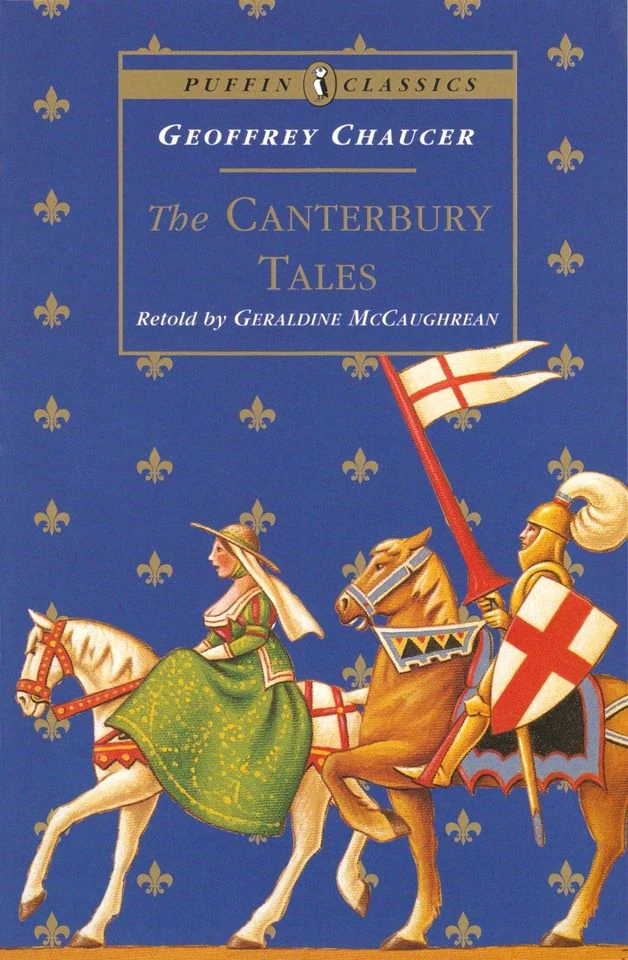
In Geoffrey Chaucer’s The Canterbury Tales, a pilgrimage from London to Canterbury becomes the setting for a contest in storytelling. The travellers are bound for the shrine of Saint Thomas Becket, but their journey also brings together a wide range of voices and tales. Across 24 stories, the collection moves from chivalric romance to ribald comedy, moral fable and religious allegory, offering a varied account of medieval society and human behaviour.
A journey that holds the stories together
The pilgrimage supplies a shared setting for the collection, while the storytelling contest gives the travellers a reason to narrate. The pilgrims are described as coming from different social positions, and each turn at storytelling adds another kind of subject and tone. Rather than following one genre throughout, the work places markedly different forms side by side.
This arrangement makes the act of telling part of the poem’s frame. The travellers’ destination connects their stories, but their variety is equally important: the collection moves between entertainment, questions of conduct and religious themes. Its range offers a view of the lives, values and ambitions associated with different levels of medieval society, without reducing that society to a single voice.
Romance, comedy and social observation
“The Knight’s Tale” and “The Miller’s Tale” show how sharply the collection can change register. The Knight’s story is characterised as a romance concerned with chivalry and noble prowess. The Miller’s is a humorous, ribald tale of infidelity and trickery. The contrast is not simply between serious and comic subjects: it demonstrates how the storytelling frame accommodates different perspectives and kinds of narrative.
Moral fables and religious allegories broaden the range further. Together, these forms give the collection room for both elevated ideals and earthy comedy. The tales’ varied styles and subjects are part of their social interest: they present human behaviour through stories that do not all share the same tone or purpose. The supplied account identifies the Knight’s and Miller’s tales as examples, without providing detailed plots for the remaining stories.
Chaucer and the language of the poem
Chaucer began writing The Canterbury Tales in the late 1380s, and the work remained unfinished when he died in 1400. He held roles as a courtier, diplomat and civil servant. The supplied article connects this range of positions with his perspective on different social classes and human experience, which it sees reflected in the writing.
The poem was written in Middle English rather than Latin or French, languages with established literary standing. The original account argues that Chaucer’s choice contributed to the acceptance of English as a language of literature and scholarship. That broad historical claim is best understood as part of the work’s stated significance, rather than as proof that one author alone transformed the status of English. The poem’s use of Middle English remains central to how the supplied material presents its literary importance.
Reading the tales today
The collection is described as a continuing subject of English literary study, and the original article says Chaucer’s work has inspired writers and artists over the centuries. It offers no names or examples of that influence, so the more specific case for the poem rests on its features described here: its pilgrimage frame, its mixture of genres and its range of social voices.
The supplied article recommends looking for an edition with notes and annotations to help readers approach Chaucer’s Middle English, but does not identify a particular edition. It also provides a purchase link. That link is reproduced as supplied, not as an independently assessed recommendation: The Canterbury Tales by Geoffrey Chaucer.
Why The Canterbury Tales deserves a place in British Legacy
The Canterbury Tales merits a place in British Legacy as a work of medieval English literature whose language, structure and narrative range are all central to its significance. Chaucer wrote in Middle English, and the supplied account identifies that choice as contributing to the standing of English as a literary language. The collection’s shared pilgrimage gives its many stories a connecting shape, while the storytelling contest lets voices and subjects from different social positions appear within that frame.
Its importance is also visible in the contrast between its forms. The Knight’s chivalric romance and the Miller’s bawdy comedy sit alongside moral fables and religious allegories, making the work more than a single-kind narrative. The supplied article describes it as a continuing cornerstone of English literary study. Taken together, these specific qualities explain its relevance: readers encounter both the variety of medieval storytelling and a major work written in Middle English. That contribution is a firmer basis for its British literary legacy than unqualified claims about universal influence or unbroken popularity.