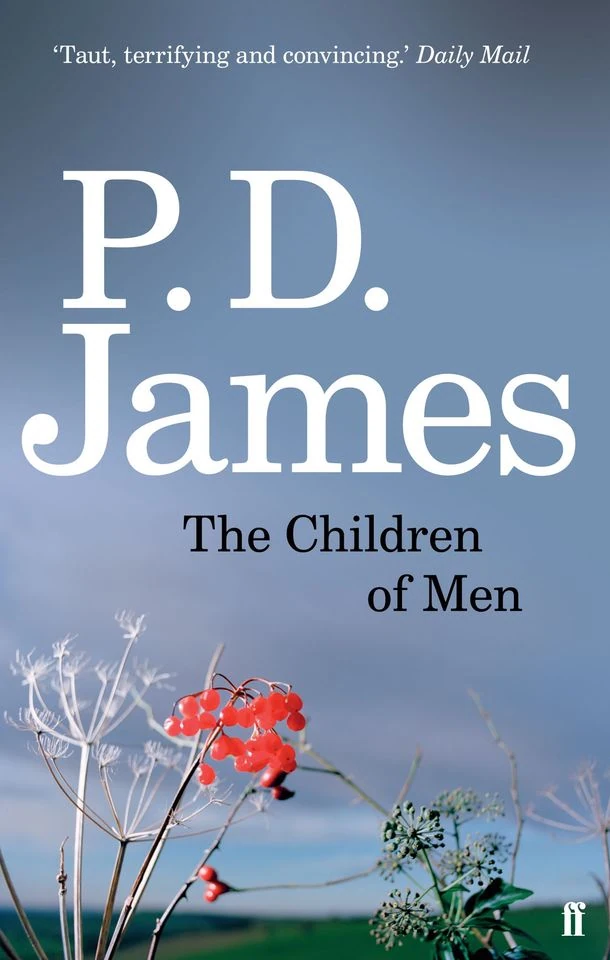
In P.D. James’s The Children of Men, the end of human reproduction is not a distant scientific puzzle: it has remade everyday life and politics. Published in 1992 and set in England in 2021, the novel follows Oxford academic Theo Faron as he is drawn into opposition to a government led by his cousin, Xan Lyppiatt. Then Theo learns that Julian, a member of the resistance, is pregnant. The possibility of a child changes the stakes of a society that has come to expect no next generation.
A country living with extinction
The crisis begins in 1995, the year known in the novel as Omega. Human sperm, including frozen sperm, has lost its potency; no scientific breakthrough has reversed the loss. By January 2021, England is steadily depopulating. The people born in 1995, the Omegas, are treated as a generation apart. Their youth and privileged position sharpen divisions between them and the older population.
James makes the consequences visible in the habits of ordinary life. Newborn animals receive the attention and ceremony once associated with human babies; some women care for lifelike dolls. These details are at once unsettling and telling: the desire to nurture has not disappeared, but it has been redirected. The state requires citizens to learn skills such as animal husbandry in case they are among the last people alive. Even practical preparation has acquired the shadow of an ending.
The novel’s England is governed by decree through the Council of England. Parliament has been reduced to an advisory role, while the Warden’s promises of freedom from fear, want and boredom frame a regime focused on security, comfort and pleasure. The courts remain, but jury service has fallen away. Convicted criminals are sent to a penal colony on the Isle of Man, where the account of the novel describes hunger, violent gangs and almost no possibility of escape.
Other policies expose the human cost of this order. Foreign workers, known as Sojourners, are recruited for labour and forcibly repatriated at 60; British Omegas are barred from emigrating. Elderly and infirm people may be expected or compelled to take part in a state-sanctioned mass drowning called a Quietus. The state also maintains fertility testing: healthy women under 45 undergo regular examinations and most men have their sperm tested. The prospect of extinction has not made the government less intrusive. It has supplied new reasons for intrusion.
Theo, Xan and the Five Fishes
Theo’s account moves between his diary and a third-person narrative closely focused on him. An Oxford don, he is a former adviser to Xan, who appointed himself Warden of England after the last general election in 2006, when public interest in politics had ebbed. Xan has abolished democracy. Theo resigned rather than share responsibility for governing, a decision that leaves him with knowledge of the regime but no faith that he can change it.
His former student Julian approaches him on behalf of a dissident group called the Five Fishes. Its members want Theo to ask Xan for reforms, including a return to a more democratic system. The group includes Julian’s husband, Rolf; Miriam, a former midwife; Gascoigne, from a military family; and Luke, a priest. Theo’s family connection gives the dissidents a possible route to the Warden, but their meeting with the Council goes badly. Xan understands that the proposals come from others and warns that he will act against dissenters if they are not “sensible”.
In March, the Five Fishes circulate a leaflet setting out their demands. The State Secret Police (SSP) begin closing in. Theo warns Julian that the group is in danger and tells her to leave if the others will not stop. She replies that they should not meet again; Theo says she can send for him if she needs help. He then decides to spend the summer abroad, before the natural world overtakes the country and its society breaks down.
A pregnancy changes the stakes
After Theo returns in October, Miriam tells him that Gascoigne has been arrested while trying to blow up a Quietus embarkation stage. The remaining Fishes must flee before investigators force information from him. Julian wants Theo with them. Miriam explains why Julian has not come herself: she is pregnant. Theo doubts what he is hearing until Julian lets him listen to the baby’s heartbeat.
As the group runs, a confrontation with a gang of Omegas ends with Luke’s death while protecting Julian. Julian tells Theo that he, not Rolf, is the child’s father. Rolf, who believes he should replace Xan and select women to bear children by him, leaves the group intending to inform the Warden. The political conflict now has an intensely personal centre: Julian’s pregnancy challenges the assumption on which the country’s despair is built, while also making her a target.
The group reaches a shack known to Theo. Miriam delivers Julian’s baby, a boy, although Julian had expected a girl. When Miriam is gone too long, Theo finds her dead in a nearby house. Xan arrives alone, though his forces are nearby. He tells Theo that Rolf and Gascoigne are dead and offers him the choice of becoming his lieutenant or being killed. Theo refuses.
The cousins reach for their guns. The baby’s sudden cry startles Xan, who misses; Theo kills him. He takes the Coronation Ring from Xan’s finger, a sign that he may now hold authority, at least temporarily. The other Council members see the child and are overcome with emotion. Julian asks Theo to baptise him. The ending does not simply undo the violence or restore the old political order. It leaves Theo with a new responsibility and makes the child’s existence an immediate, fragile fact rather than an abstract promise.
James’s dystopian turn and the film adaptation
Phyllis Dorothy James, known as P.D. James, was chiefly associated with crime and detective fiction. The Children of Men took her into dystopian fiction, where the central uncertainty is not the identity of a criminal but the fate of a society. Its imagined future gives her subjects for examining governance, social responsibility and what people do when they believe the future has ended.
James said of the story, “I thought, if there was no future, how would we behave?” The question is reflected in the novel’s details: a government that equates order with obedience, citizens preparing for a world without successors, and dissidents who refuse to accept the Warden’s settlement. The imported account connects the book with late twentieth-century anxieties about birth rates, environmental deterioration and political turmoil. That is a useful interpretive context, though the supplied evidence does not establish those concerns as the direct cause of the novel.
Mexican director Alfonso Cuarón’s film adaptation was released in 2006 and starred Julianne Moore and Clive Owen. It used the premise to address contemporary issues including the treatment of refugees. According to the supplied account, James said she was proud to be associated with the film despite its differences from the book. The adaptation brought the premise to a new medium while making a distinct work from its source.
Why The Children of Men deserves a place in British Legacy
The Children of Men deserves a place in British Legacy because it uses a recognisably British political setting to make a crisis of human survival concrete. James imagines England under a Warden, a diminished Parliament and a Council that promises security and comfort while ruling by decree. The Five Fishes’ demands for democratic reform are set against the pressure of the SSP and the government’s coercive policies. Through those particulars, the novel asks what political authority becomes when citizens have lost faith in a shared future.
Its central achievement is to join that public question to an intimate one. Theo’s uneasy passage from former adviser to reluctant participant in resistance is bound to Julian’s pregnancy, which challenges the certainty that there can be no children. The story does not make hope effortless: violence follows the group, Miriam is killed, and Theo must face Xan. But the birth at the novel’s end gives the possibility of renewal a human scale. James, an English writer known principally for detective fiction, carried her work into dystopia and built a stark social and political world around that possibility. The 2006 film adaptation extended the novel’s reach into cinema, while the differences between the two versions show how its premise could be reimagined for another medium. Its British legacy lies in that combination of a specific imagined England, a rigorous test of power and a lasting question about how people behave when they believe there is no future.
Sources
The Children of Men (revision 1355250760)
Adapted in part from The Children of Men by Wikipedia contributors, under CC BY-SA 4.0. Text has been edited and combined with the existing article; this adapted text is shared under the same licence. Contributor history.