The Crown made the recent history of the British monarchy into a six-season television drama, following Elizabeth II from the years before her accession to the early twenty-first century. Created and principally written by Peter Morgan, it combines royal and family stories with the political events surrounding the sovereign. Its scale and British production locations helped give the series a distinctive visual world; its dramatisation of real people and events also raised questions about what audiences might mistake for fact.
A drama built across six decades
Morgan developed the series from his film The Queen (2006) and stage play The Audience (2013), both of which focused on Elizabeth. Netflix announced an adaptation of The Audience in 2014. The series ultimately ran for six seasons and 60 episodes, covering a period from shortly before Elizabeth’s 1947 wedding to Philip Mountbatten through to the 2005 wedding of Charles and Camilla Parker Bowles.
The first season begins before Elizabeth becomes queen and follows her accession and coronation after the death of George VI. It also depicts Winston Churchill’s departure as prime minister and Princess Margaret’s relationship with Peter Townsend. Later seasons move through the Suez Crisis, the Profumo affair, the Aberfan disaster, the premierships of Harold Wilson, Margaret Thatcher, John Major and Tony Blair, and the changing circumstances of Charles and Diana. The final season includes the death of Diana, the Queen’s Golden Jubilee and the early relationship of Prince William and Catherine Middleton.
That long span shaped one of the programme’s most visible choices: its principal cast changed every two seasons as the characters aged. Claire Foy played Elizabeth in the first two seasons, Olivia Colman in the third and fourth, and Imelda Staunton in the fifth and sixth. Matt Smith, Tobias Menzies and Jonathan Pryce played Philip across the same successive periods; Princess Margaret was played by Vanessa Kirby, Helena Bonham Carter and Lesley Manville.
Performances and production on a British stage
The changing cast let the series make time visible, while placing its central performances within an extensive ensemble. Among its other roles, John Lithgow played Churchill, Gillian Anderson played Thatcher, and Josh O’Connor and Dominic West portrayed Charles at different ages. The series was produced for Netflix by Left Bank Pictures and Sony Pictures Television, with Morgan among its executive producers.
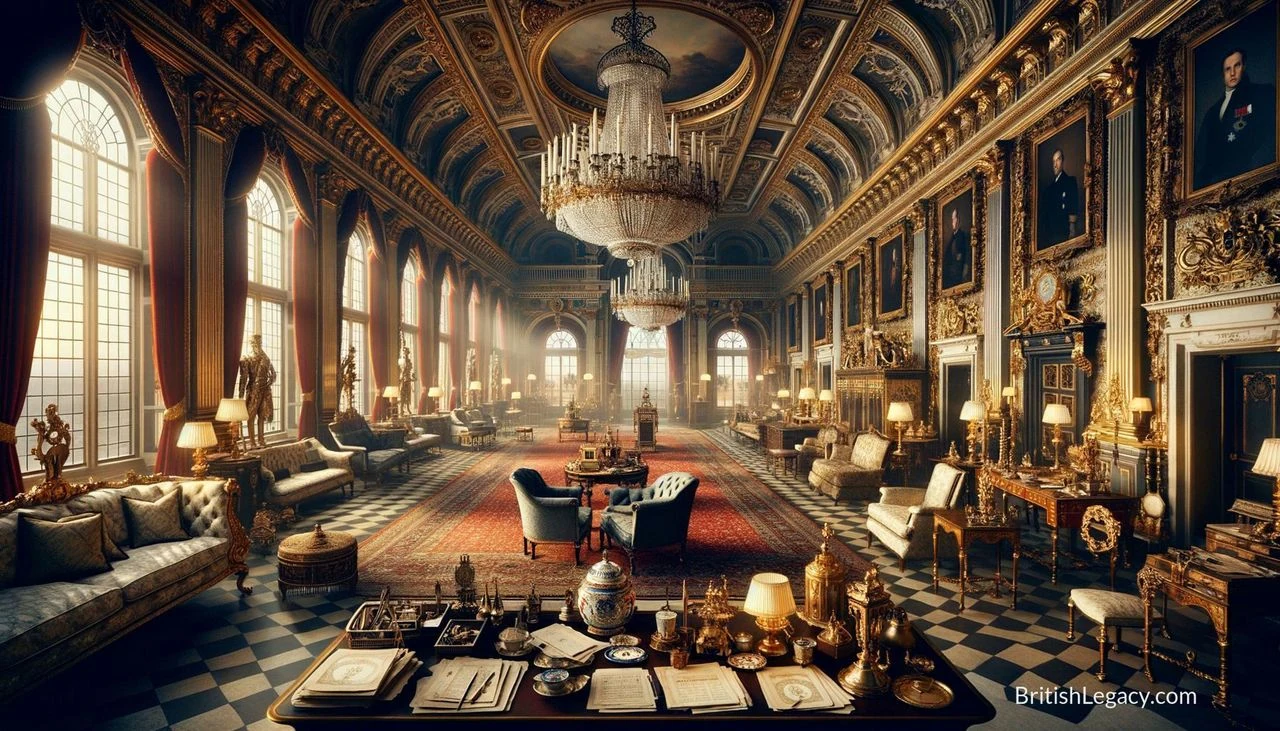
Production made substantial use of British locations. Elstree Studios in Borehamwood, Hertfordshire, provided sets for royal and government interiors, while buildings including Lancaster House, Wrotham Park and Wilton House stood in for Buckingham Palace. Ely and Winchester cathedrals represented Westminster Abbey. The production also filmed at locations around the UK, including Belvoir Castle, Hatfield House and the Historic Dockyard at Chatham. Some places outside Britain and British locations used for foreign settings helped the series build scenes set elsewhere.
The first season took 152 days to film, with about a quarter shot at Elstree and the rest on location. The series’ production design and cinematography became part of its appeal, but its visual care should not be confused with documentary evidence: costumes, sets and recognisable places make a dramatisation convincing without making each scene a record of what happened.
History shaped for television
The Crown brings political events and private relationships together by placing the royal family at the centre of both. Its stories include the sovereign’s relationships with successive prime ministers and conflicts within the family. That approach provides a dramatic route into Britain’s post-war political and social history, but it also gives invented conversations and scenes the same polished presentation as events that can be independently documented.
The distinction became a public issue as the series progressed. Critics challenged particular portrayals and omissions, especially in the later seasons. The fourth season drew criticism in the UK for its treatment of real events; calls from the culture secretary Oliver Dowden and actor Judi Dench for a fiction warning were followed by Netflix describing the series as a “fictional dramatisation” inspired by real events. Former prime ministers John Major and Tony Blair also objected to a season-five storyline depicting Charles seeking support for the Queen’s abdication. Major said no such conversation had taken place.
Other contested scenes illustrate why the distinction matters. Michael Fagan, whose intrusion into the Queen’s bedroom appears in the fourth season, said his conversation with her was short and polite, unlike the exchange shown in the drama. The series’ historical consultant Robert Lacey has distinguished historical truth from a broader dramatic “truth” about the past, while acknowledging that the programme sometimes departs from the historical record to convey a message. That is an account of the programme’s method, not a guarantee that each invention is harmless or self-evident to viewers.
Reception and recognition
The series received praise for its acting, writing, direction, cinematography and production values, though critical response varied over its six seasons. Its awards included 24 Primetime Emmy Awards, among them Outstanding Drama Series for the fourth season, and two Golden Globe Awards for Best Television Series – Drama. Performers including Foy, Colman, Emma Corrin, O’Connor, Anderson and Elizabeth Debicki also won Golden Globes for their work.
Its production was not without controversy. Left Bank Pictures said that Smith had been paid more than Foy for the first two seasons, partly because of his prior fame. The pay difference prompted a petition calling on Smith to donate the difference to the Time’s Up Legal Defense Fund. Left Bank apologised to both actors and said that they were not responsible for setting one another’s pay; the company also said it supported efforts to improve gender equality in film and television.
The final season was released in two parts in November and December 2023, completing the six-season story. The programme’s international distribution made its portrayal of British public life accessible to audiences well beyond the UK. That reach increased the importance of its fiction label: a series can invite viewers into a period of history while also influencing what they believe about the people and events it depicts.
Why The Crown deserves a place in British Legacy
The Crown belongs in a record of British television because it joined a major UK production operation to a sustained dramatisation of the country’s recent political and royal history. Its six-season structure allowed it to follow changing generations of performers and characters across decades, from Elizabeth’s accession to the early twenty-first century. British studios, buildings and landscapes were not incidental backdrops: locations from Elstree to cathedral interiors and country houses helped create the series’ visual account of public institutions and private life. Its awards and international release show how a production rooted in British settings and history reached a global audience.
Its significance is also more complicated than a list of accolades. The series made historical interpretation a visible part of popular television, bringing events such as the Suez Crisis and Aberfan into a continuing family drama. At the same time, disputes over invented scenes, omissions and the depiction of living memory demonstrated the risks of presenting dramatised history with documentary-like detail. That tension gives the programme lasting relevance: it offers an accessible cultural entry point to Britain’s recent past, but also a reason to distinguish drama from evidence. For British Legacy, both its creative achievement and the debate it generated form part of its contribution to British television.
Sources
The Crown (TV series), revision 1377882390 · The Crown (TV series)
Adapted in part from The Crown (TV series) by Wikipedia contributors, under CC BY-SA 4.0. Text has been edited and combined with the existing article; this adapted text is shared under the same licence. Contributor history.