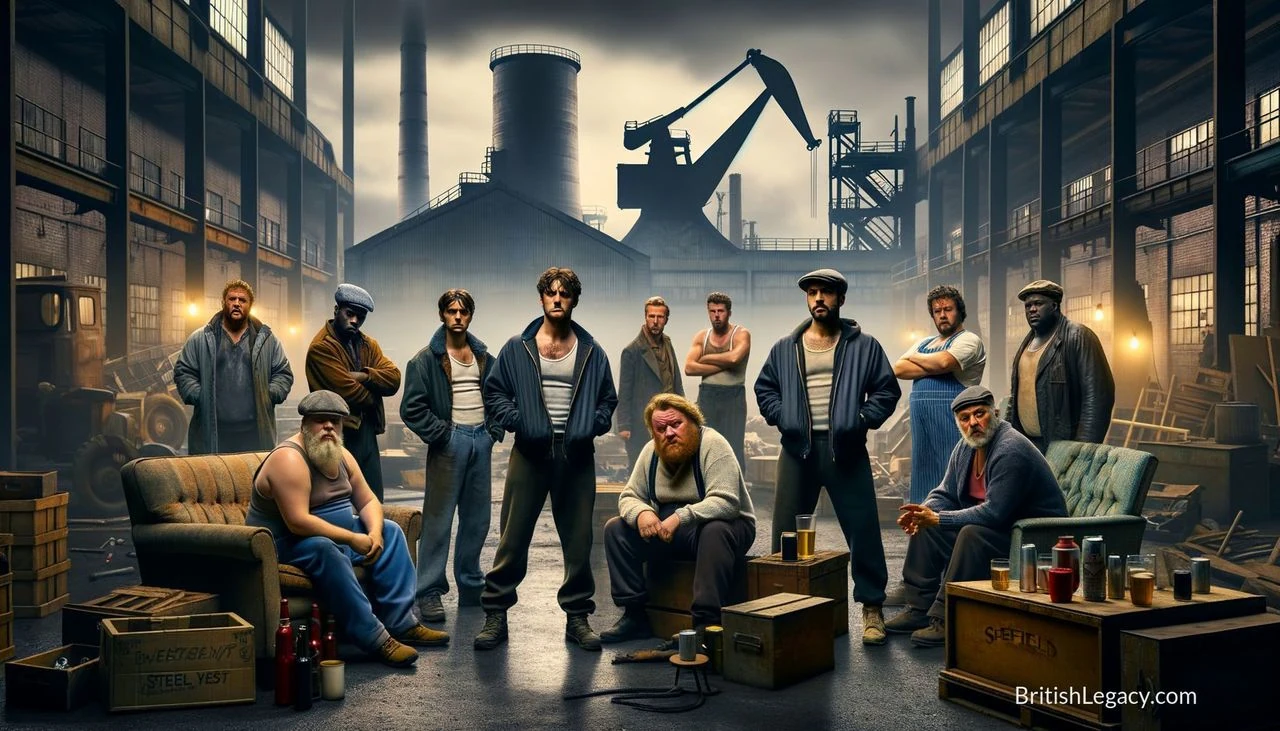
When six unemployed men in Sheffield decide to form a striptease act, the joke is not simply that they intend to take their clothes off. In The Full Monty, a plan to earn money becomes a test of pride, friendship and what it means to provide for a family after work has disappeared. Peter Cattaneo’s 1997 film, written by Simon Beaufoy, made that premise the basis of a comedy with a recognisable local setting and a reach far beyond it.
A plan born of redundancy
The story unfolds in mid-1990s Sheffield, where the steel mills that had sustained the city’s working life have closed and workers have been made redundant. Gary “Gaz” Schofield and his friend Dave Horsfall, both former steelworkers, try to make money by taking scrap metal from an abandoned mill. Gaz’s immediate problem is more personal: he cannot meet his child-support payments, and his former wife, Mandy, is seeking sole custody of their son, Nathan. Gaz has joint custody, but his lack of work threatens his relationship with the boy.
After seeing women queue for a Chippendales performance, Gaz decides to organise a rival act with local men. He promises the group will go further than the professionals: “the full monty”, meaning a complete strip. The recruits are an unlikely team. They include Lomper, the mill’s security guard, whose suicide attempt Gaz and Dave interrupt; Gerald Cooper, their former foreman, who has concealed his unemployment from his wife; Horse, an older dancer; and Guy, who cannot dance but has one conspicuous qualification. The six begin rehearsing, with Gerald asked to teach them some steps.
The scheme brings its own costs and risks. Gaz cannot afford the deposit needed to book the club, so Nathan gives him money from his savings, trusting his father to repay it. Dave, uncomfortable with his body, leaves the group and takes a security job at Asda. A rehearsal at the mill is interrupted by police; Gaz, Gerald and Horse are arrested for indecent exposure, and the incident costs Gaz the right to see Nathan. Meanwhile, Gerald’s concealed debts catch up with him: bailiffs seize the couple’s belongings, Linda throws him out, and he ends up staying with Gaz.
Comedy with the pressure left in
The film’s humour grows from the men’s predicament rather than replacing it. Unemployment is not an abstract backdrop: it governs Gaz’s struggle over access to Nathan, Gerald’s shame about his lost job and Dave’s anxiety about his body. The story also touches on fathers’ rights, depression, impotence, homosexuality, working-class culture and suicide. Its group is not presented as a single, uncomplicated picture of masculinity. The men arrive with different fears, abilities and circumstances, and the act only works when they find a way to perform together.
One of the film’s best-known moments begins in a Jobcentre queue, where the men cannot resist dancing when Donna Summer’s “Hot Stuff” plays. It was reportedly considered too unrealistic and nearly removed from the finished film. The scene’s appeal lies in its mixture of ordinary setting and spontaneous movement: the men are waiting for work, yet briefly find a shared rhythm. The film’s use of Sheffield speech also grounds its comedy in place. Alongside British slang, it includes dialect words such as “nesh”, used for someone unusually susceptible to cold, and “jennel”, a local word for an alley.
Location reinforced that connection. The film was shot in and around Sheffield in April 1996, with a small number of locations in Shirebrook, Derbyshire. Shiregreen Working Men’s Club stood in for the fictional Millthorpe Working Men’s Club, the setting for the final scenes. The opening uses footage from City on the Move, a 1972 promotional film presenting Sheffield as a thriving centre of industry and commerce. That earlier image of a successful steel city sits in telling contrast with the film’s redundant workers and closed mills.
From a local story to an international hit
Made with financing of almost £3 million, The Full Monty became an international commercial success. The Wikipedia article records a worldwide gross of about $258 million, and says the film became the highest-grossing British film at the time, later overtaken by Titanic. Its scale of success did not depend on making Sheffield incidental. The city’s industrial history, speech and working men’s club remain essential to the story, even as its concerns travelled across national borders.
The film received four Academy Award nominations: Best Picture, Best Director, Best Original Screenplay and Best Original Score. Anne Dudley won for Best Original Musical or Comedy Score. It also won the 1997 BAFTA for Best Film, while Robert Carlyle received the BAFTA for Best Actor in a Leading Role. The British Film Institute later placed it 25th in its list of the best British films of the twentieth century.
Music gives the film a second kind of cohesion. Dudley wrote around 20 minutes of original score, using a mix of instruments to reflect the differences among the six men and the way they eventually come together. The soundtrack also places familiar pop songs beside her compositions, including “Hot Stuff”, “You Sexy Thing” and Tom Jones’s “You Can Leave Your Hat On”. The music helps make the film’s final performance feel like a group achievement, not simply Gaz’s gamble.
The story continued in other forms. Wendy Holden novelised the film in 1998. A musical adaptation opened on Broadway in 2000, with its characters and setting Americanised, and later played in London’s West End. Beaufoy adapted the story as a stage play, which opened at Sheffield’s Lyceum Theatre in February 2013 before a national tour and a West End run in 2014. A television follow-up featuring members of the original cast was released in 2023.
Why The Full Monty deserves a place in British Legacy
The Full Monty deserves a place in British Legacy because it made a particular British industrial experience central to a film that found audiences around the world. Sheffield is not a decorative setting: the closure of its steel mills explains why the men are out of work, why Gaz is short of money and why the group’s unlikely show matters to them. The film’s location shooting, local speech and working-men’s-club finale keep that social and regional grounding visible. Its comedy makes room for hard subjects, including redundancy, strained family relationships, depression and men’s unease about their bodies, without reducing the characters to examples of hardship.
Its achievements are both artistic and cultural. The film won a BAFTA for Best Film and an Academy Award for Dudley’s score, while its four Oscar nominations and BFI recognition mark a sustained place in British cinema. Its later life as a musical, play and television series shows how readily its central idea could be reworked, even as the Broadway version shifted the setting and characters to America. More importantly, the film’s influence rests on a specific act of storytelling: it lets a group of redundant workers reclaim a measure of agency through a shared performance. The result gave Sheffield’s post-industrial story a distinctive comic form, and made dignity, friendship and care for family inseparable from the laughter.
Sources
Adapted in part from The Full Monty by Wikipedia contributors, under CC BY-SA 4.0. Text has been edited and combined with the existing article; this adapted text is shared under the same licence. Contributor history.