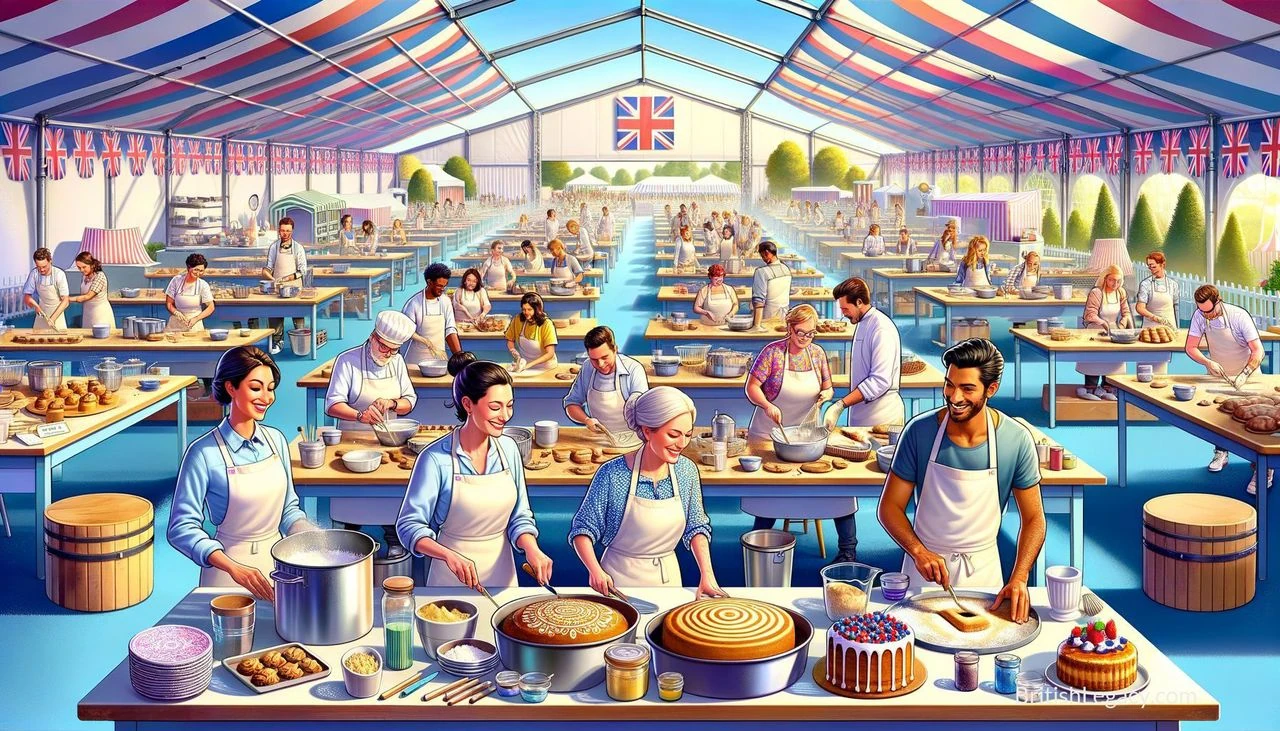
When The Great British Bake Off began on BBC Two in August 2010, its proposition was simple: amateur bakers, three challenges and one person leaving the tent each week. Its growing audience turned that modest contest into one of British television’s most recognisable formats. Along the way, the programme moved from BBC Two to BBC One and then Channel 4, changed presenters and judges, inspired spin-offs and helped bring home baking into the public eye.
A village competition, made for television
Producer Anna Beattie conceived the competition after hearing about American bake-offs and drawing on the tradition of baking contests at English village fêtes. Her interest was in a contest centred on people who simply wanted to bake a good cake. The idea took four years to find a television home. In 2009, Beattie pitched it to the BBC Two controller, Janice Hadlow; the commission was developed over the following six months.
The production gave that village-fête premise a distinctive setting: bunting-draped marquees in gardens and other scenic locations. The first series travelled between locations, with its final filmed at Fulham Palace in London. From the second series, the bakers and crew stayed at one site for the competition. Contestants are amateurs selected through applications, auditions and screen tests, then brought together to bake under pressure in front of the cameras.
At the heart of the format are three weekly tests. In the Signature challenge, bakers present recipes they have made before, often for friends and family. The Technical gives everyone the same recipe, with limited instructions, and ranks the results blind. The Showstopper asks for a bake that displays skill and imagination as well as flavour and professional finish. Judges name a Star Baker and decide who leaves; three contestants reach the final, where one is chosen as the series winner.
From BBC Two hit to Channel 4 institution
The first episode aired on 17 August 2010, with Mel Giedroyc and Sue Perkins presenting and Mary Berry and Paul Hollywood judging. The first four series were shown on BBC Two. As the audience grew, the programme moved to BBC One in 2014. The fifth series brought in more than ten million viewers for its final in the series overview, and the programme became a major fixture in British television ratings.
That success did not prevent a change of broadcaster. In September 2016, Love Productions agreed a three-year deal with Channel 4, making the seventh series the last to air on the BBC. The move took effect in 2017. Giedroyc and Perkins and Berry left; Hollywood stayed, joined by new judge Prue Leith, while Noel Fielding and Sandi Toksvig became presenters. Toksvig departed in 2020 and Matt Lucas took her place. Alison Hammond replaced Lucas in 2023, presenting alongside Fielding. In January 2026, Leith announced her departure, and Nigella Lawson was confirmed as her successor.
The changes in channel and personnel altered the programme’s line-up without displacing its central ritual: contestants bake, the judges taste and assess, and one baker is eliminated. Its longevity rests partly on that dependable structure, which leaves room for new presenters and judges while keeping the contest intelligible to returning viewers.
More than a tent and a technical challenge
The programme’s influence reaches beyond its weekly competition. It has been credited with encouraging interest in home baking, and shops reported rising sales of baking ingredients and equipment. The Women’s Institute also reported a notable rise in membership: between 2010 and 2013, its membership grew by a quarter to more than 211,000, the highest level since the 1970s. The organisation’s chair, Ruth Bond, said the programme made baking look enjoyable and helped take away the fear factor.
Its effects showed up in other forms too. The programme was associated with increased sales of baking books, more baking clubs and growth in independent bakeries. One analyst cited in the account reported that more than three-fifths of adults baked at home at least once in 2013, compared with a third in 2011. Those figures suggest a cultural footprint extending from television into kitchens, shops and shared activities.
The Bake Off name also became a platform for other programmes. An Extra Slice offers a companion discussion with interviews with eliminated contestants; Junior Bake Off brings young bakers into the format; and Bake Off: The Professionals sets teams of pastry chefs against one another. Celebrity editions have raised money for causes including Sport Relief, Comic Relief and Stand Up to Cancer. In 2022, a stage musical based on the series opened in Cheltenham. The programme’s success also helped prompt a wider run of competition formats, including The Great British Sewing Bee and The Great Pottery Throw Down.
A British format with an international life
The original series has travelled well beyond its home audience. Its format has been sold for local versions in other countries, while the British programme has aired internationally. In the United States, where “Bake-Off” is a Pillsbury trademark, it is known as The Great British Baking Show. The different title has not changed the underlying contest: amateur bakers face the same kind of staged tests and judges’ decisions that made the British programme recognisable.
The programme has also accumulated awards. It won BAFTA television awards in 2012, 2013 and 2016, a Rose d’Or in 2012, and National Television Awards in the skills or challenge categories in 2015 and 2016. These honours mark recognition for the programme’s production as well as its on-screen contest. Its later success is especially striking beside the mixed response to the first series: the idea took years to secure a commission, and early reviewers were not unanimous in their enthusiasm.
Why The Great British Bake Off deserves a place in British Legacy
The Great British Bake Off merits a place in British Legacy because it turned a recognisably local tradition—the village-fête baking contest—into a durable television format without losing sight of amateur skill. Its three challenges make different demands: personal repertoire, technical judgement under sparse instructions and an ambitious final display. That design gives the programme a clear competitive spine, while its contestants remain home bakers rather than professional chefs. It has endured changes of broadcaster, presenters and judges because that basic encounter between practical knowledge, pressure and invention remains compelling.
Its British legacy is not only a matter of television fame. The programme has been associated with renewed home-baking interest, increased sales of ingredients and equipment, growth in baking clubs, and a rise in Women’s Institute membership. It has also generated companion and children’s series, professional and charity editions, a stage musical, and adaptations around the world. Those consequences connect a British television production to everyday activity and to creative work beyond broadcasting. The show’s particular achievement is to make an amateur competition both commercially adaptable and culturally legible: a tent, a set of technical tests, and people baking for the pleasure of making something well.
Sources
The Great British Bake Off — Wikipedia, revision 1379729016
Adapted in part from The Great British Bake Off by Wikipedia contributors, under CC BY-SA 4.0. Text has been edited and combined with the existing article; this adapted text is shared under the same licence. Contributor history.