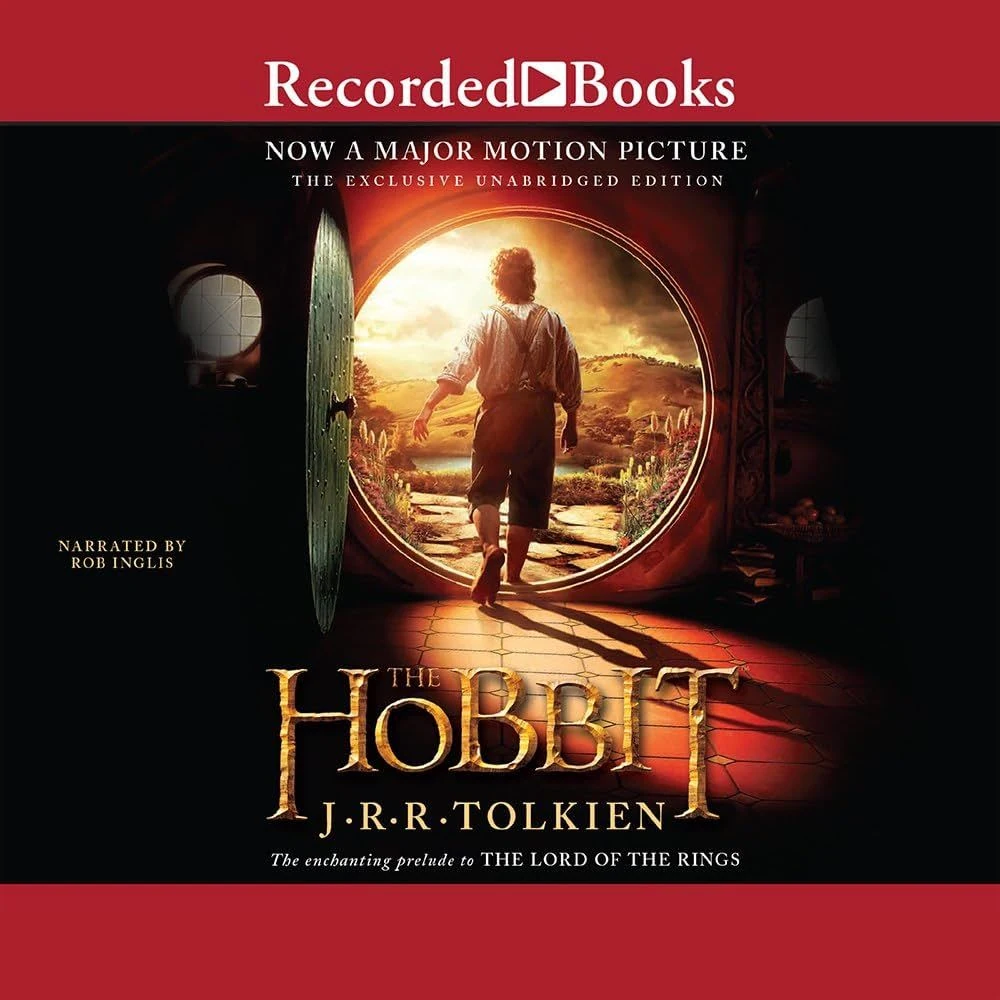
A home-loving hobbit leaves the Shire, joins a company of dwarves and finds himself on a quest to reclaim a mountain kingdom from a dragon. Published on 21 September 1937, J.R.R. Tolkien’s The Hobbit follows Bilbo Baggins through a succession of dangers and discoveries, introducing readers to Middle-earth before Tolkien developed that world further in The Lord of the Rings.
Bilbo and the quest for the Lonely Mountain
The wizard Gandalf enlists Bilbo to join thirteen dwarves led by Thorin Oakenshield. Their aim is to reclaim the Lonely Mountain and its treasure from Smaug. On the way, Bilbo and the company encounter trolls, goblins, giant spiders and elves. Bilbo also meets Gollum, from whom he acquires a gold ring. The journey’s many encounters bring the inhabitants and dangers of Middle-earth into view as the company makes its way towards the mountain.
Bilbo begins as a contented and unassuming figure, reluctant to leave home. The supplied account describes his change into a clever and courageous hero, and identifies bravery, friendship and the search for identity among the book’s themes. His role in the adventure is not that of a conventional warrior: the story places an initially unlikely traveller among a company with a clear destination and lets his responses to the journey shape his development.
The ring links The Hobbit with Tolkien’s later writing, while the book’s quest has its own cast, purpose and outcome. It works both as an adventure in its own right and as an introduction to a setting that Tolkien would use again. That combination helps explain why the novel can be read independently, while also opening a door to the larger story associated with The Lord of the Rings.
From a children’s story to Middle-earth
Tolkien was a philologist and professor at the University of Oxford. The supplied article says he began The Hobbit as a children’s story for his own children, drawing on interests in mythology, language and ancient literature. It describes the tale as taking shape informally alongside his academic work. The result sets an accessible adventure within a world populated by wizards, dwarves, goblins and other peoples.
First published in 1937, the novel introduced readers to Bilbo and to Middle-earth, which Tolkien developed further in subsequent writing. Its publication preceded The Lord of the Rings, and its events and ring connect the two works. The supplied article reports a favourable critical reception and commercial success, as well as translations into numerous languages; it gives no figures by which to measure those claims.
Adaptations and reach
The supplied article describes adaptations for animated and live-action screen, radio, video games and stage. These versions have carried Bilbo’s journey into different forms, extending the story beyond the novel. The article also credits The Hobbit with helping to renew interest in fantasy and inspiring other writers and storytellers. It names no particular authors or examples, so the scale of that influence cannot be specified from the available material.
What can be said from the supplied account is that the book has remained in circulation across languages and media. Its central journey—from Bilbo’s departure from the Shire to the company’s attempt to reclaim the Lonely Mountain—gives adaptations a clear narrative to draw on, while the world around that journey leaves room for further storytelling.
Why The Hobbit deserves a place in British Legacy
The Hobbit deserves a place in British Legacy as a work by J.R.R. Tolkien, identified in the supplied material as a professor at the University of Oxford, and as the 1937 novel that introduced readers to Middle-earth. That connection is grounded in Tolkien’s British academic and literary context, rather than in the story’s fictional setting. The book’s significance lies in the particular achievement of making a self-contained adventure—Bilbo’s journey with Thorin Oakenshield’s company—an entry point to a world Tolkien would develop further.
The supplied account also describes translations and adaptations for screen, radio, games and stage, evidence of the story’s reach beyond its original form. Its imaginative setting and its account of an initially reluctant traveller finding a role in a difficult undertaking have helped make it a distinctive work of British fantasy literature. Claims about the precise extent of its influence should be treated cautiously where no examples or measurements are supplied. Even so, the novel’s introduction of Middle-earth, its subsequent connection with The Lord of the Rings and its continued life in multiple media give it a specific and enduring place in Britain’s literary legacy.