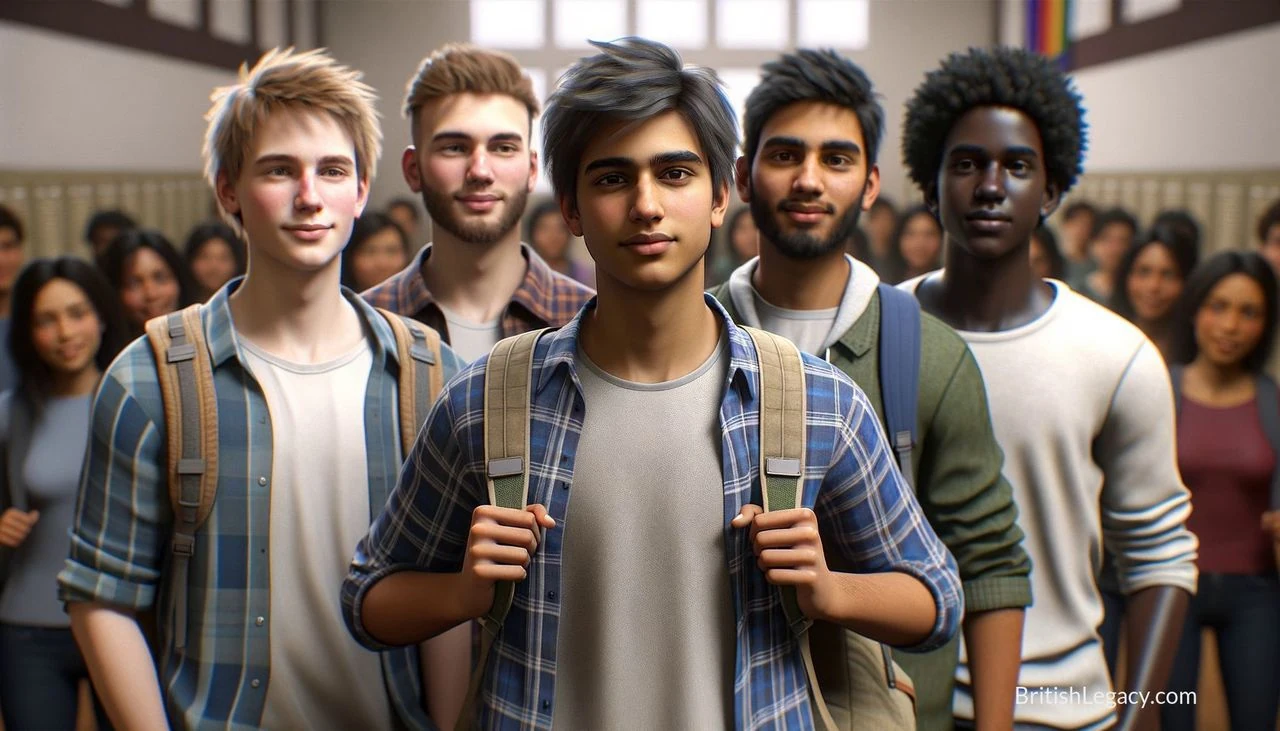
When Will McKenzie arrives at Rudge Park Comprehensive, he brings a briefcase, a sharp sense of his own intelligence and little idea how quickly school can puncture his confidence. In The Inbetweeners, he joins Simon, Jay and Neil: four sixth-form boys trying to negotiate friendship, sex, popularity and school life, usually making their own awkward situations worse. Created and written by Damon Beesley and Iain Morris, the sitcom made adolescent embarrassment its subject and its comic engine.
A new school, and three unlikely friends
The series began on E4 on 1 May 2008. Will, played by Simon Bird, has been transferred from private school following his parents’ divorce. At Rudge Park he falls in with Simon Cooper (Joe Thomas), Jay Cartwright (James Buckley) and Neil Sutherland (Blake Harrison). Their suburban school is fictional, but the boys’ problems are recognisable: fitting in, trying to attract girls, coping with indifferent or hostile staff and working out how to belong to a group.
Each friend brings a different weakness to the quartet. Will is studious and often the most sensible, yet can be drawn into his friends’ schemes and is repeatedly humiliated. Simon’s long-running crush on Carli gives him a recurring source of hope and frustration. Jay boasts compulsively about sex and status, while Neil’s easy-going nature makes him particularly susceptible to Jay’s stories. Their contrasts supply plots, but the comedy depends on their continued friendship: the boys return to one another even after a plan has failed or one of them has become the target of the joke.
School is not simply a backdrop. The series places the boys among classmates, teachers and families who complicate their attempts to manage their reputations. Mr Gilbert, the cynical head of sixth form, has little patience for Will. Charlotte Hinchcliffe briefly dates him; school bully Mark Donovan intimidates the group, though his behaviour is not entirely one-dimensional. At home, Will’s well-meaning mother and Simon’s caring parents can embarrass their sons as readily as they support them. These recurring relationships give the boys’ setbacks a social context beyond the four friends’ own bravado.
Three series of adolescent misadventure
The first series ran from 1 to 29 May 2008, with six episodes. A second six-episode series followed from 2 April to 7 May 2009, and the third ran from 13 September to 18 October 2010. Channel 4 also broadcast the first series later in 2008. The programme was created and written by Beesley and Morris; its directors included Gordon Anderson, Ben Palmer, Beesley and Morris. Simon Bird narrates as Will, giving the misadventures a point of view that can make the gap between what Will thinks is happening and what everyone else sees part of the joke.
The humour is deliberately crude and often uncomfortable. The boys’ talk is full of sexual boasting, insults and slang, but their claims rarely match their experience. That distance between performance and reality lets the series expose the insecurity beneath the posturing without turning the characters into polished role models. The show does not suggest that every viewer’s adolescence was the same; rather, its precise attention to small humiliations and social misjudgements helps explain why its particular version of sixth-form life found an audience.
The programme’s path to acclaim was not instant. The first episode drew 238,000 viewers, and the first series averaged 459,000, according to the Wikipedia account. The second-series opener reached 1.2 million when its E4 and time-shifted E4+1 audiences were combined. The first episode of series three attracted an overnight average of 2.6 million, then a record for an E4 programme. These figures mark a substantial rise in audience across the run, rather than an immediate success from the outset.
Recognition, films and a life beyond E4
The Inbetweeners received British Comedy Awards for Best New TV Comedy and Best Male Comedy Newcomer for Bird in 2008. It was nominated for the British Academy Television Award for Best Situation Comedy in both 2009 and 2010; it did not win that category. In 2010 it won the BAFTA Audience Award, the ceremony’s public-vote prize. The following year, the British Comedy Awards recognised the programme’s contribution to British comedy.
The creators and cast indicated after the third series that they did not intend to make a fourth: the programme had run its course, but a film was planned. The Inbetweeners Movie, released in 2011, takes the four friends on holiday to Malia, Greece. A sequel, The Inbetweeners 2, followed in 2014 and is set in Australia. The first film’s reported worldwide box office exceeded £57 million, against a budget of £3.5 million. Those films carried the characters into early adulthood without changing the basic appeal of watching them misunderstand a situation, overestimate themselves and depend on their friends.
The franchise also travelled beyond Britain. An American adaptation ran for one season on MTV in 2012 before cancellation; its brief run contrasts with the continued life of the original. In the UK, Channel 4 marked the series’ tenth anniversary with Fwends Reunited, broadcast on 1 January 2019. The retrospective received a largely negative response from critics and viewers, some of whom had expected a new episode rather than a chat show. The mixed reception is a reminder that affection for a comedy’s characters does not guarantee that every return to them will work.
In October 2025, the creators’ company Fudge Park agreed with Banijay UK to explore the rights and potential for new versions across film, television and stage. Wikipedia’s revision also reports that Netflix announced production of a third film on 7 September 2026, with the original main cast returning and Beesley and Morris writing and directing. The first three series remain the foundation of the franchise: their short, self-contained run established the school setting and friendships that the later films and projects revisited.
Why The Inbetweeners deserves a place in British Legacy
The Inbetweeners merits a place in British Legacy because it made a distinctly specific setting and social experience central to a successful television comedy. Rudge Park Comprehensive is not presented as an idealised school or a venue for extraordinary adventures. It is the everyday world of sixth form: lessons, family embarrassment, social hierarchies, crushes and the effort to appear more confident than one feels. The series’ four friends approach those pressures differently, and its humour comes from the gap between their ambitions and their limited understanding of one another and themselves.
Its British cultural contribution is visible in the programme’s E4 beginnings, its growing audiences across three series, its BAFTA Audience Award and its reach into two cinema releases. The films’ reported box-office success carried the characters beyond television, while the short-lived American adaptation shows that exporting a format did not simply reproduce the original’s circumstances. The programme’s lasting significance need not depend on calling its jokes universally relatable or its portrayal definitive. Its achievement is more concrete: Beesley and Morris built a recognisable comedy around the social language and humiliations of suburban teenage life, and audiences followed four awkward friends from school into young adulthood. That combination of precise setting, ensemble characterisation and popular reach makes the sitcom a worthwhile part of Britain’s television story.
Sources
The Inbetweeners — Wikipedia revision 1377315756
Adapted in part from The Inbetweeners by Wikipedia contributors, under CC BY-SA 4.0. Text has been edited and combined with the existing article; this adapted text is shared under the same licence. Contributor history.