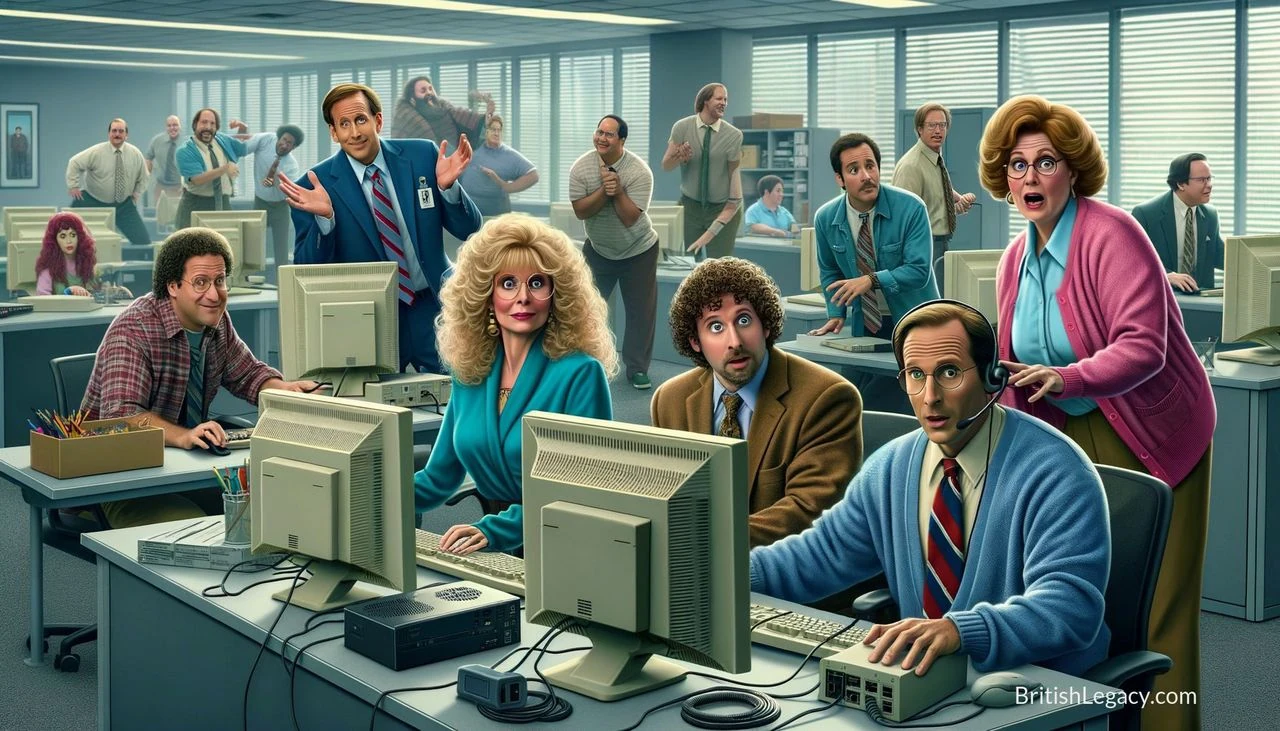
In the offices of Reynholm Industries, the rest of the company looks out on modern London. The IT department, by contrast, works in a cluttered basement. That divide gives The IT Crowd its setting and much of its comic logic: the people keeping the business running are isolated from the colleagues who need them, while Jen Barber, their supposedly technical manager, knows next to nothing about computers.
Created, written and directed by Graham Linehan, the Channel 4 sitcom brought together Chris O’Dowd as Roy Trenneman, Richard Ayoade as Maurice Moss and Katherine Parkinson as Jen. Their contrasting temperaments made routine office problems a launchpad for farce. Across four series and a later special, the programme built a distinct comic world around workplace frustration, technical dependence and the awkwardness of dealing with other people.
A company with a basement problem
The series premiered on Channel 4 on 3 February 2006. Its fictional London employer, Reynholm Industries, gives the show an office hierarchy without requiring the audience to take the company’s business seriously. The organisation’s activities are deliberately hazy; its supposed ventures include buying and selling ITV, running a chemicals laboratory and making an unnamed product. The IT team’s basement, rather than the company’s grander surroundings, is where the action repeatedly returns.
Roy and Moss are the department’s technicians. Roy is work-shy and sardonic, often trying to avoid his job; Moss is highly intelligent and shy, with a deep store of technical knowledge but limited social ease. Their employer depends on their expertise while the wider staff treat them as oddities. That mismatch makes their workplace less a conventional office comedy than a small comic ecosystem, in which the people with the most useful knowledge have little status.
Jen’s appointment unsettles the arrangement. She convinces Denholm Reynholm, the company’s founder and chief executive, that she has extensive computer experience. Once she meets Roy and Moss, her role becomes that of a relationship manager between the technicians and their colleagues. She is not a technical expert, but her attempts to make the department function in the wider workplace repeatedly create new complications. The three leads are therefore not simply a team of specialists: each misunderstands the others in a different way.
Deadpan advice and escalating absurdity
Roy’s familiar support routine is to answer calls with stock suggestions, including “Have you tried turning it off and on again?” and “Is it definitely plugged in?” Sometimes he uses a tape recording rather than speaking to the caller himself. The joke depends on recognition: the advice is simple, but the person asking for help may be unable to carry it out, or may not understand what the question means.
Moss’s technical fluency works just as well when set against everyday problems. His shyness and habit of supplying excessive detail can make conversation difficult; practical emergencies, including fires and spiders, are another matter. Jen, meanwhile, often has to negotiate situations she does not understand. Her confidence in people can be as misplaced as her supposed computer skills. The comedy comes from the three characters’ different blind spots, not from technology alone.
The sitcom regularly pushes ordinary workplace embarrassment into surreal or physical comedy. A machine designed to measure Jen’s screams and Moss’s disastrous appearance at a dinner party are among the situations that carry the characters well beyond routine IT support. Linehan wrote the series after a PC technician with poor people skills made a house call. Its comic premise consequently links a recognisable encounter with an exaggerated world in which social misfires can take over an entire episode.
The show was recorded with a live studio audience. Its first series was made at Teddington Studios, with later series filmed at Pinewood Studios; location footage included Thomas More Square and Amhurst Road. This production approach sat alongside cinematic-style footage recorded before the live tapings. The contrast between the contained basement set and the wider world helped keep the workplace central even when the stories became increasingly outlandish.
Four series, then a farewell
The IT Crowd ran for four series of six episodes each, followed by a special. The first series aired in 2006; subsequent series followed in 2007, 2008 and 2010. A fifth series was commissioned for 2011 but was not made. Linehan and the writers struggled to meet regularly and tried a virtual writers’ room, but he later judged the arrangement impractical. Scheduling pressures and the programme’s budget requirements also contributed to the decision to shelve the series.
A farewell episode remained possible, although Linehan and the cast had other commitments. It was filmed in 2013, and the special, The Internet Is Coming, was broadcast on 27 September that year. The ending gave the programme a defined run rather than an open-ended continuation: four series, each with six episodes, and one concluding special.
The programme’s awards record reflects recognition over several years. It won the International Emmy Award for Comedy and the Rose d’Or for Best Sitcom in 2008, then took the BAFTA for Best Situation Comedy in 2009. In 2014, Ayoade won the BAFTA for Best Male Comedy Performance and Parkinson won Best Female Comedy Performance; O’Dowd was nominated in the male category. These accolades distinguish the series’ broader ensemble success from the individual recognition its performers received later.
Beyond the London office
The show travelled internationally, with broadcasts in a range of countries. Its American afterlife, however, was not a successful adaptation that reached a full television run. NBC developed more than one version: a pilot starring Ayoade as Moss was filmed in 2007, but the project did not proceed to production, and a later pilot announced in 2014 also failed to reach the screen. The original series’ international circulation and the unrealised remakes are different parts of its story.
Its home releases also extended the programme’s playfulness beyond the episodes. The first UK DVD, The IT Crowd – Version 1.0, used menus resembling a ZX Spectrum and included additional comedy material. Later releases continued the computer-game theme, with menus inspired by games and hidden extras. These details made the DVD presentation an extension of the show’s interest in computer culture, rather than a neutral container for the episodes.
The series’ place in the mid-2000s is especially clear in its focus on dependence on computers and the people asked to fix them. Its fictional company turns IT support into a low-status service that everyone needs and few understand. The basement setting, the recycled advice and the gap between technical knowledge and social standing all help make that premise legible beyond the specific technologies shown on screen.
Why The IT Crowd deserves a place in British Legacy
The IT Crowd deserves a place in British Legacy as a specific achievement in British television comedy: a Channel 4 sitcom that made the everyday tensions of office life the basis for an unusually heightened comic world. Its premise is rooted in a recognisable workplace divide. A company relies on its IT department but isolates it in a basement; two technicians have expertise without social standing; and their manager is tasked with bridging the gap despite knowing little about computers. The resulting comedy takes technical dependence seriously enough to understand it, then uses that dependence to create absurd situations.
The programme’s legacy also rests on its craft and reach. Linehan’s writing and direction brought together a consistent ensemble and a live-audience sitcom format, while the show’s four six-episode series and 2013 special gave it a clear shape. International broadcasts carried the series beyond Britain, and its awards included the International Emmy, the Rose d’Or and the 2009 BAFTA for Best Situation Comedy. The later BAFTAs for Ayoade and Parkinson recognised performances that helped distinguish Moss and Jen from conventional workplace types. Rather than claiming a universal national character for its humour, its British connection is concrete: it is a Channel 4 sitcom, made around a London office, whose particular comic treatment of technology, hierarchy and social awkwardness became part of the country’s television output.
Sources
The IT Crowd (revision 1379109602)
Adapted in part from The IT Crowd by Wikipedia contributors, under CC BY-SA 4.0. Text has been edited and combined with the existing article; this adapted text is shared under the same licence. Contributor history.