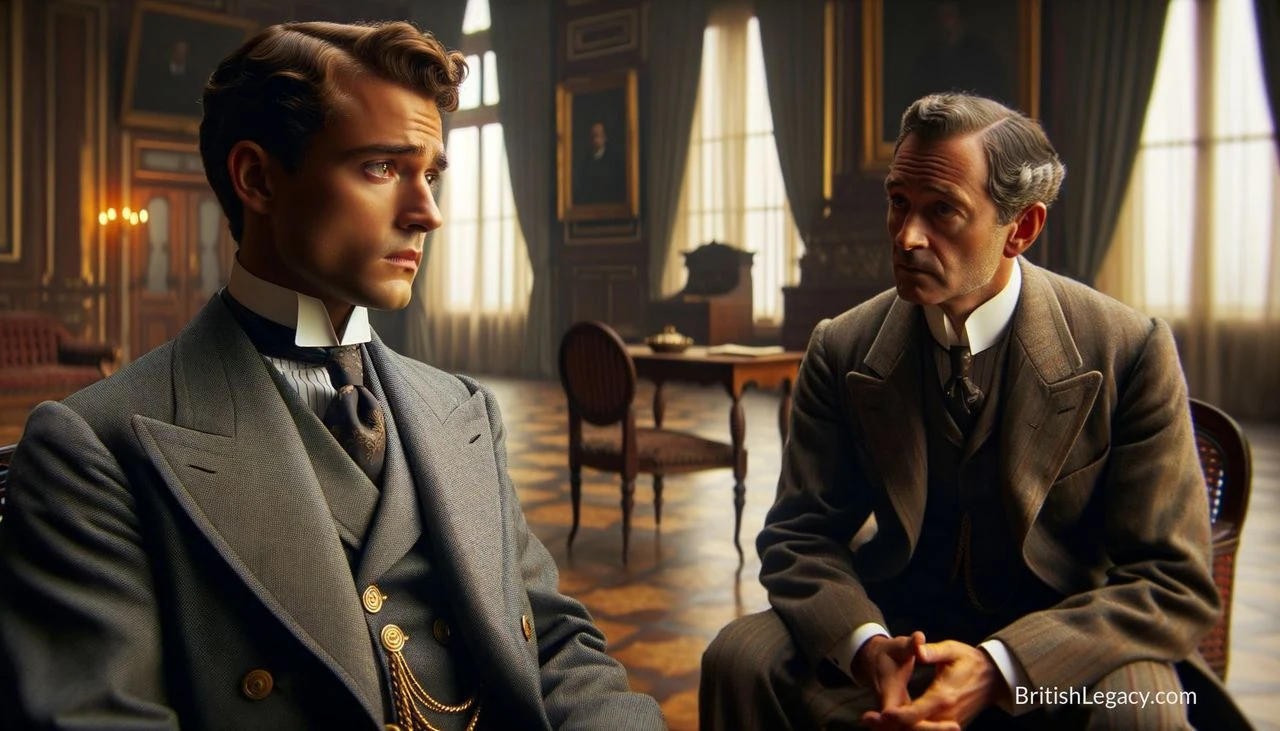
When King George VI addressed Britain and the Empire after war with Germany was declared in 1939, the broadcast carried an unusual weight: the monarch had to speak publicly despite a stammer. Tom Hooper’s The King’s Speech turns that challenge into an intimate historical drama, centred on the relationship between the King, played by Colin Firth, and Australian speech therapist Lionel Logue, played by Geoffrey Rush. The film connects a private struggle with the new demands radio placed on the royal family, but its emotional account should not be mistaken for a literal reconstruction of every event.
A monarch in the age of radio
The film begins with Prince Albert, known to his family as Bertie, struggling through a public address at the closing of the British Empire Exhibition. His wife, Elizabeth, persuades him to seek help from Logue, whose approach combines speech exercises with attention to psychological causes. Early sessions establish the film’s central tension: Bertie is a royal patient, while Logue insists on a more direct and personal relationship than court protocol would normally allow.
That relationship unfolds against the constitutional crisis surrounding Bertie’s elder brother, Edward VIII. After Edward decides to abdicate, Bertie becomes King George VI. The story culminates in the 1939 wartime broadcast, when Logue helps the King prepare to address the country. The film makes the moment a test of both speech and public responsibility: the King does not become effortlessly fluent, but works through the difficulty and completes the address.
The wireless is more than background detail. In the film, George V explains that broadcasting will bring the royal family into people’s homes, making the ability to speak over the radio an increasingly important part of the monarchy’s public role. The story’s stakes therefore extend beyond Bertie’s confidence. The King’s voice becomes a means of addressing a nation facing war.
Firth, Rush and the making of the film
Firth’s performance gives physical form to the effort involved in speaking: the pauses, tension and interruptions are central to his portrayal. Rush plays Logue as an unconventional therapist whose frankness creates both humour and friction. Helena Bonham Carter appears as Queen Elizabeth, with Guy Pearce as Edward VIII. The supporting cast also includes Timothy Spall, Derek Jacobi, Jennifer Ehle and Michael Gambon.
David Seidler’s screenplay grew from an interest in George VI’s life and the relationship with Logue. Seidler had developed a stammer in childhood and, as an adult, resolved to write about the King. He began researching the subject in the late 1970s and 1980s, but delayed the project at the request of Queen Elizabeth the Queen Mother, who did not want the story pursued during her lifetime. After her death in 2002, Seidler returned to it. He first shaped the work as a stage play, concentrating on the relationship between the two men, before adapting it for the screen with the production team.
Material from notes written by Logue came to the filmmakers’ attention shortly before shooting. With permission from the people preparing a book based on those notes, the screenplay was revised to incorporate material from them. Seidler and Hooper also chose not to make the final broadcast a flawless triumph: Hooper said the real speech showed the King managing his stammer rather than overcoming it completely.
Filming took place in London and elsewhere in Britain between November 2009 and January 2010. The production used Ely Cathedral for Westminster Abbey, Lancaster House for interiors representing Buckingham Palace, and the Pullens buildings in Southwark for a 1930s London street. Elland Road and Odsal Stadium stood in for Wembley Stadium in the opening sequence. Other locations included the Old Royal Naval College in Greenwich, Hatfield House and Battersea Power Station.
Style, release and reception
Hooper and cinematographer Danny Cohen used wide-angle lenses and close framing to convey the Duke of York’s sense of constriction. Many scenes take place in interiors, where corridors and confined rooms contrast with the grand settings expected of a royal drama. The score, composed by Alexandre Desplat, uses a spare arrangement of strings and piano. Beethoven’s Seventh Symphony accompanies the climactic broadcast, an editorial choice retained from the temporary music used during editing.
The film premiered at the Telluride Film Festival on 6 September 2010 and screened at the Toronto International Film Festival, where it won the People’s Choice Award. Its UK cinema release followed on 7 January 2011. It became a substantial commercial success, earning more than £250 million internationally on a reported budget of £8 million. The film also prompted debate over its original British Board of Film Classification 15 rating for strong language; the rating was later lowered to 12A.
At the 83rd Academy Awards, The King’s Speech received 12 nominations and won four: Best Picture, Best Director for Hooper, Best Actor for Firth and Best Original Screenplay for Seidler. At the 64th British Academy Film Awards it won seven awards, including Best Film and Outstanding British Film. Its reception also included discussion of the boundary between dramatic licence and historical accuracy. The chronology of the King’s treatment was compressed, and commentators challenged the film’s treatment of political figures and events. The film’s power as drama does not make every scene a record of what happened.
Stammering on screen
The film brought stammering into a prominent popular story. The British Stammering Association welcomed the film-makers’ depiction of the frustration and fear people who stammer can experience, and praised Firth’s portrayal as authentic. The Royal College of Speech and Language Therapists also welcomed the film and launched its Giving Voice campaign around the time of its commercial release.
That response was not unqualified. Some commentators objected to the film’s suggestion that emotional repression or childhood trauma lies behind stammering, and to its emphasis on psychological treatment. The film’s account is shaped for dramatic purposes; it should not be taken as a general explanation of the condition. This distinction matters because the film’s emotional force helped bring attention to speech difficulties, while aspects of its plot risk turning a complex condition into a simplified dramatic device.
Why The King's Speech deserves a place in British Legacy
The King’s Speech earns its place in British Legacy through the way it brings together a British historical setting, a distinctive film-making achievement and a story about public communication. Its central moment—the 1939 broadcast—shows a monarch addressing Britain and the Empire at the start of war, while the film focuses on the preparation and effort behind that public voice. The drama makes a national event legible through the working relationship between George VI and Lionel Logue, rather than presenting monarchy only through ceremony and spectacle.
The film’s British connection is also visible in its production: it was made by a British-led creative team and shot at locations across the country, from Southwark and Ely Cathedral to Leeds and Greenwich. Its awards included both the Academy Award for Best Picture and BAFTA’s Best Film and Outstanding British Film, while its international box-office success carried a story set in British history to a broad audience. Its treatment of the past is not beyond question; the compressed chronology and altered details invite viewers to distinguish drama from historical record. That tension is part of its lasting value. The film can entertain and prompt interest in the people and events behind it, while its public discussion of stammering also brought a communication difficulty into wider view. Its achievement lies not in flawless historical fidelity, but in making a specific British story compelling and widely seen.
Sources
Adapted in part from The King's Speech by Wikipedia contributors, under CC BY-SA 4.0. Text has been edited and combined with the existing article; this adapted text is shared under the same licence. Contributor history.