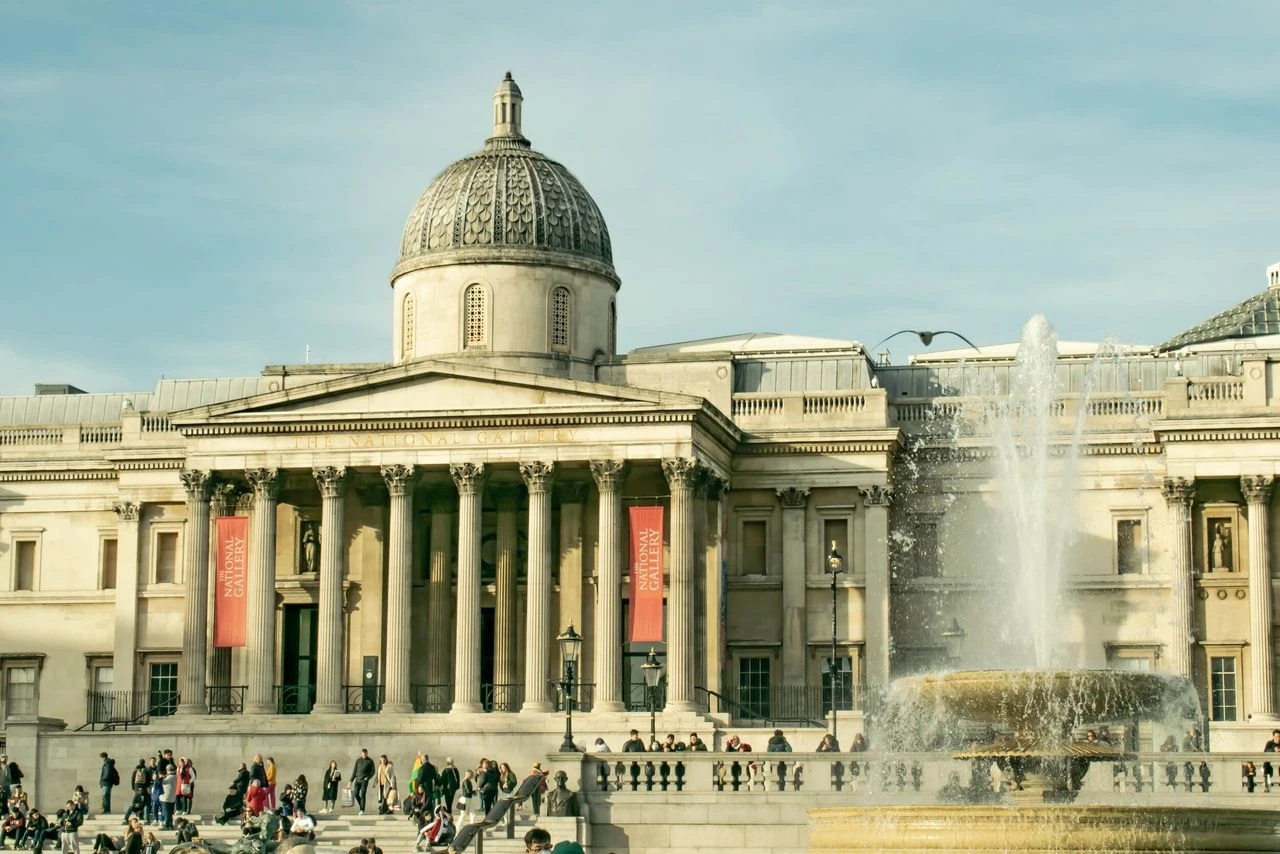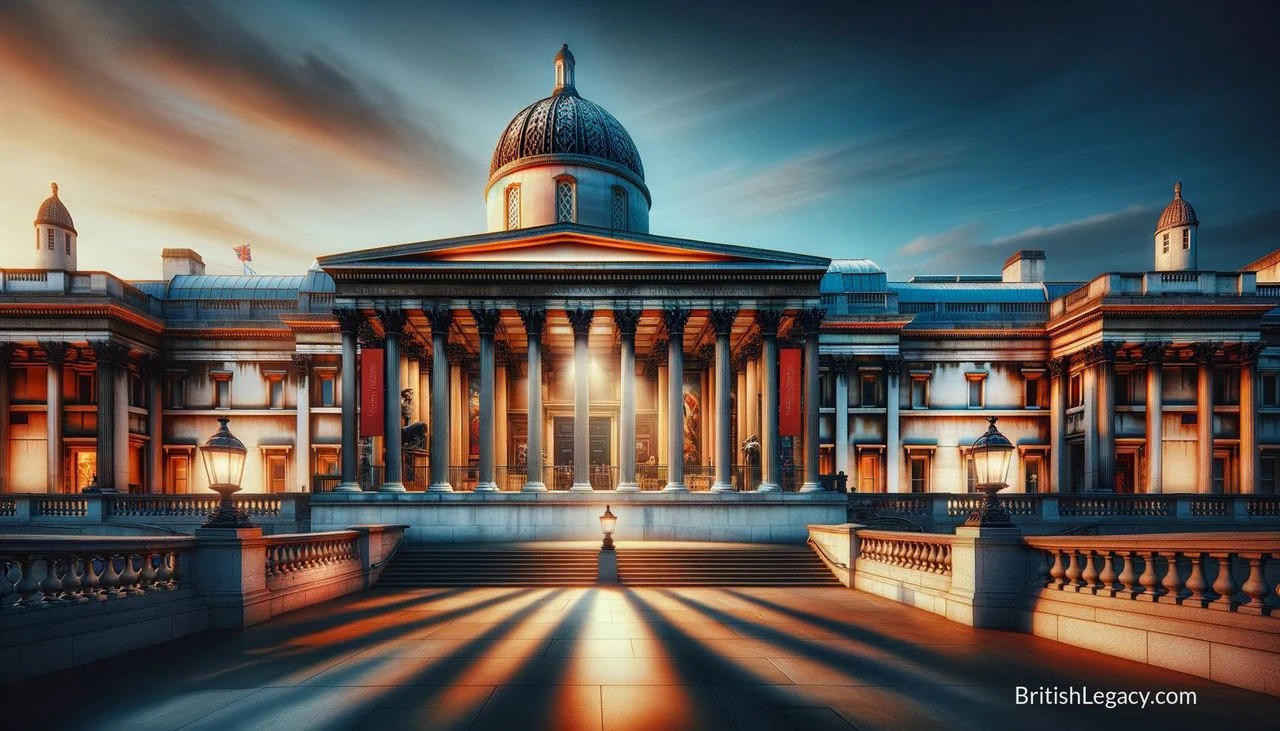
The National Gallery began not with a royal collection but with a government purchase: 38 paintings from the heirs of banker John Julius Angerstein in 1824. First displayed in his former townhouse in Pall Mall, the collection moved to Trafalgar Square in 1838. Today the Gallery holds more than 2,300 paintings dating from the mid-13th century to 1900. Its history is also a story of public access: the collection belongs in trust to the British public, and entry to the main collection is free.
A national collection, built in public
Britain’s National Gallery took a different route from institutions in continental Europe, many of which opened by nationalising royal or princely collections. The British Royal Collection remained with the sovereign. Earlier proposals to establish a national gallery had failed, including an appeal to buy Sir Robert Walpole’s collection in 1777 and unsuccessful offers of other collections in the early 19th century.
The opportunity to acquire Angerstein’s paintings came in 1823, after his death. His collection included works by Raphael and the series Marriage A-la-Mode by William Hogarth. The government agreed to buy all 38 pictures for £57,000 in 1824, following pressure in Parliament and an offer from collector Sir George Beaumont to donate 16 paintings on condition that the Angerstein collection was purchased and a suitable building found.
The Gallery opened that year at 100 Pall Mall. The paintings were joined by Beaumont’s gift in 1826 and, in 1831, by a bequest of 35 pictures from the Reverend William Holwell Carr. The first home was crowded and poorly suited to public display. In 1832, construction began on a new building on the site of the old Royal Mews at Charing Cross, beside the developing Trafalgar Square. William Wilkins designed it; the building opened to the public in 1838.
The location connected the wealthy West End with poorer districts to the east. In the 1850s, a proposal to move the Gallery to South Kensington prompted a defence of its central site and its public purpose. A parliamentary commission argued in 1857 that the pictures were not an end in themselves, but a means of giving people “an ennobling enjoyment”. That ambition remains visible in the Gallery’s free admission to its main collection.
Wilkins’s building and the changing Gallery
The present building is the third site to house the Gallery. Wilkins’s neoclassical design, built between 1832 and 1838, has been extended and altered repeatedly. It drew criticism from the outset: the restricted site, a public right of way and the presence of the Royal Academy in part of the building limited the space available for pictures. Extensions by architects including E. M. Barry and Sir John Taylor added galleries and grand interior spaces, while later restorations changed how visitors encountered the building’s Victorian rooms.
The lack of room was more than an architectural inconvenience. In 1897, the National Gallery of British Art, soon known as the Tate Gallery, opened at Millbank. This allowed works by artists born after 1790 to move there, while paintings by Hogarth, Turner and Constable remained in Trafalgar Square. In 1996, the two institutions’ respective remits were clarified; 1900 became the National Gallery’s cut-off point for paintings.
The Sainsbury Wing, designed by Robert Venturi and Denise Scott Brown, opened in 1991. It provides space for earlier Renaissance paintings and is a notable British example of postmodernist architecture. A major donation from Lord Sainsbury and his brothers made it possible for the extension to be devoted entirely to the Gallery. Its quieter, more intimate rooms contrast with the ornamented spaces of the older building.
Paintings, collecting and changing taste
The collection is encyclopaedic in scope, with significant works representing major developments in Western painting from Giotto to Cézanne. Its best-known pictures include Jan van Eyck’s The Arnolfini Portrait, Diego Velázquez’s Rokeby Venus, Leonardo da Vinci’s The Virgin of the Rocks, and Vincent van Gogh’s Sunflowers. British painters are represented by works including Hogarth’s Marriage A-la-Mode, John Constable’s The Hay Wain and J. M. W. Turner’s The Fighting Temeraire.
Private gifts have shaped the collection as much as government purchases. The Gallery’s early directors and donors helped broaden its range, and private donations now account for two-thirds of the collection. In the mid-19th century, director Charles Lock Eastlake pursued early Italian and Northern Renaissance paintings, acquiring works that had previously attracted less attention. His successors added art from later periods, including 18th-century paintings, while successive bequests and public appeals brought major works into the collection.
Changing taste has brought debate as well as growth. The Gallery’s first major campaign of cleaning paintings in the 1840s attracted criticism, as did conservation work after the Second World War. A parliamentary inquiry in 1853 cleared the Gallery over the earlier controversy; a commission in 1947 concluded that the post-war cleanings had caused no damage. The arguments reflect a continuing challenge: caring for paintings requires decisions about how best to preserve them, and those choices can alter how the public sees them.
The collection has also adapted to changing ideas about art. Impressionist painting was initially controversial among the Gallery’s trustees. Later, exhibitions and acquisitions widened the range of works shown. In 2024 the Gallery marked its bicentenary with programmes, events and collaborations. Its current expansion plans, announced in 2025, envisage a new wing with space to display 250 additional paintings. The architectural competition winner, Kengo Kuma and Associates with BDP and MICA, was announced in April 2026, subject to ratification at the end of a standstill period.
A gallery in wartime and in public life
The Second World War tested the Gallery’s purpose. Before hostilities began, its paintings were evacuated to locations in Wales. In 1940, as the Battle of France intensified, the possibility of sending them to Canada was rejected. Instead, the collection was moved to a slate quarry at Manod, near Blaenau Ffestiniog. Its wartime storage helped establish the importance of maintaining stable temperature and humidity for paintings.
The empty building in Trafalgar Square remained in use. Pianists including Myra Hess gave lunchtime concerts to support public morale, while exhibitions showed work by British artists and war artists. In 1941, the “Picture of the Month” scheme brought a painting back from storage for display to the public. The pictures returned to Trafalgar Square in 1945. The Gallery was not simply a storehouse to be protected; even without its collection on site, it remained a place for culture and shared experience.
Its public role has continued through exhibitions, research, education and loans. The Gallery presents work by artists responding to its collection through programmes that have included the Artist’s Eye exhibitions and artist residencies. Its holdings have also been lent to other institutions, while public campaigns have helped secure major acquisitions that would otherwise have been beyond its means. The Gallery’s history includes disagreement and change, but its collections have remained part of a wider national conversation about art, access and stewardship.
Why The National Gallery deserves a place in British Legacy
The National Gallery deserves a place in British Legacy because its foundation established a public collection through a deliberate act of government: buying Angerstein’s paintings and opening them to visitors. That beginning was not the transfer of a royal collection to the state. It was a decision to assemble works for public benefit, in a central London location intended to be accessible across social classes. The free admission policy for the main collection continues that commitment, while the Gallery’s paintings offer visitors direct encounters with major works from centuries of European art.
Its British significance also lies in the way it has adapted. Private bequests, changing collecting priorities, the creation of the Tate Gallery and the later expansion of the Sainsbury Wing all changed what the institution could show and how it understood its remit. During the Second World War, the collection was protected in Wales, but the Trafalgar Square building remained open for concerts and exhibitions, maintaining a cultural space in London. Today, conservation, research, loans and new display plans extend that public role. The Gallery preserves works of international importance while giving people in Britain a free, shared setting in which to encounter them. Its story is therefore not only about famous pictures, but about how a national institution has gathered, cared for and made art available across generations.
Sources
National Gallery — revision 1378402389 · National Gallery
Adapted in part from National Gallery by Wikipedia contributors, under CC BY-SA 4.0. Text has been edited and combined with the existing article; this adapted text is shared under the same licence. Contributor history.