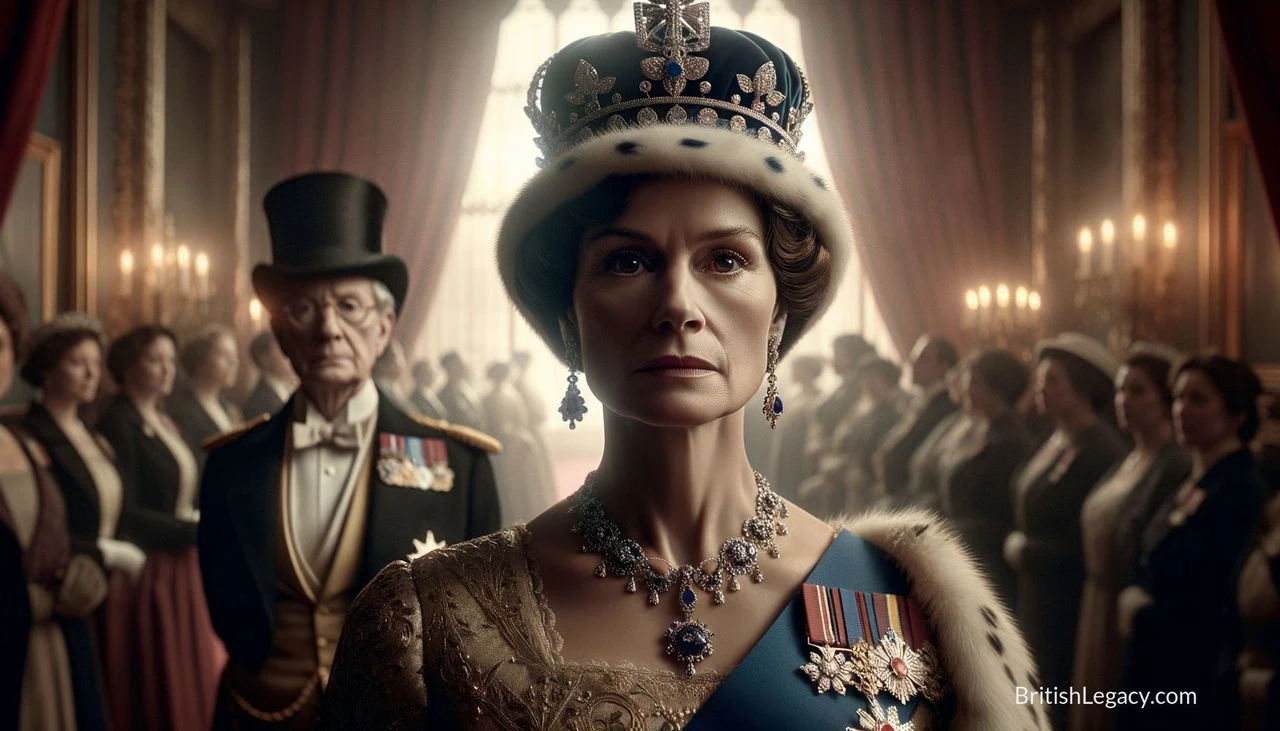
Stephen Frears’s 2006 film The Queen centres on a moment when private royal conventions collided with public grief. Starring Helen Mirren as Elizabeth II, it dramatises the monarch’s response to Princess Diana’s death in Paris in 1997 and the debate that followed over how the Royal Family should acknowledge the loss. Its subject is not simply a family in mourning, but the pressure placed on a public institution when people expect it to speak and act in ways that tradition may not readily allow.
A death, and a public response
The film sets its story against the national mourning that followed Diana’s death in a car accident. In its dramatic account, the Royal Family’s initial reticence to make a public statement becomes a source of anger and tension. The contrast between the scale of public feeling and the monarchy’s restrained response gives the story its central conflict: the question of how duty should be expressed when the expectations of the public change.
Mirren’s performance places the Queen at the centre of that conflict. The portrayal moves between stoicism and vulnerability, showing a monarch confronted with pressure to respond while remaining bound to established forms of conduct. The film presents these competing demands as a human and political problem rather than a simple contest between right and wrong.
Monarchy and government
Tony Blair, played by Michael Sheen, represents a different reading of the moment. As Prime Minister, he urges the monarchy to adapt to what he sees as the public’s changing expectations; the Queen’s position is more closely associated with tradition and decorum. Their disagreement gives the private crisis a wider political frame, bringing questions about the monarchy’s relationship with the public into the drama.
Peter Morgan’s screenplay and Frears’s direction approach their subjects without making the film a straightforward defence or condemnation. The story instead asks viewers to consider how leadership, institutional custom and public sentiment pull against one another. That balance is part of the film’s method: its dramatisation offers a perspective on royal affairs, not a claim that private motives can be known with certainty.
Performance and film-making
Mirren’s work earned her the Academy Award, BAFTA and Golden Globe for Best Actress, according to the account of the film. Her portrayal anchors a production that combines dramatisation with real news footage to evoke the late 1990s. Alexandre Desplat composed the score, which adds to the film’s emotional register without changing the historical setting on which its story depends.
The film’s reach extends beyond the events it depicts. Its combination of political drama and a recognisable national moment helped prompt discussion about the monarchy’s place in a contemporary democratic society. Rather than serving only as a record of one crisis, The Queen uses that crisis to examine how public institutions are judged when established habits meet urgent expectations.
Why The Queen deserves a place in British Legacy
The Queen merits a place in British Legacy because it turns a recent episode in British public life into a drama about the relationship between institutions and the people they serve. Its focus on the aftermath of Diana’s death brings together the monarchy, the prime minister and public mourning, showing how a moment of national attention can expose different ideas of duty. The film’s value lies not in settling those disagreements, but in making their stakes visible to audiences.
Mirren’s award-winning performance, Frears’s direction and Morgan’s screenplay give that discussion a memorable dramatic form. The use of news footage alongside dramatisation places the story within the period it evokes, while the film’s questions about tradition, public feeling and political responsibility remain legible beyond the immediate events. As a British film about a British institution at a moment of pressure, it offers a specific and accessible way to reflect on how the monarchy’s public role is represented and debated.