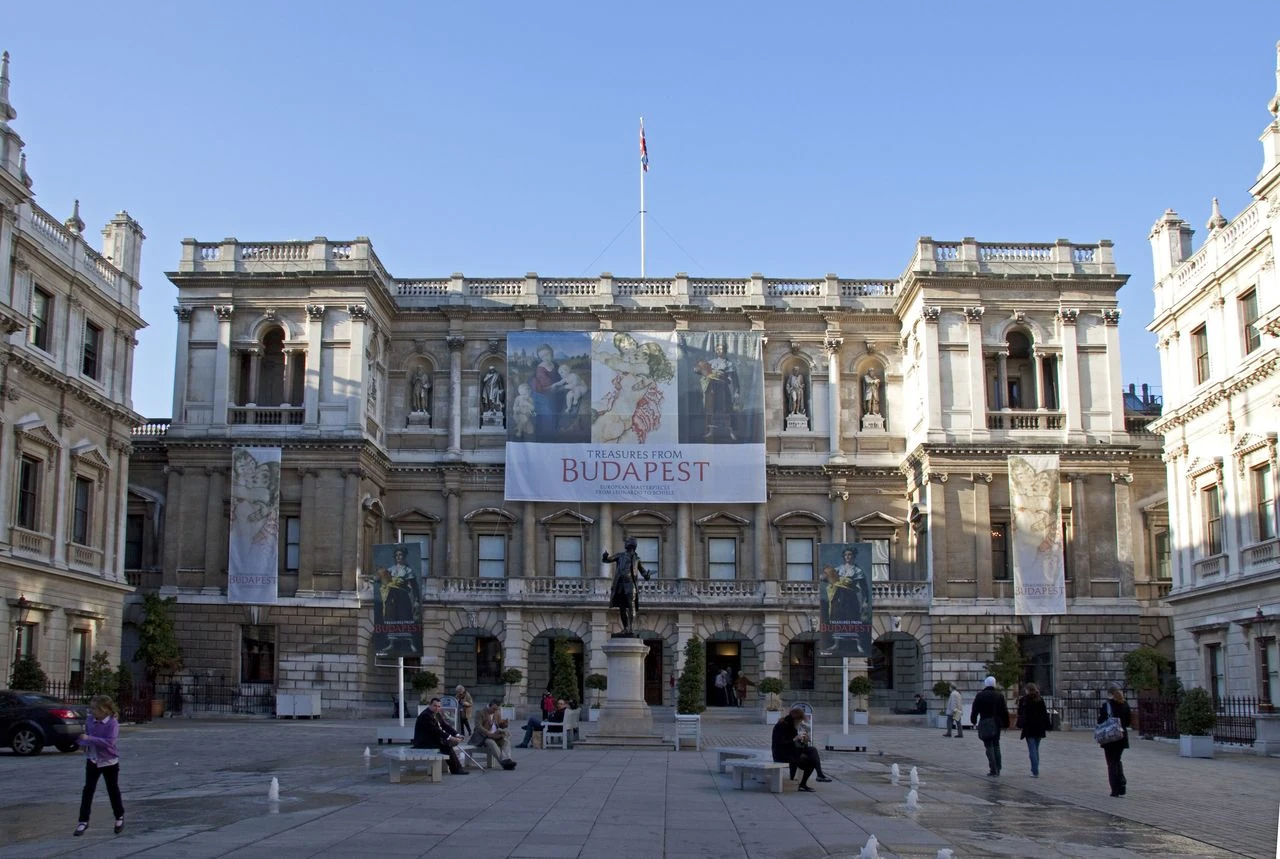
Since its foundation in 1768, the Royal Academy of Arts has combined three roles: educating artists, exhibiting art and bringing public attention to debates about visual culture. Established under the patronage of George III, with Sir Joshua Reynolds as its first president, it was conceived as a place where artists and the public could engage with the visual arts. Its influence is best understood not as a single achievement, but through the continuing relationship between its Schools, its exhibitions and its wider cultural programme.
A foundation for artists and public engagement
The Academy was founded under a Royal Charter granted by George III. Reynolds led a group of artists and architects involved in its establishment, and became its first president. Their stated purpose was to encourage the development and appreciation of the visual arts through exhibitions, education and debate. That combination remains central to the Academy’s identity: it is neither solely a gallery nor solely an educational institution.
The Royal Academy Schools were established alongside the Academy. Their history is associated with artists including J.M.W. Turner and John Constable, cited among the notable British artists they educated. The Schools continue to offer postgraduate education without charge to a select group of students from around the world. This model links a long-established British institution to the practical development of artists, while opening its training to students beyond Britain.
The Summer Exhibition and changing art
The Academy’s Annual Summer Exhibition has been held since 1769. It is described as the world’s oldest open-submission art exhibition, bringing work by emerging artists into the same public setting as work by established names. The format makes the exhibition a meeting point between established artistic reputations and artists seeking an audience. Its continuing presence also gives the Academy a recurring opportunity to present contemporary work alongside more familiar traditions.
Exhibitions at the Academy have also introduced British audiences to artists from abroad and to avant-garde movements. That role places the institution in a wider exchange: the Academy’s British history does not mean its programme is limited to British art. The account of its work describes international collaborations and global perspectives as part of its reach, although it does not specify individual projects or exhibitions.
Education, exhibitions and debate
Alongside its Schools and exhibitions, the Academy has used lectures, symposia and panel discussions to engage the public in discussion about visual art. These events give its work an intellectual and civic dimension: visitors and participants can encounter art not only as objects on display, but as a subject for discussion. The Academy’s programme therefore joins the making and showing of art with opportunities to consider its meaning and place in society.
Taken together, these activities connect the institution’s history to its present work. Its foundation set out an ambition to support artistic development and public appreciation; its Schools, exhibitions and discussions give that ambition practical form. Claims that the Academy has defined British art or serves as a global centre of excellence go beyond the specific examples available here, but its long-running exhibition and educational roles demonstrate a substantial contribution to the country’s cultural life.
Why the Royal Academy of Arts deserves a place in British Legacy
The Royal Academy deserves a place in British Legacy because its history links artistic education with public access to art. Founded in London in 1768 under George III’s charter, it brought artists and architects together around a purpose that included teaching, exhibitions and debate. The Royal Academy Schools extend that purpose through postgraduate education, while the association of their history with Turner and Constable illustrates their connection to British artistic life. The Academy’s continuing free provision for a select group of students from around the world also gives its educational role an international dimension.
Its exhibitions offer another specific part of that legacy. The Annual Summer Exhibition, held since 1769, provides a platform for emerging artists alongside established names, while the Academy has also presented British audiences with art from abroad and avant-garde movements. Lectures, symposia and panel discussions add a forum for public engagement with visual culture. These are concrete, distinct contributions: supporting artists’ development, making work visible and encouraging discussion. Together they explain the Academy’s place in British cultural history without requiring claims that it alone defines British art.