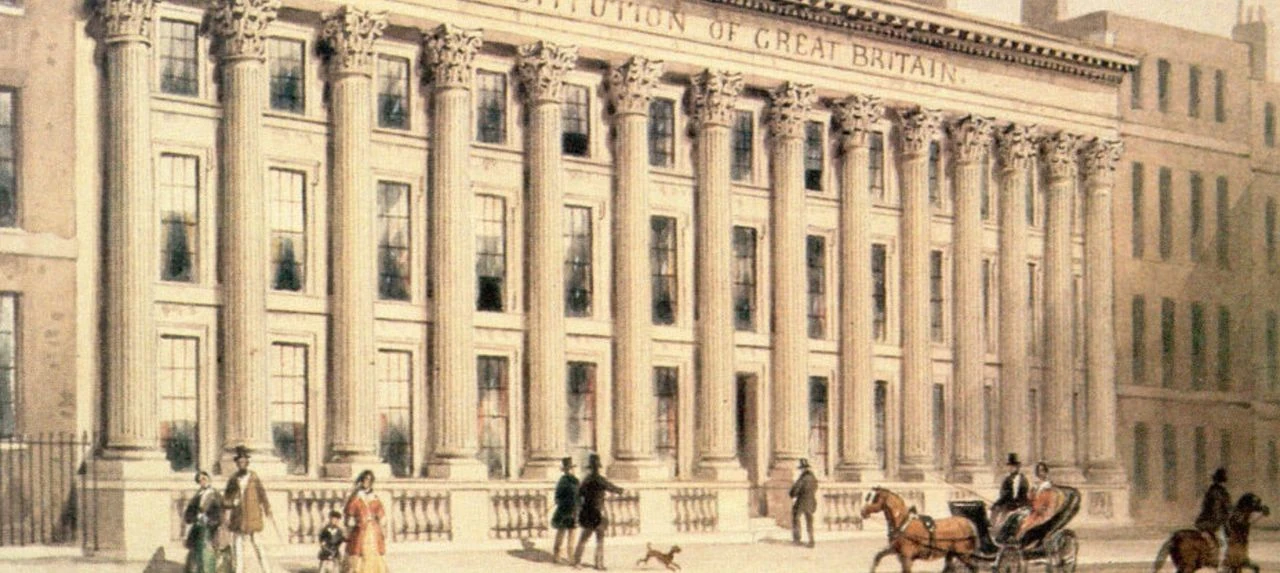
Founded in 1660, the Royal Society grew from informal gatherings of naturalists and philosophers into an institution that has shaped the organisation and public life of science. Its history includes a Royal Charter, a commitment to testing claims against evidence, and connections with figures including Isaac Newton and Charles Darwin. The Society’s work has also extended beyond individual scientists, through its journal, policy advice and international relationships.
Gatherings, a charter and a guiding principle
The Society’s beginnings lay in meetings where naturalists and philosophers discussed ideas and carried out experiments. These early participants, described as “philosophical enthusiasts”, helped establish the foundations of a more formal organisation. In 1662, two years after its foundation, the Royal Society received a Royal Charter.
Its motto, Nullius in verba — “take nobody’s word for it” — expresses a commitment to evidence and independent examination. Rather than treating an assertion as true simply because an authority had made it, the Society’s stated ideal was to test claims. This emphasis on inquiry and scepticism became a defining part of its identity.
The society’s early history is also tied to the development of scientific publishing. Philosophical Transactions of the Royal Society first appeared in 1665. It is described as the world’s longest-running scientific journal, providing a continuing means of circulating research.
Scientists, discoveries and publication
Isaac Newton was among the Society’s notable Fellows. In 1687, his Philosophiæ Naturalis Principia Mathematica was published under the Society’s auspices. The work laid foundations for classical mechanics and set out laws of motion and gravity. Newton’s association with the Society is one example of how its history intersects with the work of individual scientists.
Charles Darwin’s theory of evolution by natural selection, presented in On the Origin of Species, also reached a wider audience in part through a platform associated with the Society. Francis Crick and James Watson are linked in the Society’s history with research on the structure of DNA. These examples span different fields and periods; they point to a role for scientific institutions not only in recognising individual achievement but also in creating settings where ideas can be communicated and discussed.
The Society’s Fellows have included scientists such as Newton, Darwin and Stephen Hawking. Its stated areas of activity include physics, chemistry, biology and astronomy, and it has supported research and collaboration across these fields.
Public policy and international work
The Royal Society’s remit reaches beyond research and publication. It advises governments and provides scientific input on issues of public policy, while also working to encourage public understanding of science. Its educational and outreach activity sits alongside this advisory role: both connect scientific knowledge with people and decisions beyond the research community.
Its work is not confined to the United Kingdom. The Society collaborates with scientific academies and institutions in other countries, and its international fellowships and grants have supported scientists from varied backgrounds. Such connections make it a participant in scientific exchange across borders as well as a British institution with a long history.
Among the challenges identified in its contemporary work are climate change, artificial intelligence and public health. The Society’s stated aim is to encourage scientific developments to be used ethically and for the common good. This places questions about the application of research alongside its promotion and communication.
Why the Royal Society deserves a place in British Legacy
The Royal Society deserves a place in British Legacy because its story brings together several lasting parts of Britain’s scientific life: organised inquiry, the publication of research, and the effort to make scientific knowledge relevant to public decisions. Founded in 1660 and granted a charter in 1662, it gave continuity to a community that began with discussion and experiment. Its motto, Nullius in verba, captures an enduring principle: claims should be examined rather than accepted solely on authority.
That principle is reflected in the Society’s history of publication and its connections with work by figures including Newton and Darwin. Its journal has provided a channel for research since 1665; its policy advice and public engagement extend science’s reach beyond specialist circles. International collaboration, fellowships and grants add another dimension, linking a British institution to scientific work elsewhere. The value of this legacy lies not in claiming that one organisation accounts for scientific progress, but in recognising its continuing part in supporting inquiry, communication and the considered use of evidence.