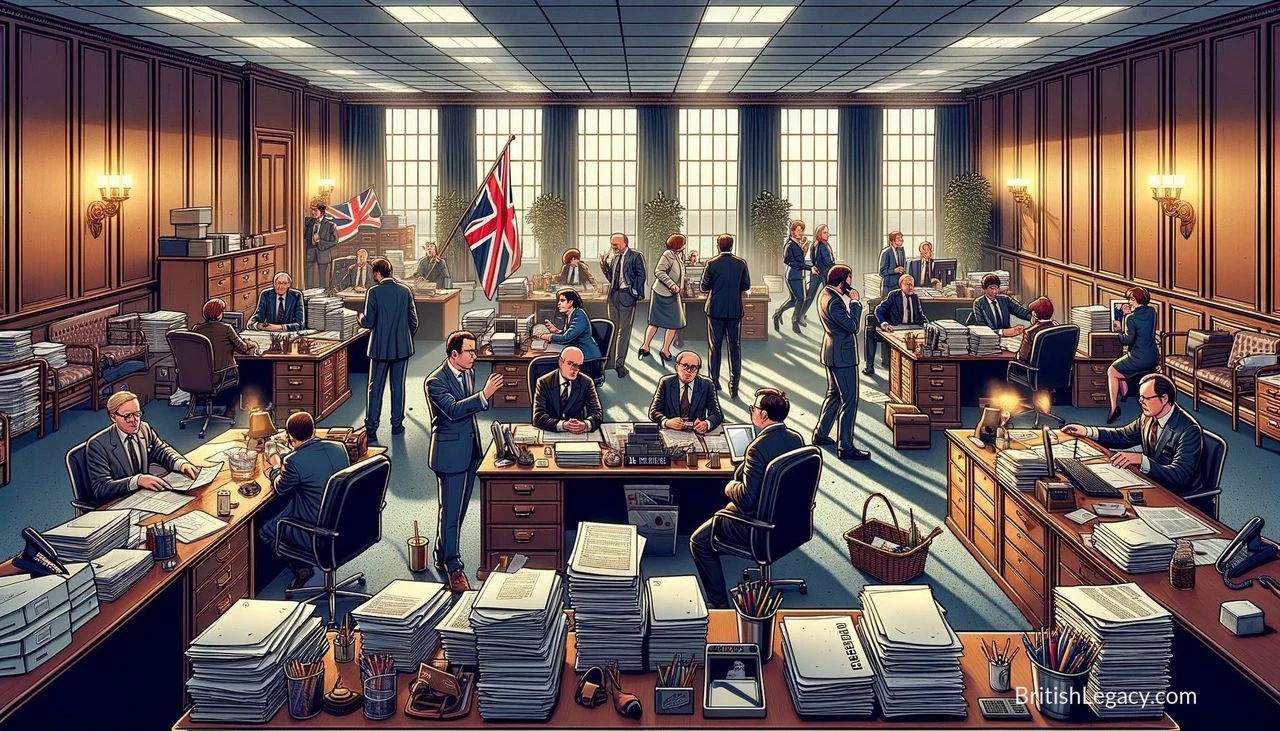
In The Thick of It, a minister can spend the morning trying to announce a policy and the afternoon trying to explain why it was announced at all. First broadcast on BBC Four in 2005, Armando Iannucci’s comedy made the machinery around government its subject: ministers, special advisers, civil servants, party spin doctors and the media, each pulling at the same story from a different direction. Its frantic handheld style and vividly profane dialogue made political confusion feel immediate, while its fictional setting left room to satirise the habits of more than one party.
A department built for political disorder
The series is set in the fictional Department of Social Affairs and Citizenship, or DoSAC, previously the Department of Social Affairs. Conceived as a broad “super department”, it gives the writers scope to bring different policy problems into the same office. The department’s changing name and occupants are part of the joke: a reshuffle may alter the title on the door, but it does little to end the mistakes and manoeuvring inside.
At the centre of the early episodes is Hugh Abbot, played by Chris Langham, a minister whose attempts to assert himself are repeatedly undermined by events and by Malcolm Tucker. Peter Capaldi’s Tucker is a Number 10 communications enforcer, charged with keeping ministers in line and managing crises through press tactics and political spin. He is forceful, profane and feared by the people around him, but the show’s interest is not confined to his outbursts. The department’s advisers and civil servants have their own rivalries, ambitions and blind spots.
James Smith plays Glenn Cullen, the minister’s experienced special adviser; Chris Addison is the younger adviser Ollie Reeder; and Joanna Scanlan is Terri Coverley, DoSAC’s press secretary. Their competing judgements help make the office feel like a workplace rather than a simple stage for Tucker’s tirades. When Hugh is replaced at the beginning of the third series by Nicola Murray, played by Rebecca Front, the department keeps its familiar staff even as its political balance shifts. The fourth series brings another change: after an election produces a coalition, Peter Mannion (Roger Allam) becomes secretary of state, facing both his own team and coalition junior minister Fergus Williams (Geoffrey Streatfeild).
From a small BBC Four commission to a wider canvas
Iannucci began developing the idea after revisiting Yes Minister while making a documentary about British sitcoms. He saw that the pressures on ministers had changed: alongside the civil service, they faced demands from Downing Street to follow a centrally set agenda. Research conversations with policy makers and political journalists informed the premise. Martin Sixsmith, a journalist and former civil servant, advised the writing team. The series’ realism rests on this attention to political dynamics, not on treating its fictional department as a documentary record.
BBC Four controller Roly Keating commissioned the first series with a limited budget. The initial run consisted of three episodes, broadcast in May and June 2005; a second three-episode series followed in October. Two hour-long specials arrived in 2007, bringing opposition politicians and advisers into the story. The third series moved to BBC Two in 2009, and the fourth followed in 2012. Across the four series and specials, the changing cast and government arrangements gave the satire room to move from departmental mishaps to elections, coalition tensions and political survival.
The production’s loose, documentary-like look was made with handheld cameras, without an incidental music or laughter track. Actors could move around the set during takes, with camera operators following them and wireless microphones capturing the dialogue. The scripts were written by a team led by Iannucci, including Jesse Armstrong, Simon Blackwell, Roger Drew, Sean Gray, Ian Martin, Will Smith and Tony Roche. Some dialogue was improvised, but Capaldi said that most of the final cut remained based on the original script. Ian Martin also worked on the language as the programme’s “swearing consultant”.
Changing ministers, escalating consequences
The early episodes follow Hugh Abbot as he tries to establish himself in office without provoking Tucker or being overtaken by his own department’s errors. The 2007 specials widen the scope to a change of prime minister and the formation of an opposition. One follows a computer problem at Immigration and the fallout from a disastrous television interview; the other compresses the scramble for influence around a transfer of power into a single night.
When Nicola Murray replaces Hugh in series three, she arrives without a team of her own and has to rely on Ollie and Glenn. Her “Fourth Sector Pathfinder Initiative” becomes one of the series’ running policy threads, while party conference, a radio broadcast and mounting tensions at Downing Street extend the action beyond the department. The fourth series shifts to coalition government. Mannion must contend with Fergus Williams, while Murray moves into opposition politics. A public inquiry and a contentious health bill bring the series’ competing political interests together in its closing episodes.
This progression allows the show to make political process part of its comedy. A change of minister does not reset the system; it alters who has leverage, who is exposed and who must explain the latest decision. The parties are not named, and many of the policies are deliberately generic. That choice lets the writing focus on recurring behaviours—spin, self-preservation and the struggle to control a public account—rather than presenting a single party as the target.
Recognition, spin-offs and a phrase beyond the screen
The programme received major television awards. Its first series won the 2006 BAFTA for Best Situation Comedy, and Langham received the award for Best Comedy Performance. Capaldi won BAFTA’s Best Male Comedy Performance in 2010; Front won Best Female Comedy Performance that year, and the series also received the situation-comedy award. The Royal Television Society recognised it as Best Situation Comedy in 2006 and 2010, while the Broadcasting Press Guild honoured the programme and its writing team in those years.
The series also generated work beyond its original television run. The feature film In the Loop, released in the UK in 2009, brought Tucker into a story about officials and advisers caught up in efforts to promote or prevent a war. An unsuccessful American pilot was made, but the later HBO comedy Veep was not a direct spin-off. It shared a political-comedy sensibility and involved some of the same writers and production personnel. The distinction matters: The Thick of It travelled internationally through adaptation and influence, not through a single, straightforward remake.
One of the show’s clearest routes into public language was “omnishambles”, a word coined in the third series in 2009. It subsequently entered political discussion after George Osborne’s 2012 Budget and reached the Oxford English Dictionary the following year. The show’s profane dialogue became part of its identity, but its most durable verbal contribution was a compact term for a situation collapsing through accumulated mistakes.
Why The Thick of It deserves a place in British Legacy
The Thick of It deserves a place in British Legacy because it made a distinctly British political workplace—not Parliament alone, but the offices and communications teams around government—the engine of a widely recognised television comedy. Its fictional department and unnamed parties let it examine the routines of political life without tying every joke to one real administration. Ministers’ dependence on advisers, the pressure to manage the news and the scramble to survive a crisis were not background details; they formed the plot and shaped the characters.
The programme’s achievement was also formal. Its low-budget beginnings helped produce a mobile, documentary-like visual style, while a large writing team and carefully managed improvisation gave the dialogue its quick, unsettled rhythm. The movement from BBC Four to BBC Two and from a small initial cast to stories about opposition and coalition government shows how the format could expand without losing its focus on people trying to control events. Its awards recognise the work of the cast and writers, while In the Loop and the related but distinct Veep demonstrate its reach beyond the original series. Most tellingly, “omnishambles” passed from scripted comedy into political usage. That particular afterlife links the show’s invention to everyday public debate: it gave audiences a concise word for a familiar kind of failure, and made the language of political spin itself part of British television history.
Sources
Adapted in part from The Thick of It by Wikipedia contributors, under CC BY-SA 4.0. Text has been edited and combined with the existing article; this adapted text is shared under the same licence. Contributor history.