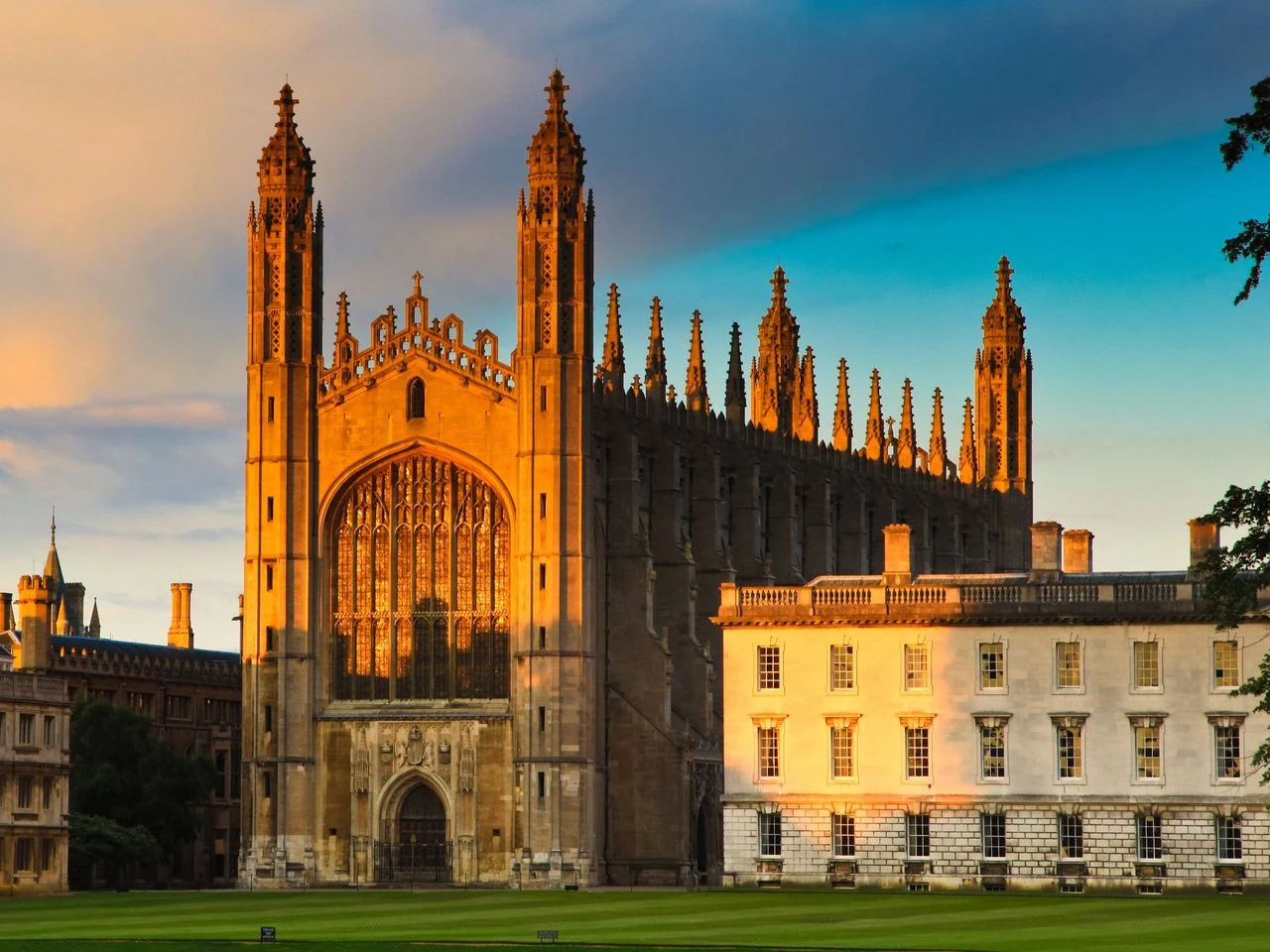
Founded in 1209, the University of Cambridge grew from the arrival of scholars who left Oxford after a dispute with local townspeople. More than eight centuries later, it remains a collegiate research university in the English city that bears its name. Its history is not only a roll-call of distinguished graduates: it is also a story of changing courses, new colleges, contested access to education and a university whose work has helped shape the life of Cambridge and the wider world.
A university takes root
Cambridge already had a scholarly and ecclesiastical reputation before the university was founded, in part through the work of monks associated with nearby Ely Cathedral. The university’s formation followed conflict in Oxford after two scholars were hanged by the town’s secular authorities. Fearing further violence, scholars left Oxford for other places, including Cambridge, where their arrival helped form the nucleus of a new university.
The institution gained formal recognition in stages. A chancellor had been appointed by 1225. In 1231, King Henry III issued writs establishing rules for rents and arrangements for resolving disputes involving the university. Later recognition followed: Cambridge was described as a studium generale in 1290 and confirmed as such by a papal bull in 1318. These milestones trace its emergence from a gathering of scholars into a recognised centre of learning.
Colleges developed after the university itself. Peterhouse, founded in 1284 by Hugh de Balsham, Bishop of Ely, was the first. Further colleges appeared in the 14th and 15th centuries; others followed much later, including Downing in 1800 and Robinson in the late 1970s. Today Cambridge has 31 colleges, self-governing institutions with their own property and endowments. Students belong to a college, where they receive accommodation, welfare and social support, as well as much of their small-group teaching. University departments and faculties organise lectures, research and degree programmes.
Teaching, mathematics and discovery
Cambridge’s teaching model gives a prominent place to weekly small-group supervisions in colleges, alongside lectures, seminars and laboratory work. In a supervision, students discuss work prepared in advance with a member of staff or, in some cases, a doctoral student. The system connects the university’s broad academic departments with close instruction in its colleges, a distinctive feature of its collegiate organisation.
Mathematics became one of Cambridge’s defining strengths. From the time of Isaac Newton in the late 17th century until the mid-19th century, the university placed particular emphasis on applied mathematics and mathematical physics. The Mathematical Tripos examination became a demanding route through the subject; students gaining first-class honours were known as wranglers, with the highest-ranked called the Senior Wrangler. The tradition helped train figures including James Clerk Maxwell, Lord Kelvin and Lord Rayleigh. In the early 20th century, G. H. Hardy, J. E. Littlewood and Srinivasa Ramanujan helped establish Cambridge as a leading centre for pure mathematics.
Research and teaching have extended well beyond mathematics. Cambridge’s scientific history includes Newton’s work on classical mechanics and the research of Francis Crick and James Watson on the structure of DNA. The account of that work also identifies Maurice Wilkins and Rosalind Franklin as contributors whose X-ray crystallography data played a key part. In later developments, Cambridge researchers and graduates have been associated with computing, physics, biology and technology. The university’s account of its scientific community ranges from Alan Turing’s foundations for modern computing to the creation of the first programmable computer by Maurice Wilkes.
The university has expanded its academic provision over time. The Cambridge University Act 1856 formalised its organisation and introduced subjects including theology, history and modern languages. New sites and laboratories followed, while Cambridge began awarding PhDs in the first third of the 20th century; its first doctorate in mathematics was awarded in 1924. The university now includes more than 150 departments, faculties and other academic institutions, arranged across six schools.
Access, colleges and the city
For much of its history, Cambridge admitted only men. Colleges for women began to be established in the 19th century, including Girton in 1869 and Newnham in 1872. Women gained the right to take university examinations in the late 19th century, but admission to full university degrees did not follow until 1948. Undergraduate colleges began admitting women between 1972 and 1988. The gradual change is an important part of the institution’s history: its academic traditions endured, but who could participate in them changed.
Cambridge’s relationship with its city has changed too. The historic distinction between “town” and “gown” reflected tensions between residents and university members, and conflicts sometimes became violent. The university’s growth has since made it a major source of employment and economic activity in Cambridge and the region. The expansion of technology and biotechnology businesses associated with the university has been called the Cambridge Phenomenon; between 1960 and 2010, the source account records the creation of 1,500 companies and as many as 40,000 jobs, mainly in the business cluster known as Silicon Fen.
The institution’s presence is visible in the city’s buildings and collections as well as its economy. Cambridge operates eight museums and a botanical garden, including the Fitzwilliam Museum and the Cambridge University Botanic Garden. Its 116 libraries hold around 16 million books in total, with approximately nine million at Cambridge University Library, a legal deposit library. The colleges and university departments maintain additional libraries, including collections of early printed books and manuscripts.
Cambridge’s influence also travels through publishing and assessment. Cambridge University Press & Assessment combines the university’s publishing and examination work. Its roots include the establishment of the Local Examinations Syndicate in 1858. The university’s continuing education provision adds another route into study, with award-bearing programmes ranging from undergraduate certificates to part-time master’s degrees.
People, culture and public life
Cambridge’s alumni and academics have made contributions across science, literature, politics and the arts. The names associated with the university include Charles Darwin, Stephen Hawking, John Milton, Virginia Woolf and E. M. Forster. Its wider roll of scholars and graduates includes the philosopher Francis Bacon, the mathematician and computer pioneer Alan Turing, and the economist John Maynard Keynes. Such lists need context: people’s connections to a university differ, and a long succession of notable figures is not, on its own, a history of how the institution worked.
The university’s formal structures have helped shape public life as well as scholarship. Cambridge once returned representatives to Parliament: its university constituency was established by royal charter in 1603 and abolished in 1950. The constituency represented graduates rather than a geographic area. Before 1918, the vote was restricted to male graduates with a doctorate or MA. Its history reflects both the institution’s influence and the exclusions built into older systems of representation.
Academic life has also become part of wider British culture. The Festival of Nine Lessons and Carols, sung by the Choir of King’s College, has been broadcast on Christmas Eve by the BBC since 1928. Cambridge has long had a visible student culture too, from college societies and publications to the Boat Race against Oxford. These traditions sit alongside the university’s research and teaching, giving it a public presence that reaches beyond its lecture rooms.
Why The University of Cambridge deserves a place in British Legacy
Cambridge deserves a place in British Legacy because its history makes the development of higher education in England concrete. Founded after scholars moved from Oxford, it became a collegiate university whose colleges, faculties and departments shaped different ways of teaching and learning. Its weekly supervisions, demanding mathematical tradition and expanding academic provision show how an institution can preserve distinctive practices while adapting its subjects and structures. Its long chronology also makes visible difficult changes: women had to wait until 1948 for admission to full degrees, and the university constituency’s voting rights remained restricted by sex and qualification for much of its existence.
Its legacy is not confined to the university gates. Research associated with Cambridge has contributed to mathematics, physics, biology and computing; its libraries and museums maintain collections for study and public use; and its publishing and assessment work reaches learners beyond the city. The university has also helped shape the place around it, providing employment and contributing to the growth of the Cambridge technology and biotechnology cluster. Those effects connect a local institution to national intellectual and economic life. Cambridge’s British significance lies not in a claim to unbroken excellence, but in the enduring reach of its teaching, research, collections and institutions—and in the value of examining who could take part in them.
Sources
Adapted in part from University of Cambridge by Wikipedia contributors, under CC BY-SA 4.0. Text has been edited and combined with the existing article; this adapted text is shared under the same licence. Contributor history.