Oxford’s history is not a story of a university founded on a single, certain date. Teaching is recorded there as early as 1096, but the institution emerged over time. Its defining structure is still visible in the city: a university without one central campus, made up of colleges, departments and libraries spread across Oxford. That combination of shared scholarship and distinct college communities has endured through centuries of change.
Teaching, growth and a collegiate model
The university’s foundation date is unknown. Early teaching was associated with clerics, and its curriculum reflected its ecclesiastical roots in theology and canon law. Oxford grew rapidly from 1167, when Henry II prohibited English students from attending the University of Paris. In 1209, after conflict between students and townspeople, some academics left for Cambridge, where they helped establish another university. The two institutions would become known together as Oxbridge.
Oxford’s development was not simply a matter of royal direction. Teachers, students, religious orders and benefactors all helped form its academic community. The first known foreign scholar, Emo of Friesland, arrived in 1190. The university’s head had the title of chancellor by at least 1214; masters were recognised as a corporation in 1231, and the university received a royal charter in 1248 under Henry III.
Colleges developed as communities for study and residence. University College traces its endowment to William of Durham in 1249, while John Balliol gave his name to another early college. Oxford now comprises 39 colleges, four permanent private halls and three societies. Students belong to a college, while academic departments and central university facilities connect teaching and research across those communities. Undergraduate education includes lectures and laboratory work, but the small-group tutorial remains a distinctive part of the university’s teaching.
Reform, scholarship and wider access
Oxford’s academic life has never stood still. Renaissance learning influenced the university from the late 15th century, while the Reformation brought significant changes to its religious and intellectual world. In 1636, Chancellor William Laud codified statutes that largely remained in force until the mid-19th century. The university’s curriculum and governance then faced sustained reform, including the expansion of scientific and medical study beyond its historic emphasis on classical subjects.
Women’s access to Oxford came through a long series of steps. Lady Margaret Hall and Somerville opened in 1879, followed by other colleges for women. Women became eligible for admission as full members of the university in 1920 and gained the right to take degrees. Some formerly all-male colleges began admitting women in 1974; others followed, with Oriel the last to do so, in 1985. The history shows how the collegiate structure could preserve old distinctions as well as support new educational opportunities.
Oxford’s teaching also changed in form. The university introduced the Doctor of Philosophy, or DPhil, in 1917; it was the first British university to do so, and the first degree was awarded in 1919. Today, undergraduate tutorials bring small groups of students together with an academic to discuss written work or problems. Colleges arrange this teaching, while the university conducts examinations and awards degrees.
Libraries, research and the life of the city
Oxford’s collections are part of its scholarly infrastructure. The Bodleian Library began with Sir Thomas Bodley’s work to establish a library in 1598 and opened in 1602. The university now maintains the largest university library system in the United Kingdom. The Bodleian is a legal deposit library, entitled to request a copy of every book published in the UK, and its collections are spread across a network of libraries and reading rooms.
The university also operates museums that make collections available to the public. Founded in 1683, the Ashmolean is the oldest museum in the UK and the oldest university museum in the world. The Museum of Natural History holds zoological, entomological and geological specimens; the Pitt Rivers Museum displays archaeological and anthropological collections. These institutions place research objects and cultural collections within the life of the city, rather than keeping them solely within academic departments.
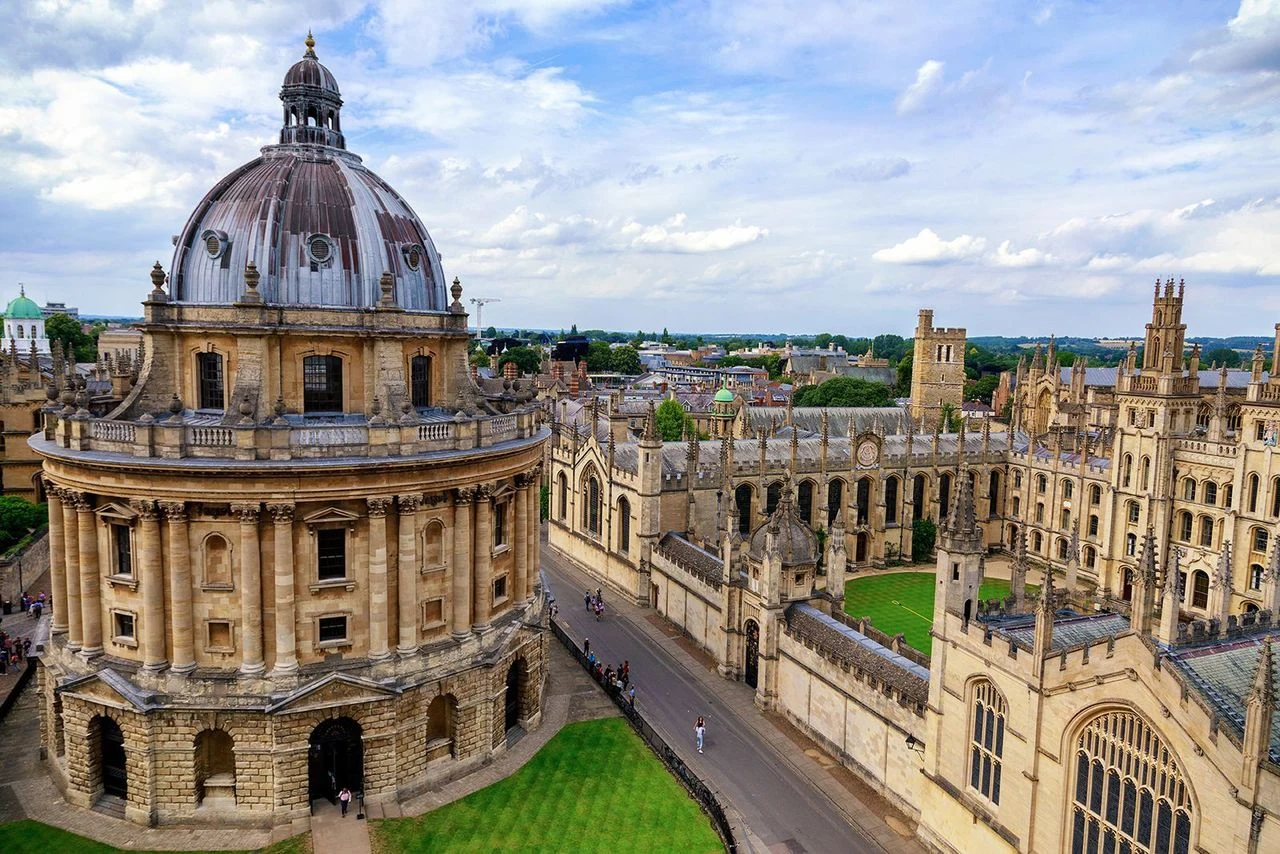
Oxford’s buildings and public spaces are similarly distributed. The Radcliffe Camera, the Sheldonian Theatre and the Examination Schools are among its recognisable university buildings, but colleges, departments and facilities are scattered across the city. The university also owns spaces used for research and recreation, including University Parks and Wytham Woods. Its work reaches beyond its buildings through research, teaching and publishing. Oxford University Press, which publishes works including the Oxford English Dictionary, connects the institution’s scholarship with readers around the world.
Public life, culture and influence
Oxford’s alumni have entered many fields, from science and literature to government and the arts. Its past students include Oscar Wilde, J. R. R. Tolkien, C. S. Lewis and Stephen Hawking. The university has also educated 31 prime ministers of the United Kingdom, among them Margaret Thatcher, Theresa May, Boris Johnson, David Cameron, Rishi Sunak and Keir Starmer. These connections make Oxford part of the history of British public life, while its international alumni and research collaborations give it a wider reach.
The university has also become a setting for stories. Philip Pullman’s His Dark Materials includes an alternative version of Oxford, while works such as Evelyn Waugh’s Brideshead Revisited and Colin Dexter’s Inspector Morse novels draw on the city and its institutions. Fiction does not explain the university’s history, but it demonstrates how its buildings, traditions and academic world have entered the public imagination.
Its influence also brings questions about access. Oxford has faced criticism over the representation of students from state schools and under-represented groups. The university has used outreach programmes to encourage applications, and the expansion of women’s education shows that access has changed substantially over time. Its history is therefore not only one of institutional continuity, but also of arguments over who can study there and how the university should respond.
Why The University of Oxford deserves a place in British Legacy
The University of Oxford deserves a place in British Legacy because its history illuminates how education in Britain has been organised, challenged and renewed. From teaching recorded in the 11th century to the development of colleges, departments and a national legal-deposit library, Oxford has built institutions that support learning across generations. Its tutorials, research collections, museums and publishing work show several ways scholarship can be taught, preserved and shared. These are concrete contributions, not simply symbols of prestige.
Oxford’s British connection is also visible in its effect on public life. Its alumni include writers, scientists and political leaders, among them 31 UK prime ministers, while its colleges and museums form part of the city’s civic and cultural fabric. Its record includes real change: women became full members in 1920, colleges gradually became coeducational, and scientific and medical subjects broadened the curriculum. That history can be considered alongside continuing debate about access. Taken together, Oxford’s institutional reach and its capacity for change make it a significant part of Britain’s educational and cultural story, with benefits that extend well beyond the university itself.
Sources
University of Oxford — revision 1379320952
Adapted in part from University of Oxford by Wikipedia contributors, under CC BY-SA 4.0. Text has been edited and combined with the existing article; this adapted text is shared under the same licence. Contributor history.