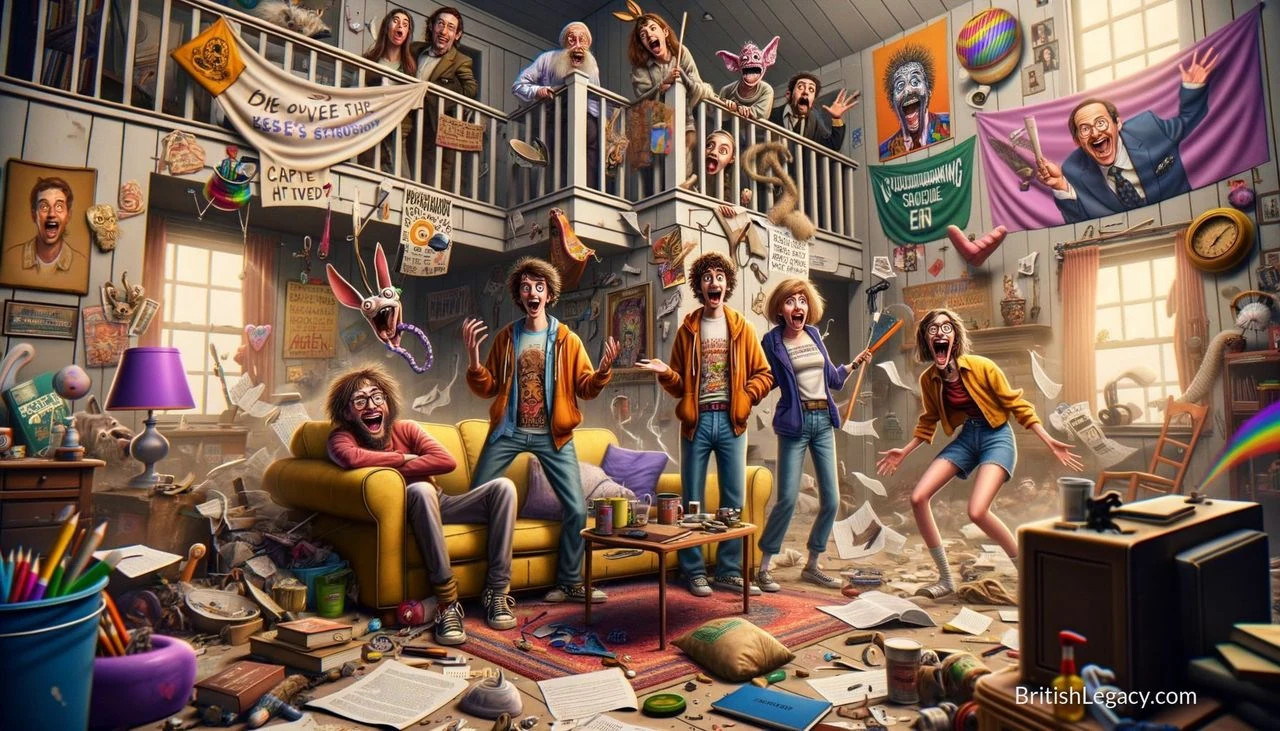
Four students share a squalid house, the furniture is under threat, and any attempt at an ordinary sitcom plot may be interrupted by a talking animal, a musical performance or a direct address to the audience. The Young Ones made disorder its method. First broadcast on BBC2 in 1982, the series combined farce and slapstick with surreal jokes and the attitudes of Britain’s emerging alternative-comedy scene. Across two series, it made an unlikely household a distinctive part of 1980s television.
A house built for comic conflict
The programme follows four undergraduate students living at the fictional 15 Credibility Street and studying at the fictional Scumbag College in London. Their differences drive the comedy. Rik, played by Rik Mayall, studies sociology or domestic sciences, depending on the episode, and loudly claims anarchist convictions. He is attention-seeking and hypocritical, a self-appointed radical whose opinions shift to suit him. Adrian Edmondson’s Vyvyan is a violent punk fan and medical student, prone to destruction and particularly hostile to Rik.
Nigel Planer plays Neil, a morose, pacifist-leaning Peace Studies student who often ends up doing the housework while the others blame him for mishaps. Christopher Ryan’s Mike is the well-dressed, unscrupulous “cool person”: a nominal leader who can profit at his housemates’ expense, but is also capable of keeping them calm when events get out of hand. Alexei Sayle appears as a range of supporting characters, including the students’ landlord, Jerzei Balowski, and members of his family.
The central four are not simply a set of stable comic types. Their arguments and alliances keep shifting, and the show repeatedly undermines its characters’ self-images. Rik’s declared politics sit awkwardly alongside his self-interest; Neil’s passive misery makes him a convenient target; and Mike’s confidence is as much a tool for getting his own way as a sign of competence. The house gives these clashing performances a common stage.
Alternative comedy meets television
Before the series, several of its principal performers had built an audience on London’s comedy-club circuit. Mayall and Edmondson performed together as 20th Century Coyote and later as the Dangerous Brothers; Planer worked in a double act, while Sayle became a prominent, forceful compere at the Comedy Store. When performers formed the Comic Strip in Soho, the group’s success helped bring them to the attention of Channel 4’s Jeremy Isaacs. Channel 4 launched The Comic Strip Presents... on its opening night, 2 November 1982. The BBC, in turn, developed The Young Ones.
Mayall wrote the sitcom with Lise Mayer and Ben Elton, with additional material from Sayle. Producer Paul Jackson was involved from the outset; a clash with Richardson led to Christopher Ryan replacing him in the cast. BBC2 broadcast the first episode on 9 November 1982, one week after Channel 4’s opening. The series ran for six episodes in 1982 and six in 1984, with the final episode broadcast on 19 June.
The programme mixed the familiar framework of a shared-house sitcom with sudden changes of comic register. Violent slapstick, surreal interruptions and lengthy cutaways could derail a plot rather than resolve it. Characters sometimes broke the fourth wall, turning to the audience or making a joke of the scene’s construction. Puppets, including talking animals and objects, added another layer of unreality. In the second series, flash frames mocked contemporary fears about subliminal messages in television and music.
Live music, larger ambitions
Music was built into the programme rather than added as a decorative extra. Eleven of the twelve episodes included a musical act; the remaining episode featured a lion tamer. Bands performed in or around the students’ house, among them Madness, Dexys Midnight Runners, Motörhead and the Damned. Other acts included Amazulu, Nine Below Zero, Rip Rig + Panic and John Otway. The performances connected the sitcom to contemporary music while helping it qualify for a larger BBC budget as a variety programme.
The series also travelled beyond its original British audience. In the United States, edited episodes began airing on MTV in 1985, making it the first non-music-related programme shown by the channel. It was broadcast in several other countries, including New Zealand, the Netherlands, Sweden and parts of Spain. Foreign-language versions and repeat screenings introduced the students’ particular brand of chaos to new audiences.
After the final episode
The show’s cast and comic world continued in other forms. In 1984, Planer, in character as Neil, released Neil’s Heavy Concept Album; its single, “Hole in My Shoe”, reached number two in the UK charts. In 1986, Mayall, Edmondson and Planer appeared in Filthy Rich & Catflap, written by Elton. The series also helped establish a pattern of television work shared by its performers: Mayall and Edmondson later made Bottom, while members of the cast appeared in other comedies, including Blackadder.
For Comic Relief, the four students recorded “Living Doll” with Cliff Richard and Hank Marvin in 1986. The reworking of Richard’s 1959 hit topped the charts in the UK, Australia and New Zealand. The programme itself was revived through repeats and home-video releases, though music-rights issues meant some releases initially omitted performances or other material. The 2007 DVD edition restored the musical acts. The series also appeared on BBC iPlayer in 2022, in edited versions originally prepared for 1990s repeats.
Its afterlife included a 1986 video game in which players tried to get a character’s belongings out of the shared house. More significantly, the series became a reference point for later television comedy. Its influence is often discussed alongside shows such as Blackadder, Absolutely Fabulous, The League of Gentlemen and Peep Show; that comparison describes a continuing appetite for comic forms that depart from the conventional sitcom, rather than a claim that all those programmes share the same style.
Why The Young Ones deserves a place in British Legacy
The Young Ones deserves a place in British Legacy because it brought a distinctly alternative comic sensibility into mainstream British television. Its performers had developed their work on London’s comedy circuit, and the series carried that energy to BBC2 without smoothing away the roughness: the slapstick could be startling, the plot deliberately unstable, and the characters’ political posturing an object of ridicule as much as a point of view. Mayall, Mayer and Elton’s writing, with additional material from Sayle, helped make a shared student house the setting for jokes about youth, class, politics and the everyday frictions of communal life.
The programme’s legacy also lies in its willingness to make television form part of the joke. Direct addresses, abrupt cutaways, puppets and live music disrupted the usual rhythm of a sitcom, while the mix of comedy and bands connected the programme to contemporary popular culture. Its appearance on MTV in the United States extended that British television experiment abroad, and its performers continued to shape British comedy through later series and collaborations. Remembering The Young Ones is not a matter of calling every element unprecedented; it is recognising how a particular group of writers and performers made an unruly, formally inventive comedy work for a national broadcaster, and left an enduring example of what a sitcom could attempt.
Sources
The Young Ones (TV series), revision 1377874342 · The Young Ones (TV series)
Adapted in part from The Young Ones (TV series) by Wikipedia contributors, under CC BY-SA 4.0. Text has been edited and combined with the existing article; this adapted text is shared under the same licence. Contributor history.