
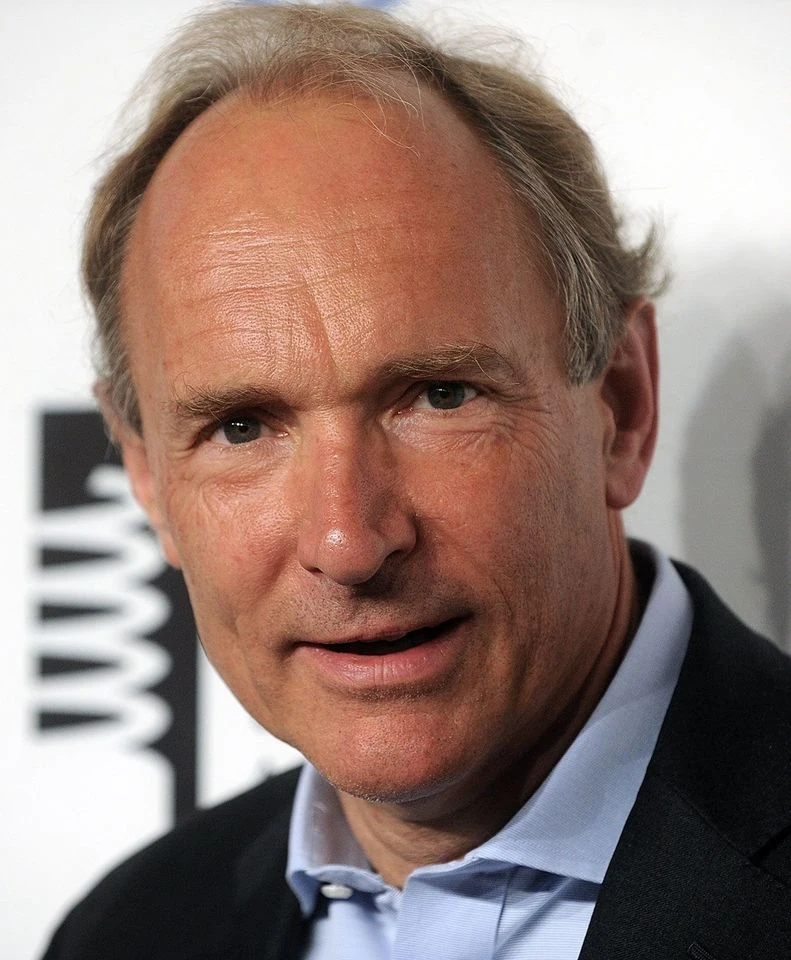
When Tim Berners-Lee appeared at the London 2012 Olympic opening ceremony and typed “This is for everyone”, the words summed up the ambition behind his best-known work. Berners-Lee did not invent the internet. He created the World Wide Web: a way to publish, link and retrieve information across that existing network. Its practical effect was to make networked information far easier to use, and to give people beyond scientific and technical circles a means to publish as well as read. The distinction between internet and web matters. One is the network; the other is a system for finding and sharing information on it.
Born in London in 1955 and educated at Oxford, Berners-Lee developed the web while working at CERN, the European particle-physics laboratory. His contribution combined existing ideas rather than beginning from scratch: hypertext, computer networks and a set of shared technical rules became a system that could operate across different machines. He also helped establish the web as an open resource rather than a product dependent on a single owner. His later British work on public data and his continuing involvement in web standards and governance extend that original concern: how to make information accessible and useful to others.
A family close to computing
Berners-Lee was born in London on 8 June 1955. His parents, Mary Lee Woods and Conway Berners-Lee, were mathematicians and computer scientists who both worked on the Ferranti Mark 1, an early commercially built computer. The family connection offers context for his later interests, but it does not make his own achievement a foregone conclusion. At school he developed a practical interest in electronics, including by tinkering with a model railway.
He attended The Queen’s College, Oxford, where he took a first-class degree in physics in 1976. As an undergraduate he built a computer from an old television set bought from a repair shop. It was a small project, but it reflects a useful thread in his career: rather than treating computers as mysterious finished machines, he experimented with how their parts and systems might be put to work.
After Oxford, Berners-Lee worked as an engineer at Plessey in Poole, Dorset. In 1978 he joined D. G. Nash in Ferndown, where he helped create typesetting software for printers. He then worked at John Poole’s Image Computer Systems in Bournemouth, running its technical side for three years and working on a real-time remote procedure call. These roles gave him experience with software, information and computer networking before his most influential work began.
Berners-Lee first worked at CERN as an independent contractor from June to December 1980. There he proposed a hypertext-based project to help researchers share and update information, and built a prototype called ENQUIRE. The system connected related pieces of knowledge. It was an early experiment in making information navigable, though not yet the World Wide Web. After leaving CERN, he returned to Image Computer Systems; in 1984 he went back to CERN as a fellow.
The information problem at CERN
CERN brought together researchers and staff working across many teams and computer systems. Information could be spread among different documents and machines, making it hard to discover what already existed or how one item related to another. Berners-Lee saw an opportunity to join hypertext—the practice of linking text to other documents—with the internet. His proposal was not to build a new network, but to create a common way to use the one already there.
On 12 March 1989, he put forward an information-management proposal based on hypertext. His manager, Mike Sendall, accepted the work, describing the proposals as “vague, but exciting”. In 1990 Berners-Lee redistributed the proposal and developed the project with CERN colleague Robert Cailliau, who had independently proposed a hypertext system. They set about making a web browser and server, building on ideas that already existed rather than claiming that every element was entirely new.
The first browser also functioned as an editor. Berners-Lee created the first web server, CERN httpd, and published the first website on 20 December 1990. It described the World Wide Web itself and explained how people could use a browser, set up a server and create a website. The project’s first public-facing material was therefore practical documentation: an account of the system and an invitation to participate. On 6 August 1991, Berners-Lee posted a public invitation to collaborate with the project on Usenet.
The web’s architecture made that participation possible. A URL gives a resource an address; HTTP provides a method for requesting and transferring information; and HTML structures web documents, including links to other pages. Together, these components allow a document on one computer to refer to another resource and for software elsewhere to retrieve it using shared conventions. The importance lies not in any one acronym but in the way the components work together.
That combination made the internet more legible to ordinary users. Before the web, networked information could require specialist commands or familiarity with separate services. The web offered a common way to address documents, request them and move between them through links. The underlying rules were technical, but their effect was straightforward: people could publish and read information without needing to build a separate system for every collection of documents.
Berners-Lee did not create hypertext or the internet. His achievement was to connect those ideas into a usable, general-purpose publishing system. The ACM’s citation for his 2016 Turing Award recognised his invention of the World Wide Web, the first web browser, and the fundamental protocols and algorithms that allowed it to scale. The award’s account underscores the difference between an idea and an infrastructure: a system has to work beyond its original laboratory if it is to become widely useful.
Keeping the web open
The web’s spread depended not only on its design but also on the terms on which others could use it. Berners-Lee made his idea freely available, without a patent or royalties due for its use. The World Wide Web Consortium, or W3C, was founded in 1994 at the Massachusetts Institute of Technology. Its work brought organisations together to develop standards and recommendations for the web. A shared standards process helps different systems work together, rather than forcing users and developers into incompatible versions controlled by separate organisations.
That openness was not an incidental detail. If access to the web’s foundations had depended on a single commercial owner, participation could have been narrower and more conditional. Instead, the web could be adopted by institutions and individuals beyond CERN. Berners-Lee’s role in making the system freely available and founding the W3C joined invention to stewardship: the work did not stop when the first browser and server functioned.
The reach of the web quickly exceeded its original scientific setting. People used it to publish and find information, and organisations adopted it for communication and services. Its everyday uses now range across education, research, commerce, public information and personal communication. That breadth is part of the achievement, but it also means the design and governance of the web have consequences beyond engineering. Questions about access, trust and who controls information become questions about the society that uses it.
Berners-Lee has continued to argue about those consequences. In 2009 he co-founded the World Wide Web Foundation. In November 2019, the foundation launched the Contract for the Web, an initiative calling on governments, companies and citizens to commit to principles intended to address misuse and protect the web’s potential. These efforts extend his concern from making a system work to considering the conditions under which it can serve people well.
His position has not been limited to celebrating the web’s growth. He has spoken in favour of net neutrality, arguing that internet service providers should not control or monitor customers’ browsing without consent. He has also raised concerns about interference with or surveillance of internet traffic. Such arguments reflect an ongoing tension: a common network can enable wide participation, but that possibility can be weakened if access or activity is controlled in ways users cannot influence.
In 2018 he announced Inrupt, an open-source start-up intended to support a commercial ecosystem around the Solid project. Solid aims to give people more control over their personal data, including where it is stored and which applications may access it. The project approaches a familiar problem from another angle. If the web made it easier to connect documents and systems, how might people retain greater control over information about themselves as applications use it?
Open data and British public life
Berners-Lee’s work in Britain has applied the logic of accessible, reusable information to public administration. In 2010 he created data.gov.uk alongside computer scientist Nigel Shadbolt. The initiative formed part of a wider effort to make government information available for public use. That is not the same as saying that all information should be released without qualification. It does, however, reflect the idea that data can have wider value when people can find and reuse it.
In the same period, Berners-Lee served on the government’s Transparency Board. In 2012 he and Shadbolt co-founded the Open Data Institute (ODI) in London. The ODI works to support the use of open data, including through standards, skills and responsible practice. These efforts connect his British public work to the original web project: in both cases, information becomes more useful when it can be discovered and used across organisational boundaries.
Open data also raises questions of trust and stewardship. Publishing information does not automatically make it understandable, safe or useful. Institutions must consider how data is organised, what can responsibly be shared and how others may rely on it. Berners-Lee’s later work therefore extends beyond a simple call for unrestricted publication. It addresses how public information can support transparency and innovation while remaining responsibly managed.
His institutional roles have kept that work connected to research and practice. The University of Oxford lists him as a professorial research fellow in its Department of Computer Science; the ODI identifies him as its president and co-founder. His career has thus moved between technical invention, standards-setting and public policy, with information-sharing as a recurring concern.
Recognition and continuing work
Berners-Lee was elected a Fellow of the Royal Society in 2001 and knighted by Queen Elizabeth II in 2004 for services to the global development of the internet. In 2007 he was appointed to the Order of Merit. The 2013 Queen Elizabeth Prize for Engineering and the 2016 ACM A.M. Turing Award recognised the significance of his work. The Turing Award citation specified the web, the first browser and the protocols and algorithms that allowed the system to scale.
In 2012, he appeared at the London Olympic opening ceremony, where the words “This is for everyone” were displayed after he typed them on a computer. It was a concise public expression of the web’s founding promise, not a claim that its benefits had been evenly realised or that its problems had been solved. His later advocacy for more responsible governance makes clear that openness is a continuing aim rather than a condition guaranteed by the original invention.
Berners-Lee’s influence is sometimes compressed into the label “inventor of the web”. The label is deserved, but it can obscure the detail: he proposed a system, built a browser and server, developed a way of addressing and exchanging documents, and helped create institutions to maintain shared standards. His importance lies in the connected work as much as in the initial idea.
Why Tim Berners-Lee deserves a place in British Legacy
Tim Berners-Lee deserves a place in British Legacy because a British-born computer scientist working at CERN helped make the internet usable as a worldwide publishing space. His invention was not the internet itself, and it was not a single machine. It was a practical architecture: addresses for resources, a protocol for requesting them and a format for documents that could link to one another. By combining those elements with a browser and server, Berners-Lee helped make it possible for people and organisations to publish information for readers far beyond their own computer systems. The web’s everyday reach—from research and education to commerce and public information—rests on that achievement.
His contribution also includes the decisions and institutions that helped other people build on the invention. Making the web freely available without patent royalties and founding the W3C supported shared standards and wider participation. In Britain, his work with Nigel Shadbolt on data.gov.uk, his service on the Transparency Board and the founding of the Open Data Institute carried the same interest into public life: enabling information to be found and reused, while attending to responsible practice. His work on the Web Foundation, the Contract for the Web and Solid shows that he has continued to examine the risks and obligations that accompany digital systems. The British connection is specific: London birth and Oxford education, recognition by British institutions, and sustained work on British public data. His legacy is not simply that he helped create a medium used around the world. It is also his continuing argument that its rules and institutions should make meaningful participation possible.
Sources
Tim Berners-Lee — Wikipedia, revision 1374890625 · Tim Berners-Lee — Wikipedia
Adapted in part from Tim Berners-Lee by Wikipedia contributors, under CC BY-SA 4.0. Text has been edited and combined with the existing article; this adapted text is shared under the same licence. Contributor history.

.jpg)