A promised excursion to a lighthouse gives Virginia Woolf’s To the Lighthouse its outward destination. The novel’s deeper movement is through the minds of the Ramsay family and the years that alter their lives. Published in 1927, it replaces a conventional sequence of action with shifting perceptions, domestic tensions and a striking leap through time. Its three parts make the passing years part of the form as well as the subject.
A holiday on the Isle of Skye
The novel centres on the Ramsays and their eight children at a summer home on the Isle of Skye in Scotland. In “The Window”, six-year-old James hopes to visit the nearby lighthouse. Mrs Ramsay encourages him to expect the trip; Mr Ramsay, convinced the weather will not allow it, says it will not happen. The disagreement is small in practical terms, but it exposes the tensions between husband and wife and between father and son that the novel revisits.
The household includes friends and colleagues, among them Lily Briscoe, a young painter trying to make a portrait of Mrs Ramsay and James. Lily’s artistic uncertainty is sharpened by Charles Tansley, who insists that women can neither paint nor write. Her attempt to find a form for what she sees runs alongside the family’s unsettled relationships. The book also gives attention to the everyday pressures of the holiday: at a dinner party, Mrs Ramsay is discomposed when Paul Rayley and Minta Doyle arrive late after Minta loses her grandmother’s brooch on the beach.
Woolf makes the expected crossing matter before it takes place. The lighthouse is a real destination, but it also gathers hope, frustration and competing interpretations. The novel’s drama lies less in a chain of external events than in the changing thoughts and impressions through which its characters experience one another.
Three parts, and a decade between them
“The Window” establishes the family and its guests. “Time Passes” then carries the reader across ten years, during which the First World War begins and ends. The Ramsays’ summer home stands empty for much of this interval. Mrs Ramsay dies; Prue dies from complications of childbirth; and Andrew is killed in the war. These deaths are reported with a restraint that contrasts with their immense consequences for those left behind.
The house itself becomes a measure of change. Mrs McNab, who has worked for the family, appears in the section as the neglected building and its memories are brought back into view. The novel moves beyond the busy household of the opening, showing how time passes in the family’s absence as well as in its presence. Mr Ramsay, deprived of the praise and comfort he sought from his wife, is left to contend with fear and uncertainty about the worth and endurance of his philosophical work.
In “The Lighthouse”, some of the surviving family and guests return. Mr Ramsay sets out at last with James and Cam, accompanied by the sailor Macalister and his son. The children are reluctant, but the journey changes as James keeps the boat steady and receives praise from his father rather than the rebuke he expects. Cam, too, moves from resentment towards a more admiring view of him. The crossing is not a simple resolution of every strain; it is a moment of altered understanding within a relationship shaped by years of feeling.
How Woolf makes thought the action
The novel’s shifting perspective allows readers to encounter events through different characters’ consciousnesses, sometimes moving from one viewpoint to another within a sentence. Dialogue and direct action are comparatively sparse. Woolf instead follows impressions, memories and judgements as they arise, so that an ordinary family scene can contain sharply different versions of the same moment.
This method is often described as stream of consciousness, though the novel’s narration is not simply a transcription of fragmented thought. Its voice moves fluidly among its characters, drawing out the way perception changes with mood and relationship. The reader has to form an understanding from those shifts, including descriptions that may be ambiguous or at odds with one another. The effect is to make knowing another person both necessary and uncertain.
“Time Passes” changes the perspective again. Rather than organising the section around one character’s consciousness, Woolf uses a more displaced narrative voice to register the house and the years around it. Major deaths arrive parenthetically, while the building’s emptiness and gradual deterioration occupy the foreground. The contrast makes the section’s formal experiment inseparable from its subject: time continues whether or not the family is there to witness it.
Lily’s painting gives the novel another way to examine perception and creative work. She returns to the picture she began in the first part, carrying her memories of Mrs and Mr Ramsay into the act of completing it. As the sailing party reaches the lighthouse, Lily finishes the painting and recognises that realising her vision matters more to her than securing a legacy. Woolf’s account of the artist’s work is thus not a decorative parallel to the family story; it is one of the novel’s central enquiries into how experience can be shaped into art.
Family memory and the novel’s origins
Woolf drew on memories of her own family’s summers in Cornwall. Her father, Leslie Stephen, rented Talland House in St Ives from 1882, and the family used it as a summer retreat for about ten years. The novel’s house is on Skye, but Woolf formed it in imitation of Talland House; features of St Ives Bay, including its gardens, sea and lighthouse, also informed the imaginative landscape. This distinction matters: the story is not set in Cornwall, even though Cornwall supplied important material for it.
The family history behind the novel adds another dimension to its treatment of loss. Woolf’s mother died when Virginia was thirteen, and her father fell into gloom afterwards. Her sister Vanessa Bell later wrote that reading the passages about Mrs Ramsay was like seeing their mother raised from the dead. The family resemblance is not a one-to-one account of real people: Woolf transforms recollection through fiction, perspective and the figure of Lily, whose struggle to paint also explores the author’s own creative process and that of her painter sister.
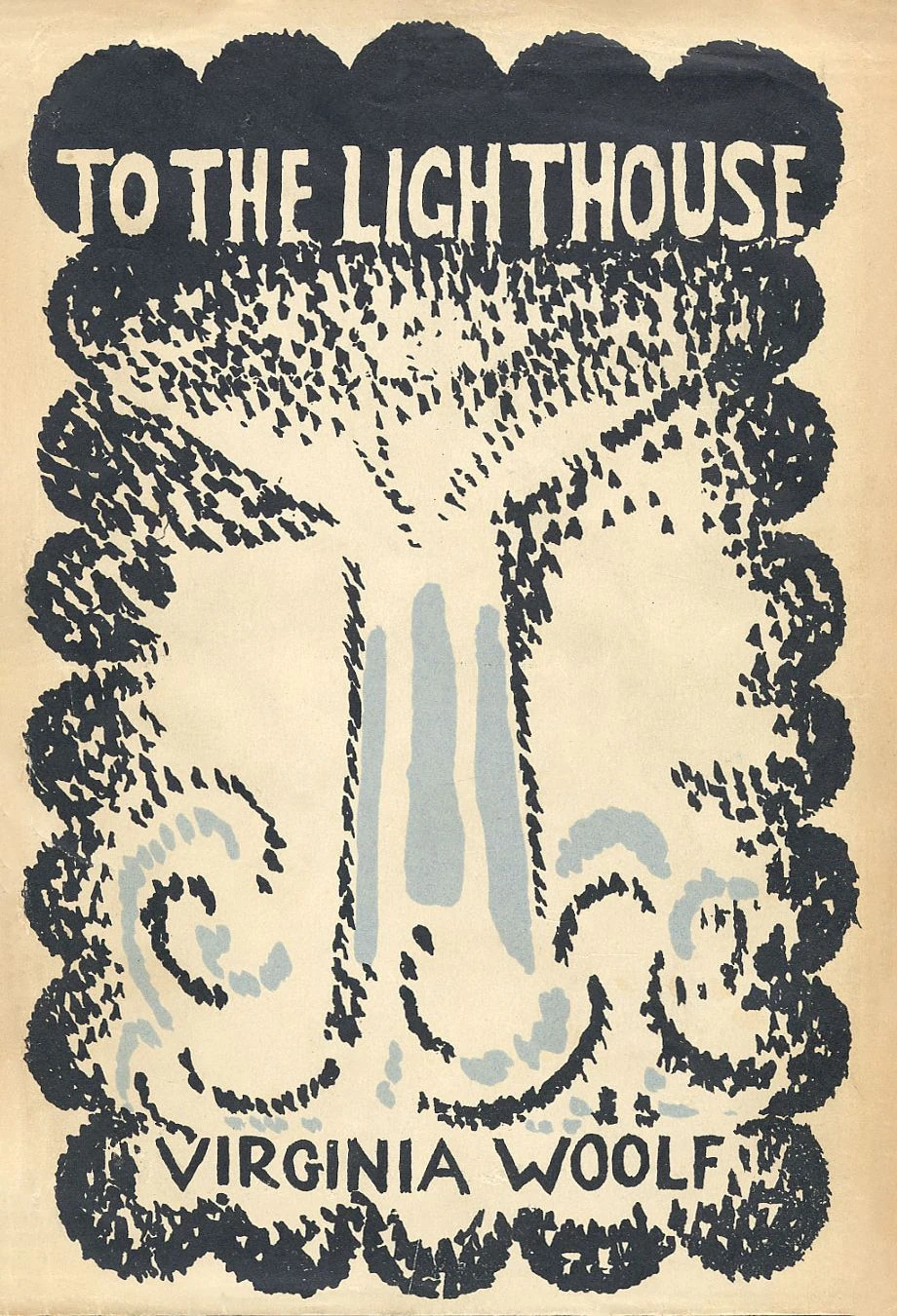
The book appeared in May 1927 through the Hogarth Press, the independent publishing house owned by Virginia and Leonard Woolf. Its first British edition had a dust jacket designed by Vanessa Bell. The novel was followed by Woolf’s Orlando: A Biography. Its early success helped Woolf buy a car, and in 1928 it led to her receiving the Prix Femina–Vie Heureuse. These details place the work not only within a literary experiment but also within the family’s publishing and artistic life.
Reception and afterlife
To the Lighthouse received critical acclaim and commercial success on publication, consolidating Woolf’s standing as a major modernist writer. Its importance rests in the combination of formal invention and intimate subject matter: the organisation of the novel makes time, perception and absence felt through the lives of a family, rather than treating them as abstract themes.
The novel has continued to be recognised in later assessments of English-language fiction. The Modern Library placed it fifteenth on its 1998 list of the 100 best English-language novels of the twentieth century; Time included it among its 100 best English-language novels since 1923 in 2005. It has also been adapted for television, radio and opera, including a 1983 telefilm, a BBC Radio 4 audio drama in 2000, and operatic versions in 2017 and 2020. The range of adaptations reflects the book’s capacity to invite new interpretations, although its most distinctive effects remain rooted in Woolf’s handling of narration and thought.
Why To the Lighthouse deserves a place in British Legacy
To the Lighthouse deserves a place in British Legacy because it is a defining example of British modernist fiction that changed what a novel could make central. Woolf places little emphasis on plot as a succession of dramatic events. Instead, she builds the book from perception: the hopes attached to a family outing, the frictions of domestic life, the impressions people form of one another and the memories that survive loss. The three-part structure gives those concerns a precise shape, moving from the Ramsays’ summer household through a decade marked by war and death to the eventual crossing. In “Time Passes”, the empty house becomes a way of registering history without turning it into spectacle.
The novel’s British connection is concrete as well as literary. Woolf published it through the Hogarth Press, the independent press she and Leonard Woolf owned, with a cover by her sister Vanessa Bell. Its imagined house on Skye was shaped by family summers at Talland House in St Ives, bringing places in Scotland and Cornwall into a single work without confusing the story’s setting. The book also connects literature with painting through Lily Briscoe’s effort to complete her picture, and with the practical world of publishing through the Woolfs’ press. Its lasting value lies in showing how formal innovation can illuminate recognisable human experiences: the difficulty of understanding others, the instability of memory, bereavement and the effort to make art from life. Those achievements make it a substantial part of Britain’s literary inheritance.
Readers can find editions through booksellers; the original article supplied an Amazon listing, which is included here as a supplied link, not as an endorsement or a checked statement about current availability.
Sources
To the Lighthouse — Wikipedia, revision 1373690167
Adapted in part from To the Lighthouse by Wikipedia contributors, under CC BY-SA 4.0. Text has been edited and combined with the existing article; this adapted text is shared under the same licence. Contributor history.