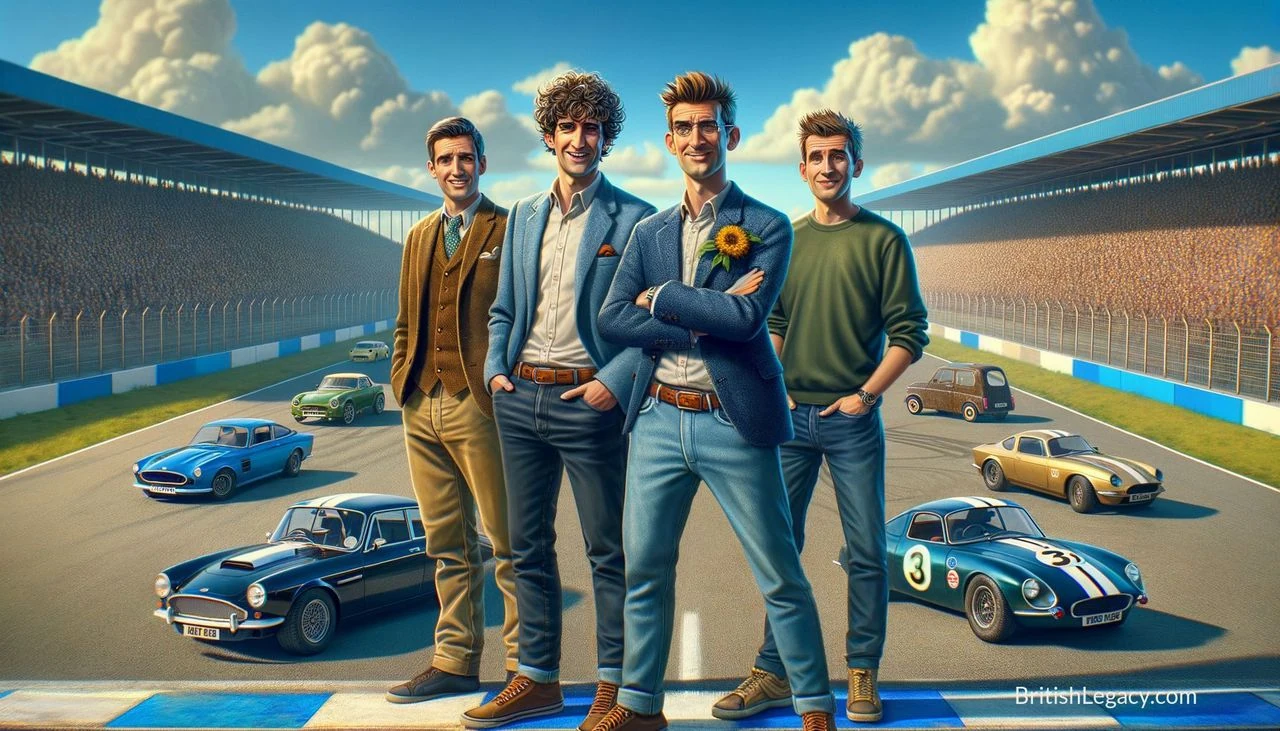
When the BBC revived Top Gear in 2002, it kept the subject—cars—but changed the shape of the programme. Road tests sat alongside timed laps, celebrity drives, races and challenges built around cheap second-hand vehicles. The result was a motoring magazine show that made its presenters’ arguments and comic misadventures part of the format. Its international reach grew, but so did disputes over the line between provocation and offence. The programme’s history is therefore one of reinvention, popularity and controversy, not simply a succession of entertaining road trips.
A revival with a new engine
The 2002 series was a revival of the BBC’s original Top Gear, which ran from 1977 to 2001. After the BBC cancelled that format in December 2001, presenter Jeremy Clarkson and producer Andy Wilman developed a proposal for a new version. Rather than concentrating on conventional car reviews, they pitched a studio-based programme that could connect reviews with films from Britain and abroad, timed laps and celebrity guests. The BBC approved the idea, in part to compete with Channel 5’s new motoring programme, Fifth Gear.
Production began in 2002 at Dunsfold Aerodrome in Surrey. An aircraft hangar became the studio; the site’s runways and taxiways provided space for filming, and Lotus helped design a test circuit. The first series, broadcast from 20 October, was presented by Clarkson, Richard Hammond and Jason Dawe, alongside the anonymous test driver known as the Stig. James May replaced Dawe after that first series. The programme’s later association with Clarkson, Hammond and May should not obscure this earlier line-up or May’s arrival in 2003.
The anonymous driver solved a practical production problem: Clarkson and Wilman had struggled to find a racing driver comfortable speaking on camera. They decided the test driver should remain silent and concealed. Racing driver Perry McCarthy was among those considered for the role, and his input helped Wilman settle on the name “the Stig”. The device gave the show a recurring presence without adding another conventional presenter.
Cars tested, and television made of the tests
Reviews remained central, but the new programme treated them as material for television rather than as isolated road tests. A car might be assessed for ride, handling, speed or practicality, then put through an unusual test designed to make a point about one of those qualities. In a two-part film in the third series, Clarkson and May subjected a Toyota Hilux to a succession of destructive trials to see whether it would keep running. Other segments turned car comparisons into challenges: presenters might buy vehicles to a shared budget, build a vehicle for a set purpose or race cars against other forms of transport.
Recurring features gave viewers a recognisable framework. In “Power Laps”, the Stig drove cars around the test track against the clock. “Star in a Reasonably Priced Car” invited a celebrity to set a lap time and talk about their motoring history. “The Cool Wall” turned judgements about cars into a studio argument, sorting them from “Seriously Uncool” to “Sub Zero”. Its rules were deliberately subjective: producer Andy Wilman said that the categories did not necessarily measure a car’s quality. The segment’s comic disagreement was part of the point.
The presenters also took on longer films and specials, often travelling in second-hand vehicles under a fixed budget. The format could stretch to a feature-length road trip, a race between a car and public transport, or a challenge in which the presenters had to work together. The programme’s own account of its appeal was not only about what a vehicle could do, but what could be made of it on screen. The trio’s contrasting styles—Clarkson’s brashness, Hammond’s energy and May’s measured manner—helped turn that approach into a recognisable ensemble performance.
Reach, rewards and a contested reputation
As the show’s audience grew, so did its life beyond the weekly broadcast. Top Gear Live, a touring stage version, began in London in 2008 and went on to visit other countries. The programme’s popularity also led to international adaptations, merchandising and repeat broadcasts. It was broadcast in 214 territories by the end of 2014, according to the article’s coverage of its international distribution. In November 2005 it won an International Emmy in the Non-Scripted Entertainment category; it also won the National Television Award for Most Popular Factual Programme in 2006, 2007, 2008 and 2011.
Success did not remove criticism. Some viewers objected to the increasing reliance on stunts and what they considered forced humour. Other complaints concerned remarks by presenters. Ofcom found that the Burma special breached broadcasting rules after a remark using “slope”, considered offensive in reference to an Asian person. Clarkson was also criticised over an unaired take in which he recited a racist version of a children’s rhyme; after an unbroadcast clip emerged, he apologised. The programme’s ability to provoke attention was inseparable from the question of who bore the cost of its jokes.
The final series with Clarkson, Hammond and May followed a period of controversy. In March 2015, the BBC suspended production while investigating an allegation that Clarkson had verbally and physically abused producer Oisin Tymon. The BBC terminated Clarkson’s contract later that month. Hammond and May, and executive producer Wilman, then left the programme. The trio’s final films for the BBC were broadcast as a special in June 2015; they went on to make The Grand Tour for Amazon, which began in 2016.
The BBC continued with new presenters. Chris Evans and Matt LeBlanc led the 2016 series, but Evans resigned after its broadcast. LeBlanc later presented with Chris Harris and Rory Reid; from 2019, Harris was joined by Paddy McGuinness and Freddie Flintoff. The programme moved from BBC Two to BBC One in 2020. Filming and presentation changed during the Covid-19 pandemic, including outdoor studio segments and the dropping of the celebrity lap feature.
Production was halted after Flintoff was seriously injured in an accident while filming at Dunsfold in December 2022. In November 2023, the BBC said the programme would not return for the foreseeable future. In August 2026, the BBC announced that a new series was in development, without confirming its presenters or whether it would be a reboot or continuation. That announcement marked a possibility, not a completed return.
Why Top Gear deserves a place in British Legacy
Top Gear deserves a place in British Legacy because the 2002 revival showed how a familiar subject could be reshaped for television. It retained car reviews but joined them to a studio, a purpose-built test track, timed laps, celebrity drives and challenges. That combination made automotive journalism accessible as entertainment without relying on reviews alone. Its distinctive format was sufficiently durable to survive major changes in presenters, move between BBC channels, inspire international versions and support a live touring show. Those are concrete measures of the programme’s reach, rather than a claim that every viewer or critic approved of it.
The legacy is also more complicated than the export of a successful format. The show’s use of humour and provocation brought complaints, a broadcasting ruling and sustained scrutiny of what its jokes communicated. Its 2015 presenter change followed a serious dispute during production, and Flintoff’s 2022 accident led to the suspension of filming and the BBC’s announcement that the programme would not return for the foreseeable future. Including those events matters: British television’s cultural influence carries responsibilities as well as commercial and creative rewards. Top Gear remains a significant example of British factual entertainment precisely because its reinvention, international success and contested methods belong to the same history.
Sources
Top Gear (2002 TV series), revision 1373187077
Adapted in part from Top Gear (2002 TV series) by Wikipedia contributors, under CC BY-SA 4.0. Text has been edited and combined with the existing article; this adapted text is shared under the same licence. Contributor history.