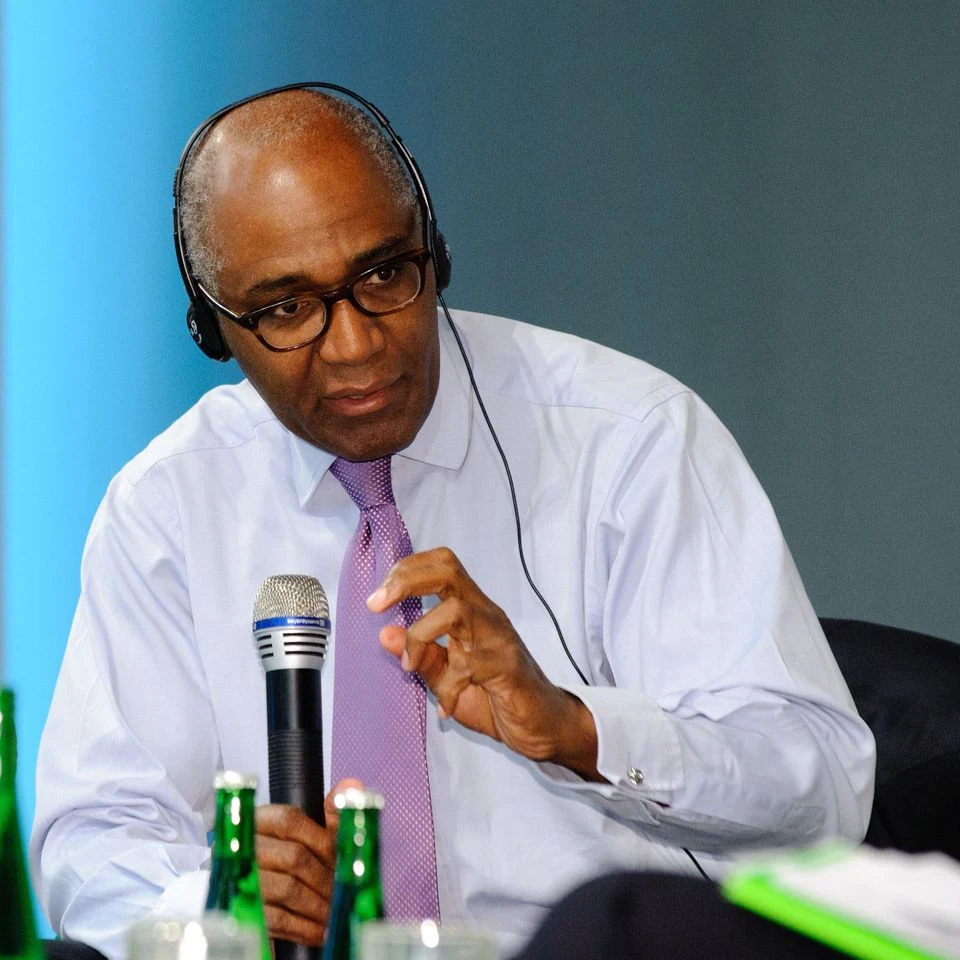
Trevor Phillips’s career has crossed television, student politics, London government and the leadership of Britain’s equality commissions. As a broadcaster, he helped bring the Windrush story to a wide audience. As a public official, he led the Commission for Racial Equality and became the first chair of its successor, the Equality and Human Rights Commission. He has also been a contentious voice in arguments about integration, multiculturalism and liberty. That combination of institution-building and public dispute makes his career a revealing part of Britain’s recent history.
A childhood between London and Georgetown
Mark Trevor Phillips was born in Islington on 31 December 1953, the youngest of ten children. His parents had emigrated from British Guiana, now Guyana, to Britain in 1950. His childhood was divided between north London and Georgetown, connecting his family’s experience of migration with the society in which he was growing up. Phillips attended Wood Green County Grammar School, then took his A-levels at Queen’s College in Georgetown before returning to England.
He studied chemistry at Imperial College London and graduated in 1975. The degree preceded a working life more often associated with journalism and politics than science, but his education sat alongside an early commitment to public debate. At Imperial he became president of the students’ union. In 1978 he was elected president of the National Union of Students, serving until 1980 and becoming its first Black president. The role gave him experience in representation and leadership within national institutions well before he became a familiar face on television.
That early record also helps explain the range of his later work. Phillips did not move directly from university into elected national politics. Instead, he developed a career across broadcasting, civic organisations and local government, taking different routes into questions of how British society works and who gets to shape it.
Broadcasting Britain’s changing story
Phillips began in television as a researcher at London Weekend Television. He later became the broadcaster’s head of current affairs, a post he held from 1992 to 1994, and produced and presented The London Programme. That work put him in a position to examine the capital as a place shaped by politics and social change, rather than simply as a setting for national news. It also established the broadcast experience he would carry into public office.
He went on to co-found Pepper Productions, an independent television production company, and worked on programmes for the BBC and Channel 4. With his brother, the writer Mike Phillips, he made television work about the Windrush generation and co-wrote Windrush: The Irresistible Rise of Multi-racial Britain. The subject was the post-war Caribbean migration that became part of modern British life. Phillips’s work on Windrush placed that history before a broad audience, making it harder to treat Caribbean migration as a footnote to the national story. The Windrush documentary won the Royal Television Society’s Documentary Series of the Year award in 1999, one of three RTS awards he received.
Phillips continued to make television after taking on political and institutional roles. In 2015 he wrote and presented Channel 4’s Things We Won’t Say About Race (That Are True), a feature-length documentary produced by Pepper Productions and Outline Productions. The programme used research and survey findings to examine race in Britain. A year later, he presented What British Muslims Really Think, which also prompted debate about how statistics should be interpreted and what conclusions can be drawn from them. His work as a broadcaster has therefore been both documentary and argumentative: he has used television to make subjects visible, and to contest the terms in which they are discussed.
London politics and the road to the CRE
Phillips’s public roles extended beyond broadcasting. He chaired the Runnymede Trust from 1993 to 1998, contributing to an organisation focused on ethnic equality. In 1996 he initiated and sat on the Trust’s Commission on British Muslims and Islamophobia. Its report examined anti-Muslim prejudice and helped establish the term “Islamophobia” in British public debate. Phillips later said the commission had recognised the existence of anti-Muslim abuse but had got much else wrong. That later criticism of the report is an important part of his record, as well as evidence of how his public position developed.
He also became involved in London politics. Phillips was elected to the London Assembly in 2000 and chaired it from 2000 to 2001, and again from 2002 until February 2003. Before his Assembly career, he had sought to become Labour’s candidate in the 2000 mayoral election. He withdrew from that selection contest and instead became the running mate of Labour candidate Frank Dobson. Ken Livingstone ran as an independent and won the mayoral election; Phillips entered the Assembly as one of Labour’s additional members.
In January 2003 the Home Secretary announced Phillips’s appointment as chair of the Commission for Racial Equality. He resigned from the Assembly to take up the role. The CRE was a statutory body concerned with racial discrimination and equality. Phillips arrived with experience of television, campaigning and London government, as well as a record of speaking publicly about race. His time at the commission brought him into a more direct position of responsibility for a national equality institution.
Leading a new equality commission
The Equality and Human Rights Commission was formed from the Commission for Racial Equality, the Disability Rights Commission and the Equal Opportunities Commission, with a remit extending beyond race. Phillips became chair of the new body in 2006, before it opened its doors in 2007. Its work covered discrimination and equality across grounds including age, disability, sex, race, religion and belief, sexual orientation and gender reassignment, as well as human rights. The change brought several areas of equality work into a single national institution.
Phillips led the EHRC until September 2012. The organisation’s breadth meant that its chair had to speak about more than the racial discrimination on which the CRE had focused. It also put Phillips at the centre of debates about how different rights and equality concerns could be addressed by a public body. His tenure was contested, and the commission experienced internal dissent. The available account records that six commissioners departed after expressing concerns about his leadership and probity; it also records that he completed his term. Those disputes belong in an account of his time in office, alongside the scale and significance of the institutional transition.
In 2008, while chair of the EHRC, Phillips opposed proposals to allow detention without charge for up to 42 days. He said he remained unpersuaded that the government had provided compelling evidence for a measure that, in the commission’s legal advice, would suspend some human rights. He raised the possibility of a legal challenge. The proposed extension was not enacted: the Brown government retained a 28-day limit, which was later reduced. This episode shows that his public interventions were not confined to cultural arguments about identity. He also used his position to question a proposed expansion of state powers.
Integration, disagreement and the costs of argument
Phillips became especially prominent for arguing that a diverse society needed integration and shared civic expectations, not only anti-discrimination law or public celebration of difference. He criticised forms of multiculturalism that he believed could leave communities living separately, without enough contact or common ground. In 2006 he warned that Britain might “sleepwalk towards segregation”. His language made him a conspicuous critic of the government’s approach to multiculturalism and ensured that his views became part of a wider debate about cohesion and belonging.
These positions were controversial. Phillips apologised for his presentation of research by Australian academic Michael Poulsen about segregation. His warnings and claims about community relations were challenged, and his arguments did not settle the questions they raised. But his career cannot be reduced to a single position on multiculturalism. The Runnymede commission he had helped establish had examined anti-Muslim prejudice; years later, he criticised parts of its analysis. In 2016, discussing the findings of What British Muslims Really Think, he said the commission had been right about incidents of abuse against British Muslims but wrong about much else. The change in view matters because it shows the distance between his earlier work and his later conclusions, rather than presenting his thinking as fixed.
His public arguments about Muslims also drew sustained criticism. In March 2020 the Labour Party suspended him following allegations of Islamophobia based on past statements. Phillips defended his comments, and the suspension was lifted in 2021. The dispute is part of the record of his public life; it should neither be converted into an unqualified conclusion about him nor omitted from a feature about the controversies surrounding his views. The debate about how he described Muslims, and about how his claims were received, remains an important context for understanding his public profile.
Phillips has also argued for the importance of free expression, including the right to offend, while objecting to giving the far right a platform. These positions, alongside his opposition to extended detention without charge, show why his public record does not fit neatly into a single political shorthand. His interventions have sometimes been forceful and polarising, but they have ranged across equality, liberty, integration and the responsibilities of public institutions.
Later work and national honours
After leaving the EHRC, Phillips continued to work in broadcasting and public life. He presented Sky News’s Sunday morning programme during 2021–22, covering for Sophy Ridge while she was on maternity leave; the programme was temporarily called Trevor Phillips on Sunday. He has also written regularly for The Times since 2015 and held a range of board and civic roles, including the presidency of the Partnership Council of the John Lewis Partnership from 2015 to 2019.
His honours reflect both strands of his career. Phillips was appointed an Officer of the Order of the British Empire in the 1999 New Year Honours for services to broadcast journalism. He was knighted in the 2022 New Year Honours for services to equality and human rights. The dates and stated reasons matter: the first honour recognised his broadcasting, while the later one recognised his work in equality and human rights. Together they mark a career that moved between cultural production and public institutions.
Why Trevor Phillips deserves a place in British Legacy
Trevor Phillips deserves a place in British Legacy because his work connects two important parts of Britain’s recent history: the telling of a changing national story and the creation of institutions responsible for equality. Through television and writing, he helped bring the Windrush generation and post-war Caribbean migration into the country’s wider account of itself. That contribution was not simply about visibility. It placed a history of migration and Black British life within the record of modern Britain, rather than leaving it at the margins. His work on The London Programme and later documentaries also shows how broadcasting can make difficult social questions part of public discussion.
His public service adds another dimension. Phillips led the Commission for Racial Equality and then the Equality and Human Rights Commission during its formative years, when several equality bodies were brought together under a wider remit. He opposed a proposed extension of detention without charge, and he repeatedly argued about how equality, integration and liberty should be understood. Some of his interventions have drawn serious criticism, particularly his remarks about Muslims; recognising his institutional and broadcast achievements does not require overlooking that. His British legacy lies in the work he undertook and the debates he helped shape: documenting social change, leading national bodies and bringing questions of race and belonging into the centre of British public life.
Sources
Trevor Phillips — Wikipedia revision 1373740677
Adapted in part from Trevor Phillips by Wikipedia contributors, under CC BY-SA 4.0. Text has been edited and combined with the existing article; this adapted text is shared under the same licence. Contributor history.