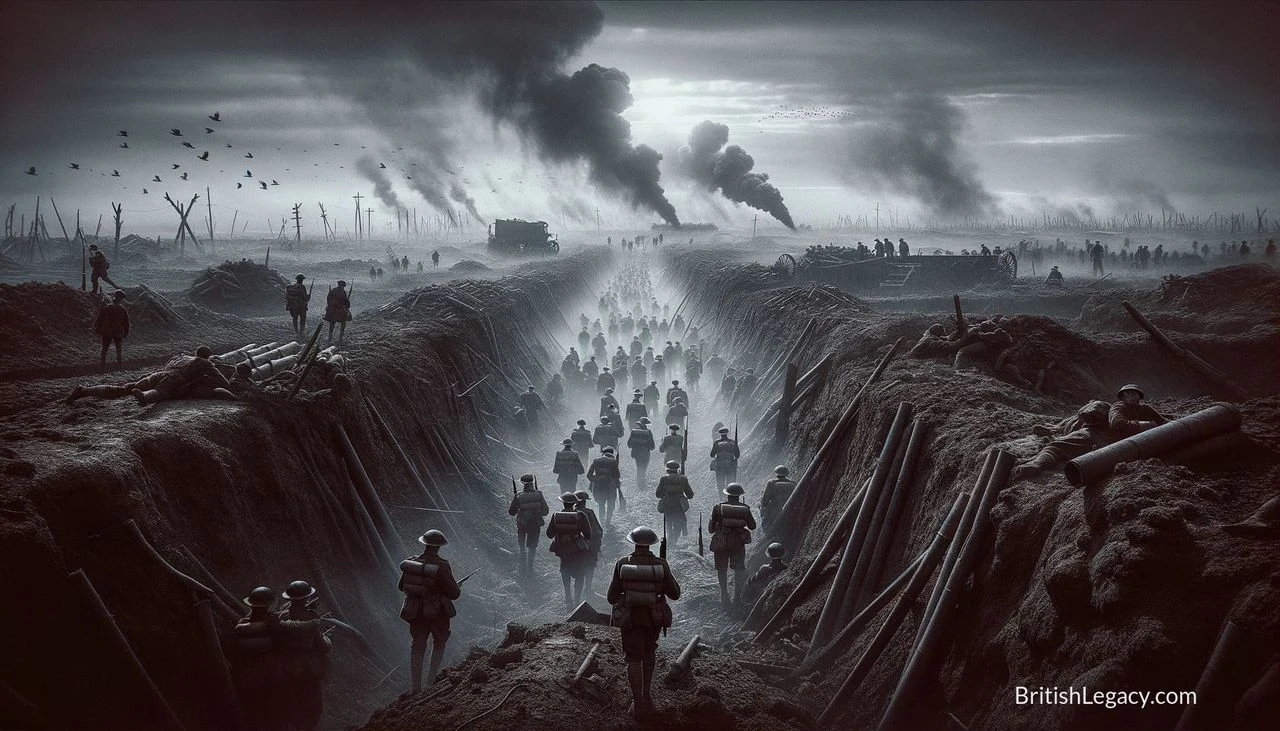
The Battle of the Somme began on 1 July 1916, as British and French forces attacked German positions in northern France. The offensive lasted until 18 November. Intended to break the deadlock on the Western Front and relieve pressure on French forces at Verdun, it became one of the most costly episodes in British military history. Its story includes failed attacks and immense loss of life, but also changes in battlefield tactics and a continuing legacy of remembrance.
An offensive on the Western Front
British and French forces launched the campaign against the German Empire in the Somme region of France. British planners, under General Douglas Haig, hoped the offensive would ease the strain on the French army at Verdun and damage German military strength. The fighting unfolded over five months amid the entrenched positions that defined the Western Front.
The first day brought a devastating toll for the British Army: 57,470 casualties, including 19,240 deaths. The scale of these losses made 1 July the bloodiest day in the army’s history, according to the account of the battle presented here. The campaign’s bombardments, muddy conditions and exposed ground contributed to the harshness of the fighting. The phrase ‘no man’s land’ refers to the contested ground between opposing trench systems, rather than to the trenches themselves.
Battlefield methods and their limits
The Somme saw the first use of tanks in warfare by British forces. Their early contribution was limited: mechanical failures and difficult terrain hindered their effectiveness. Even so, their appearance marked the arrival of a new kind of mechanised weapon on the battlefield.
Heavy artillery and creeping barrages were used to attack German positions ahead of advancing infantry. The aim was to suppress or destroy defences before troops crossed the ground between the opposing lines. These methods did not consistently produce decisive gains, and the offensive continued to exact a heavy human cost.
Loss, literature and remembrance
The battle’s losses extended across the Allied and German armies. The original account gives more than 600,000 casualties for British and French forces together, and around 500,000 German casualties. These figures convey the scale of the fighting, although casualty totals can encompass different categories of loss. The Somme’s human consequences became part of Britain’s public memory of the First World War.
The account also identifies Wilfred Owen and Siegfried Sassoon as soldier-poets whose writing gave later readers a way to encounter the suffering and disillusionment associated with war. Their poetry is part of the Somme’s cultural legacy as well as its military history. The battle’s significance is not confined to the battlefield: it has shaped how the conflict is remembered and represented.
At Thiepval, the memorial bears the names of more than 72,000 British and South African soldiers with no known grave. Alongside the cemeteries and other memorials of the former battlefields, it makes the scale of the losses visible in a particular place. Remembrance Day and the wearing of poppies provide a wider annual setting for reflecting on the First World War and its dead.
Why the Battle of the Somme deserves a place in British Legacy
The Somme deserves a place in British Legacy because it brings together military ambition, tactical change and the human cost of war in a single, consequential campaign. British forces entered the offensive hoping to break the stalemate and support the French at Verdun. The result was a prolonged battle whose first day alone brought an extraordinary number of British casualties. Its record is therefore not simply one of courage or military innovation: it also requires an honest account of the limits and costs of the methods used.
The battle’s legacy continues through the memorials, literature and acts of remembrance associated with it. Thiepval names thousands of missing British and South African soldiers; the poetry of Owen and Sassoon gives later generations a literary account of war’s effects. Together, these forms of commemoration connect a campaign fought in France to Britain’s public understanding of the First World War. Remembering the Somme means recognising both the lives lost and the enduring work of preserving their names and experiences.