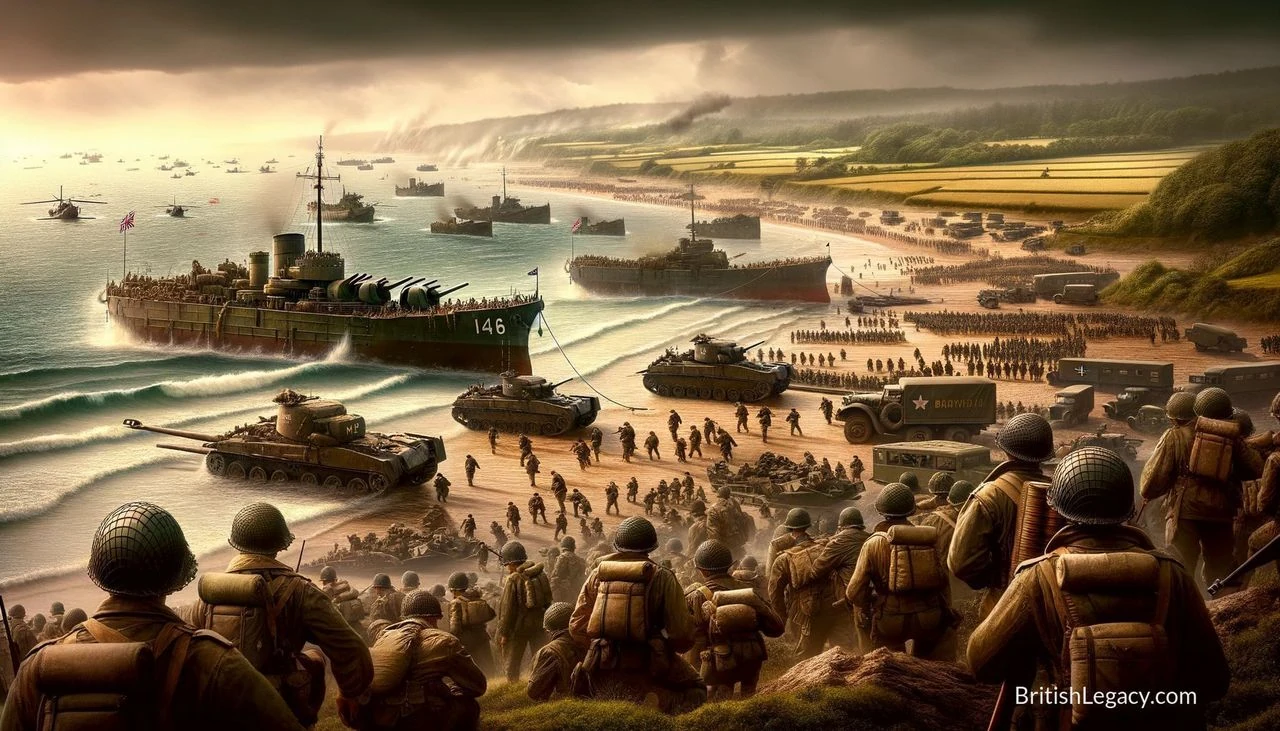
The Battle of Normandy opened with the Allied landings on 6 June 1944. British forces were central to the campaign, but they did not fight alone: American and Canadian troops were among the allies advancing through Normandy. British troops landed on Sword and Gold beaches, the Royal Navy and Royal Air Force supported the invasion, and the fighting continued inland around Caen and through the countryside. The campaign culminated in the encirclement and defeat of German forces in the Falaise Pocket, forming part of the Allied liberation of Western Europe from Nazi occupation.
Landings on Sword and Gold
Operation Overlord began with the D-Day landings. At Sword Beach, British troops met resistance and secured the area. On Gold Beach, the British 50th Infantry Division overcame defences and established a foothold. These landings gave the Allies a base from which to continue their advance into Normandy; they were the opening of a campaign, not its conclusion.
The invasion depended on planning and cooperation across the Allied forces. Bernard Montgomery, who led the 21st Army Group, was among the commanders involved in planning and carrying out the landings and the subsequent breakout. The Royal Navy and Royal Air Force also supported the operation. Their roles included helping secure the Channel and providing logistics and firepower, extending Britain’s part in the invasion beyond the troops on the beaches.
Fighting inland: Caen and the Falaise Pocket
After the landings, British forces fought alongside American and Canadian allies in the Normandy countryside. The advance passed through hedgerows, villages and towns, where the fighting continued beyond the coastal landing areas. One major focus was Caen. British troops faced German Panzer divisions in the fighting around the city, which was described as strategically important to the Allied breakout from the beachhead.
The campaign’s later stages brought the encirclement and defeat of German forces in the Falaise Pocket. The outcome marked a major point in the Allied advance through France. British forces were part of this wider operation, alongside their American and Canadian allies; the campaign’s course cannot be reduced to the actions of one country, one service or one landing beach.
Sacrifice and remembrance
The Normandy campaign came at a human cost. British cemeteries and memorials in the region commemorate those who fought and died, while the beaches remain associated with the landings and the fighting that followed. Remembering the campaign means holding both parts of the story together: the Allied advance towards liberation and the loss of life involved in securing it.
Why the Battle of Normandy deserves a place in British Legacy
The Battle of Normandy deserves a place in British Legacy because it records a substantial British contribution to an Allied campaign. British troops landed at Sword and Gold, fought in the difficult advance inland and took part in the fighting around Caen and the Falaise Pocket. The Royal Navy and Royal Air Force supported the invasion with roles in securing the Channel and providing logistics and firepower. Together, these details show the range of Britain’s involvement, from the initial landings to the wider operation.
That contribution is most accurately remembered as part of a shared effort. American and Canadian troops fought alongside British forces, and Allied commanders planned and directed the campaign together. Its place in Britain’s wartime history therefore rests not on claims of a solitary national victory, but on the documented British role within the coalition and on the sacrifices made during the fighting. The cemeteries and memorials in Normandy connect that military history to remembrance of those who died. Telling the story in this way recognises Britain’s part without obscuring the allies whose cooperation made the campaign possible.