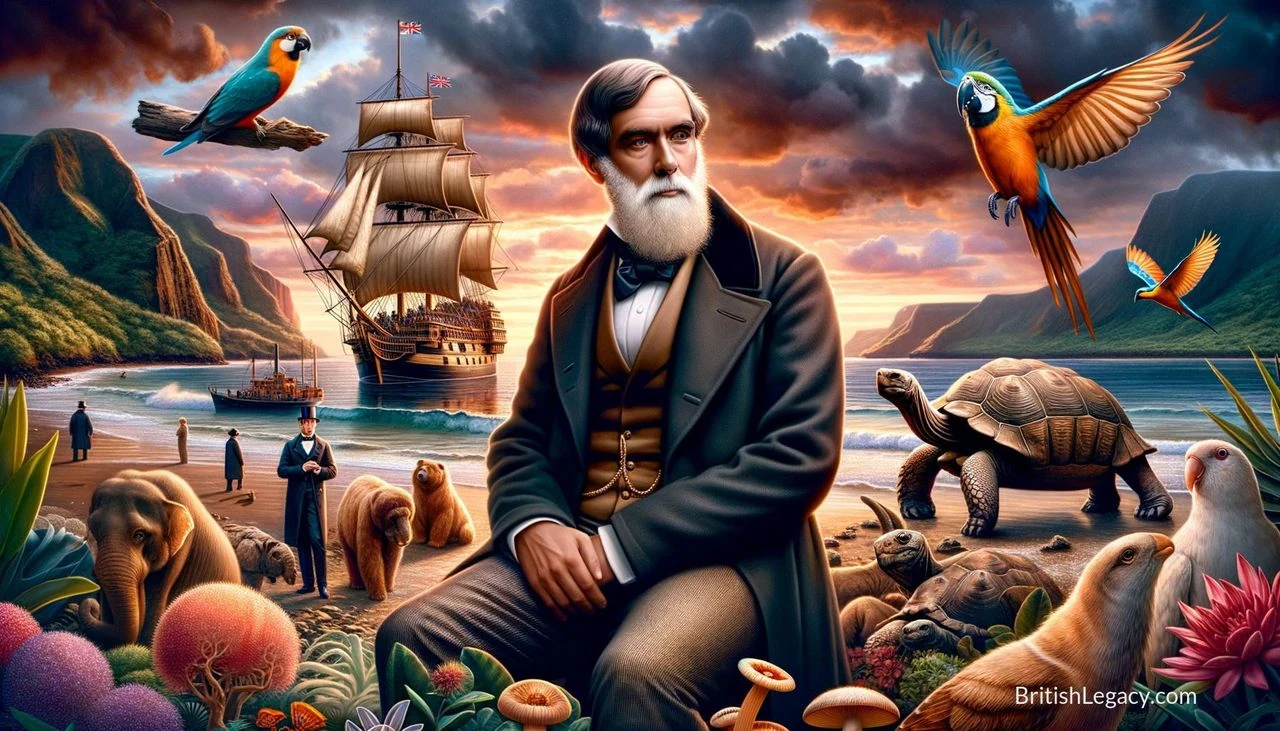
Charles Darwin’s theory of natural selection offered a way to explain how species change without treating them as fixed. It grew from years of collecting, observation and argument, not from a single discovery on the Galápagos Islands. The English naturalist’s work, set out most influentially in On the Origin of Species, changed biology and prompted lasting debate about humanity’s place in the natural world.
A Shrewsbury childhood and a change of direction
Darwin was born in Shrewsbury, Shropshire, on 12 February 1809, the fifth of six children of Robert Darwin, a doctor and financier, and Susannah Darwin, née Wedgwood. His family had deep scientific and intellectual interests: his grandfathers were Erasmus Darwin and Josiah Wedgwood. Charles was drawn to collecting and natural history while young, but his education did not follow a direct route into science.
In 1825 he went to the University of Edinburgh to study medicine. He found the lectures dull and surgery distressing, but took part in the Plinian Society, a student natural-history group, and assisted Robert Edmond Grant’s investigations of marine invertebrates. In 1828 his father sent him to Christ’s College, Cambridge, with the intention that he become an Anglican clergyman. There, Darwin’s friendship with the botanist John Stevens Henslow helped strengthen his interest in natural science. He completed an ordinary degree in 1831.
Henslow recommended Darwin for a place on HMS Beagle’s surveying voyage. The position was intended for a gentleman naturalist rather than a ship’s officer or a mere specimen collector. Darwin’s father initially objected to the journey, but his uncle Josiah Wedgwood helped persuade him to agree and fund his son’s participation. The Beagle left on 27 December 1831. Its voyage lasted almost five years.
What the Beagle voyage revealed
Darwin spent much of the voyage ashore, studying geology and collecting natural-history specimens while the Beagle surveyed coastlines. He kept notes and sent specimens and accounts back to England. In South America, fossil bones of extinct giant mammals drew his attention because they resembled, in some respects, living animals in the same region. In Chile, an earthquake and evidence of raised shorelines sharpened his interest in how the Earth changes over long periods.
The Galápagos formed part of this wider investigation, rather than a ready-made answer. Darwin noticed that mockingbirds differed between islands and were related to birds from South America. He did not initially recognise the significance of every specimen: the birds he had thought were a mixture of blackbirds, grosbeaks and finches were later identified by the ornithologist John Gould as separate species of finch. Notes made by other members of the expedition helped Darwin work out where some specimens had been collected. The observations became meaningful through comparison and later analysis.
Back in England in October 1836, Darwin set about having his collections examined by specialists and publishing the results. His travel journal became The Voyage of the Beagle, which helped make him a popular author. He also established a scientific reputation through geological and zoological work. His studies of barnacles occupied him for years and earned him the Royal Society’s Royal Medal in 1853. This close examination of specimens was part of the patient research behind his larger claims about variation and species.
Natural selection and the Origin
Darwin had begun to consider the possibility that species changed by 1837. In 1838, after reading Thomas Malthus on population, he developed the idea that competition for limited resources could help explain why some variations were preserved while others were lost. In his account, individuals with traits that better suited them to particular conditions were more likely to survive and leave offspring. Across generations, this process could produce change and, eventually, new species.
He did not rush to publish. Darwin gathered evidence and tested his ideas, while also working on geology and the reports from the Beagle collections. In 1858, Alfred Russel Wallace sent him an essay outlining a theory of natural selection. The two naturalists’ accounts were presented jointly to the Linnean Society of London on 1 July. Darwin then condensed his planned larger work into On the Origin of Species, published in 1859. Its argument rested on observations and evidence across many fields, and considered objections as well as the case for common descent.
The book became an immediate success: its first print run of 1,250 copies was subscribed before it went on sale. It did not set out a full account of human evolution, but its implications were clear enough to draw public attention and debate. At a meeting of the British Association for the Advancement of Science in Oxford in 1860, Bishop Samuel Wilberforce argued against Darwin’s explanation. The often-repeated story of a decisive exchange with Thomas Henry Huxley has helped turn the event into a symbol of conflict between science and religion, but the response to Darwin’s work was broader and more varied than any single confrontation.
Down House and a continuing scientific career
Darwin married his cousin Emma Wedgwood in 1839. In 1842 they moved to Down House in Kent, where he pursued much of his research while dealing with recurrent ill health. His work extended well beyond the Origin. Fertilisation of Orchids, published in 1862, examined the relationship between flowers and their pollinators. The Descent of Man, and Selection in Relation to Sex followed in 1871, addressing human ancestry and sexual selection. A year later, The Expression of the Emotions in Man and Animals explored continuities between human and animal behaviour.
His botanical investigations also produced books on insectivorous plants, variation in flowers and the movement of plants. His final book, on the formation of vegetable mould through the action of worms, returned to a subject that had interested him since the 1830s. Taken together, this work shows a naturalist applying observation and comparison across geology, zoology and botany, rather than relying on one famous theory alone.
Darwin and Emma had ten children. Their daughter Annie died aged ten in 1851, a loss that deeply affected her parents. Darwin remained close to his family and, despite prolonged periods of illness, continued to write and correspond with scientists. His ideas did not settle every question: by the 1870s, many scientists accepted that evolution had occurred, while the importance of natural selection as its principal mechanism remained disputed.
Death, recognition and the uses of his name
Darwin died at Down House on 19 April 1882, aged 73. He had expected to be buried at Downe, but colleagues and public and parliamentary supporters arranged for him to be buried in Westminster Abbey. The funeral there on 26 April brought together relatives, scientists, philosophers and public figures. The burial placed an English naturalist among the country’s most prominent commemorated figures.
Darwin’s influence also requires careful distinction from the many social and political arguments later associated with his name. His account of evolution was taken up in conflicting ways, and the label “Darwinism” came to cover ideas that did not necessarily reflect his own. The supplied biographical evidence records his opposition to slavery and his rejection of ranking human groups as distinct species. His work was also invoked by eugenic movements that developed after his death; those later uses should not be confused with the scope of his scientific argument.
His scientific standing was recognised in Britain during his lifetime. He received the Royal Society’s Copley Medal in 1864, and the Linnean Society later established the Darwin–Wallace Medal to commemorate the joint presentation of their accounts of natural selection. From 2000 to 2017, Darwin’s portrait appeared on Bank of England £10 notes. These honours reflect the lasting public presence of his work as well as its importance within the sciences.
Why Charles Darwin deserves a place in British Legacy
Darwin belongs in a record of British history not simply because he was born in Shrewsbury or buried in Westminster Abbey, but because his life and work changed the practice and public standing of natural science in Britain. The Beagle voyage gave him a wide body of observations; his subsequent investigations of fossils, living species and geological change helped him build an argument that could be tested against evidence. On the Origin of Species brought that argument to readers beyond specialist circles and offered biology a powerful explanation for the diversity and relatedness of life.
His achievement was collaborative as well as individual. Darwin’s work depended on collections, expert identifications and discussions with other naturalists; Wallace’s parallel account led to their ideas being presented jointly. Darwin then developed his case through further books on plants, human descent, sexual selection and animal expression. Remembering those strands avoids reducing his career to a misleading tale of one island or one book. His legacy also calls for historical care: later movements used evolutionary language for purposes that were not equivalent to Darwin’s scientific claims. British Legacy can honour the lasting contribution while keeping that distinction clear. The result is a more useful account of how careful observation, sustained research and public debate helped reshape understanding of life.
Sources
Charles Darwin (revision 1378984667)
Adapted in part from Charles Darwin by Wikipedia contributors, under CC BY-SA 4.0. Text has been edited and combined with the existing article; this adapted text is shared under the same licence. Contributor history.