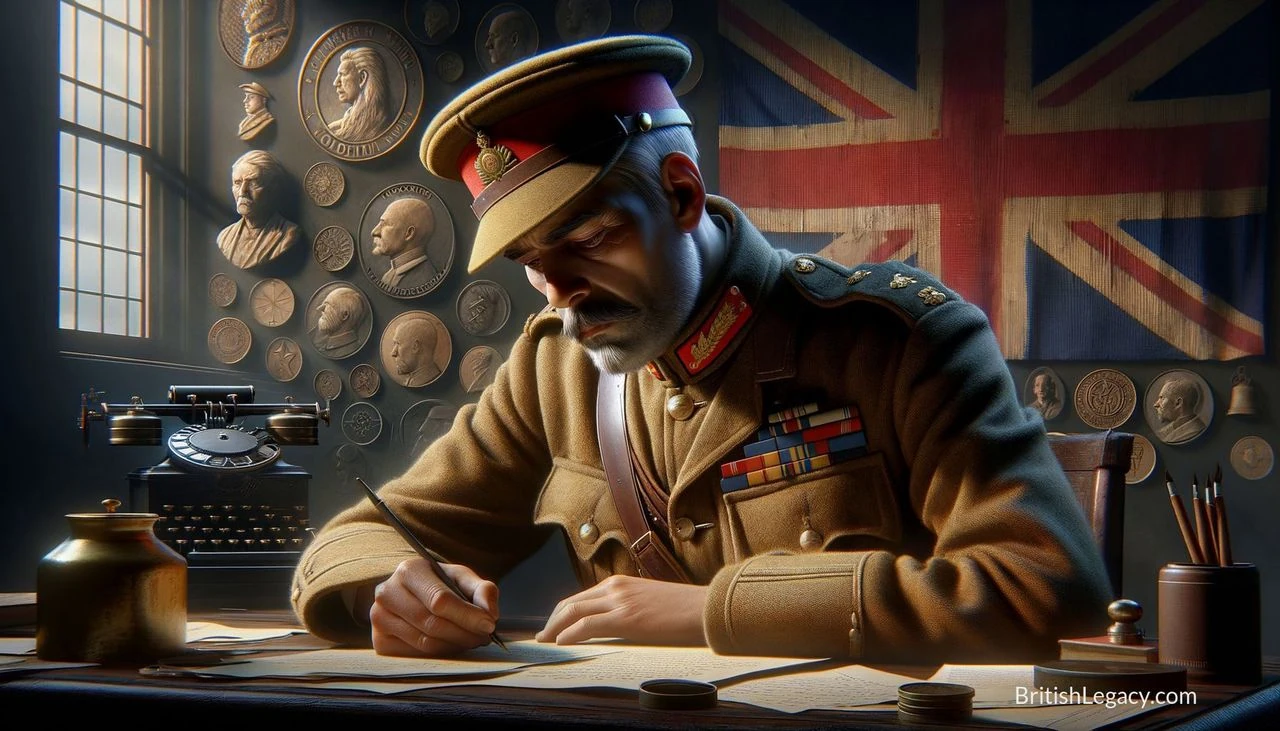
Thomas Edward Lawrence became internationally famous as “Lawrence of Arabia”, but the familiar image of a lone desert commander compresses a more complicated life. Before the First World War he was an Oxford-trained historian and archaeologist; during it, he served as a British officer and liaison to Emir Faisal’s forces in the Arab Revolt. After the war, he worked in government and spent years enlisted in the Royal Air Force, while writing the book that made his account of the revolt part of British literary culture.
Oxford, fieldwork and the road to war
Lawrence was born on 16 August 1888 in Tremadog, in Wales. His father, Thomas Chapman, had left his wife and lived with Sarah Junner, who had been governess to his daughters; the couple used the surname Lawrence and did not marry. The family moved to Oxford in 1896. Lawrence attended the City of Oxford High School for Boys and, from 1907, read history at Jesus College. He graduated with first-class honours in 1910, after researching medieval military architecture in France and the Middle East.
His education had involved travel as well as study. As a teenager, he cycled with schoolfriend Cyril Beeson through local villages, examining churches and antiquities. Later, he toured French castles and walked through Ottoman Syria to study Crusader fortifications. In 1910 he joined an archaeological expedition at Carchemish, working for the British Museum under D. G. Hogarth, R. Campbell Thompson and Leonard Woolley. He learned Arabic in Beirut and worked at the site until 1914. The work gave him direct experience of the region before he entered military service; in January 1914, he and Woolley also took part in a survey of the Negev that mapped features, including water sources, with military relevance.
When war began, Lawrence did not enlist immediately. He joined the British Army in October 1914 as a temporary second lieutenant-interpreter and was sent to the Arab Bureau in Cairo, a military intelligence unit. There he prepared maps and bulletins and interviewed prisoners. The political circumstances were already difficult: Sharif Hussein of Mecca was discussing an Arab uprising with Britain, while British and French interests, and their plans for the region, did not align neatly with promises of Arab independence.
Liaison and strategy in the Arab Revolt
The revolt against Ottoman rule began in June 1916. Later that year Lawrence travelled to the Hejaz to gather intelligence and met Hussein’s sons Ali, Abdullah and Faisal. He judged Faisal the strongest prospective leader and, when the appointed British liaison had not yet arrived, went in his place. Faisal asked for Lawrence to remain. Their work combined military advice with liaison between Arab forces and the British command.
Lawrence’s contribution was not simply a sequence of battlefield commands. He helped develop a strategy that sought to stretch Ottoman forces by threatening the Hejaz railway and advancing north, rather than trying to capture Medina. The railway could be attacked and disrupted without being permanently destroyed: Ottoman troops then had to guard and repair it, while the garrison at Medina remained contained. Lawrence also travelled between Faisal and British headquarters, helping co-ordinate operations and gather intelligence.
In 1917 he proposed an overland expedition against Aqaba, a strategically placed port on the Red Sea whose landward approaches were defended. Led by Sharif Nasir, the Arab force set out from Wejh on 9 May; Aqaba fell on 6 July after an attack from inland. Lawrence had not informed his British superiors of the plan in detail, concerned that it might be blocked because of French interests. After the capture, General Edmund Allenby accepted Lawrence’s strategy for the revolt.
Lawrence participated in several actions against Ottoman communications and garrisons, and fought alongside Arab forces. At the Battle of Tafilah in January 1918, Arab regulars under Jafar Pasha al-Askari turned a defensive engagement into an offensive rout. Lawrence was awarded the Distinguished Service Order and promoted to lieutenant colonel. His subsequent work increasingly centred on raiding and intelligence-gathering, rather than serving as Faisal’s chief British liaison.
In the closing weeks of the war Lawrence helped prepare the advance towards Damascus, but he was not there for the city’s formal surrender. The 10th Light Horse Regiment arrived first; Lawrence reached Damascus several hours later, on 1 October 1918. He helped establish a provisional Arab government under Faisal. That project collided with the post-war settlement: the secret Sykes–Picot Agreement had divided British and French plans for the region, and French forces ended Faisal’s rule in Damascus in 1920. Lawrence had tried to persuade British leaders to support Arab independence, but the outcome fell short of the promises made during the revolt.
Writing, public image and service after the war
Lawrence returned to Britain as a colonel and joined Faisal’s delegation at the Paris Peace Conference. His wartime profile grew beyond official circles after the American journalist Lowell Thomas made him a prominent figure in a lecture and film presentation about the campaign. Thomas’s show opened at Covent Garden in London in 1919; photographs of Lawrence in Arab dress helped turn him into a public celebrity. Lawrence took part in preparing the presentation, but later regretted the prominence it gave him.
He also worked with Winston Churchill at the Colonial Office, advising on Middle Eastern affairs. In 1922 he left public life and enlisted in the Royal Air Force under the name John Hume Ross. When his identity was discovered, he was forced to leave. He joined the Royal Tank Corps as T. E. Shaw, then returned to the RAF in 1925. He served at several bases, including in Britain and, from 1926, in British India. In the RAF he was involved in the development of faster rescue launches after seeing the consequences of a slow rescue response to a seaplane crew. He worked with Hubert Scott-Paine of the British Power Boat Company on a new seaplane tender. Lawrence left the service in March 1935.
His best-known book, Seven Pillars of Wisdom, recounts his part in the Arab Revolt. It also ranges across strategy, geography and Arabian culture, presenting a personal account rather than a detached military history. Lawrence worked on several versions, and the first edition appeared in 1926 as a costly private subscription publication. He said he did not want to profit from his wartime service; the production costs exceeded the sale price, leaving him in debt. An abridged version, Revolt in the Desert, followed in 1927. He later wrote The Mint, an account of enlisted life in the RAF, which was published after his death.
The book’s vivid prose helped shape the reputation that Thomas’s presentations had begun. That reputation should not be confused with an uncomplicated record. Lawrence’s account is a first-person interpretation of events, and his role in the revolt coexisted with the British government’s conflicting commitments and the failure to secure the independent Arab state he had advocated. His writing is valuable both for its literary force and as a record of how he understood his own involvement.
Death and remembrance
Lawrence was a keen motorcyclist. On 13 May 1935, near his home at Clouds Hill in Dorset, he was injured in a crash after swerving to avoid two boys on bicycles. He died six days later, aged 46, and was buried at St Nicholas’ Church, Moreton. The neurosurgeon Hugh Cairns, one of the doctors who attended him, subsequently studied deaths from head injuries among motorcyclists; that work helped lead to the use of crash helmets by military and civilian riders.
Lawrence’s story continued in books, theatre and film. David Lean’s 1962 film Lawrence of Arabia, with Peter O’Toole in the title role, brought his wartime image to a new global audience. His British commemorations include a bronze bust by Eric Kennington in St Paul’s Cathedral and a stone effigy in St Martin’s Church, Wareham. A blue plaque marks his childhood home in Oxford. In 2018, he was featured on a Royal Mint commemorative coin marking the centenary of the First World War.
Why T. E. Lawrence deserves a place in British Legacy
Lawrence belongs in British Legacy not because the popular image of “Lawrence of Arabia” tells the whole story, but because his life connects British scholarship, military service, government and literature. His archaeological work for the British Museum preceded his wartime role; his knowledge of the region informed his liaison with Faisal and his contribution to strategy during the Arab Revolt. The capture of Aqaba and the campaign’s northward movement were significant episodes, but the post-war fate of Faisal’s government also shows the limits of Lawrence’s influence. British policy and the secret agreements made by Britain and France did not deliver the independence that Lawrence had sought to support.
His legacy is therefore both substantial and unsettled. Seven Pillars of Wisdom made a lasting literary account of the revolt, while its first-person perspective and the celebrity built around Lawrence require readers to distinguish his narrative from the larger political history. His later RAF service, including work connected with faster rescue launches, reveals a life not confined to the desert campaign or its retelling. The memorials, film and continuing attention to his writing reflect his enduring place in British cultural memory. Remembering Lawrence with context honours his achievements without treating either his public legend or his political hopes as a complete account of events.
Sources
Adapted in part from T. E. Lawrence by Wikipedia contributors, under CC BY-SA 4.0. Text has been edited and combined with the existing article; this adapted text is shared under the same licence. Contributor history.