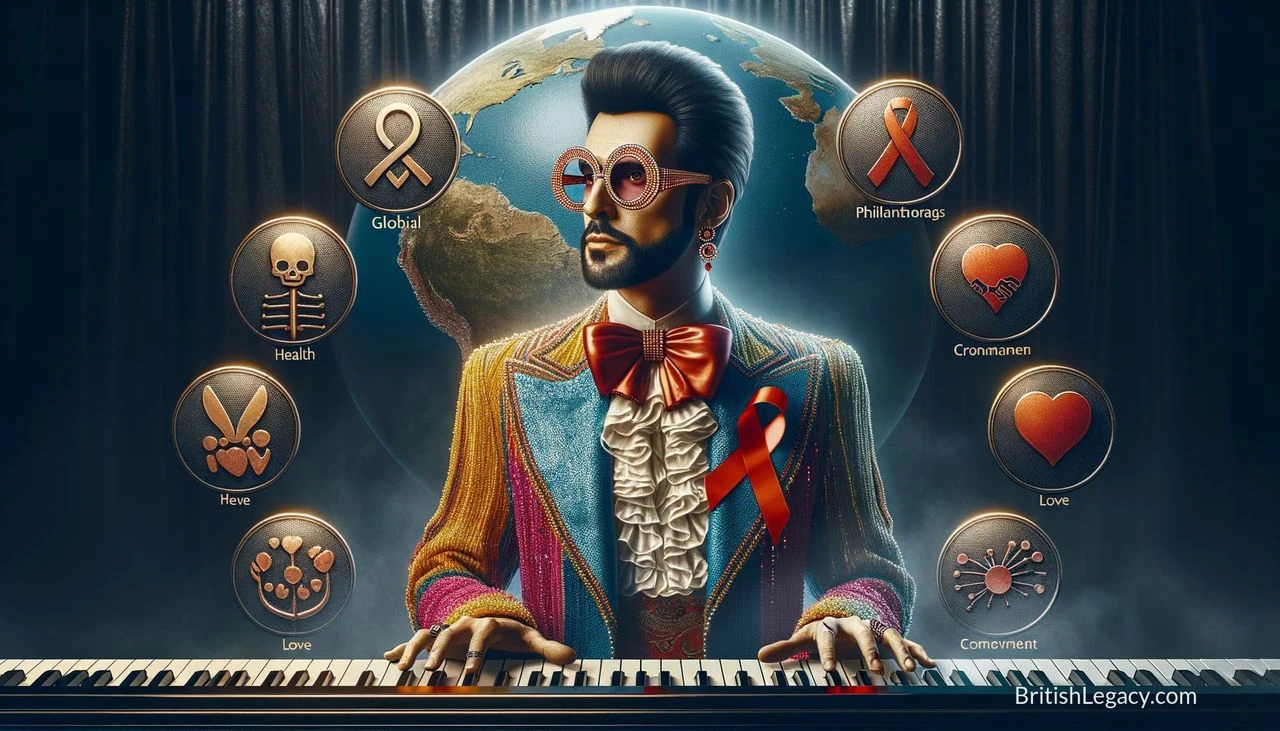
Elton John’s career brings together two kinds of reach: songs that travelled from British charts to audiences around the world, and a sustained effort to direct public attention and money towards people affected by HIV/AIDS. Born Reginald Kenneth Dwight in Pinner, Middlesex, in 1947, he began playing piano as a child. His partnership with lyricist Bernie Taupin, begun in 1967, gave that musical ability a distinctive voice and produced a catalogue that includes “Your Song”, “Rocket Man”, “Tiny Dancer” and “Candle in the Wind”. The knighthood he received in 1998 recognised services to music and charity; both strands of his work help explain his place in British cultural life.
A young pianist finds his way into music
John grew up in Pinner and showed an early aptitude for the piano. At 11, he won a junior scholarship to the Royal Academy of Music, where he attended Saturday classes. He left school at 17, before taking his A-level examinations, to pursue music. His first professional work included playing piano at a local pub and performing with the band Bluesology, which he had formed with friends in 1962.
In 1967, John answered an advertisement in the British music paper New Musical Express. At a meeting with Liberty Records’ A&R manager, Ray Williams, he was given an envelope of lyrics by Bernie Taupin, who had answered the same advertisement. John set the words to music and sent them back. Their long-running collaboration began with that exchange, rather than with the pair writing together in the same room: Taupin wrote lyrics independently and sent them to John to compose.
John adopted his professional name in 1967, drawing on the names of Bluesology musicians Elton Dean and Long John Baldry. He and Taupin first worked as staff songwriters for Dick James’s DJM Records, writing for other performers before John established himself as a recording artist. His debut album, Empty Sky, appeared in 1969; the self-titled Elton John followed in 1970. Its “Your Song” became his first hit single as a singer, marking the start of a run that would make him a major presence on both sides of the Atlantic.
The songs, the stage and the theatre
In the early 1970s, albums including Tumbleweed Connection, Honky Château and Goodbye Yellow Brick Road established John’s range as a performer and recording artist. “Rocket Man” and “Tiny Dancer” became enduring parts of his repertoire; Goodbye Yellow Brick Road also included “Bennie and the Jets” and “Candle in the Wind”. John’s piano-led songwriting sat alongside elaborate costumes and a flamboyant stage presence. The performances made spectacle part of the work, but the songs remained central: the partnership with Taupin continued to generate new material across changing musical styles and decades.
His work extended from records and concerts into musical theatre. With Tim Rice, John wrote songs for Disney’s animated film The Lion King (1994), including “Can You Feel the Love Tonight”, which won an Academy Award for Best Original Song. The collaboration continued with Aida, for which the pair received a Tony Award for Best Original Score. John also composed the music for Billy Elliot the Musical, with a book by Lee Hall. After opening in London’s West End in 2005, the production ran until 2016 and went on to be staged internationally. These projects brought his songwriting into films and theatres as well as the concert hall.
John’s British career has also included performances at national occasions and prominent venues. In 1985, he performed at Live Aid at Wembley Stadium. In 1997, he sang a revised “Candle in the Wind” at the funeral of Diana, Princess of Wales, at Westminster Abbey. He later performed at the Queen’s Diamond Jubilee Concert at Buckingham Palace in 2012. That same year, his remixed album Good Morning to the Night, made with the Australian group Pnau, reached number one in the UK. In 2013, he received the first Brits Icon award for his impact on British culture.
His Farewell Yellow Brick Road tour began in 2018 and concluded in Stockholm in July 2023. Its final concert ended a touring career that had taken his music to audiences around the world. John has said he would continue to perform occasionally, while retiring from touring to spend time with his family.
Turning celebrity towards the AIDS crisis
John’s charitable work grew from personal loss and a period in which HIV/AIDS was surrounded by fear and stigma. He had been involved in fundraising events since the 1980s. In 1985, he joined Dionne Warwick, Gladys Knight and Stevie Wonder to record “That’s What Friends Are For”; proceeds went to the American Foundation for AIDS Research. The song became a US number one the following year, making a fundraising appeal part of a widely heard popular record.
In 1990, John travelled to Indianapolis to be with Ryan White, a teenager with haemophilia whom he had befriended and whose health was deteriorating. White died that year. The death of Freddie Mercury in 1991 added to the personal losses that brought John closer to AIDS-related campaigning. In 1992, he established the Elton John AIDS Foundation to fund HIV prevention, challenge prejudice and discrimination, and support services for people living with or at risk of HIV. The foundation’s work has extended internationally, supporting programmes in dozens of countries.
John also made fundraising a visible part of his public life. From 1993 he hosted an annual Academy Awards party to raise money for the foundation. His White Tie & Tiara Ball, held at his home in Old Windsor, Berkshire, added an auction and celebrity attendance to the fundraising effort. Such events connected the reach of his entertainment career with practical support for HIV-related programmes. The foundation’s accumulated fundraising is described in the available accounts in different currencies and at different totals; the consistent point is its scale, international work and continuing focus on HIV.
In 2012, John published Love Is the Cure: On Life, Loss, and the End of AIDS, reflecting on the epidemic and the people he had lost. He has also spoken publicly about addiction and recovery, and used his profile to advocate for LGBTQ+ rights. The charitable work is not separate from his musical fame: concerts, recordings and high-profile events have all helped draw attention and resources to causes beyond the stage.
Honours, British roots and a global audience
John’s honours include appointment as a Commander of the Order of the British Empire in 1995 and knighthood in 1998 for services to music and charity. In 2020, he was appointed a member of the Order of the Companions of Honour. His songwriting has also been recognised through awards for his work with Taupin and Rice, while the 2013 Brits Icon award explicitly recognised his impact on British culture. These distinctions reflect different parts of a career that has moved between popular music, theatre and charitable fundraising.
His connection to Britain is concrete: he was born and raised in Pinner, studied at the Royal Academy of Music, began his musical career in British pubs and bands, and developed his defining songwriting partnership through an advertisement in a British music paper. British stages and institutions have remained part of his story, from Live Aid at Wembley to the West End run of Billy Elliot. At the same time, his songs, performances and foundation have reached well beyond the country of his birth.
Why Sir Elton John deserves a place in British Legacy
Elton John merits a place in British Legacy for the way his career joins enduring popular music to an identifiable British story. A childhood in Pinner and study at the Royal Academy of Music led into pub work, Bluesology and a chance meeting of circumstances with lyricist Bernie Taupin. Their songwriting partnership helped produce records and songs that reached an international audience, while John’s piano playing and striking stage performances made him a recognisable figure in British cultural life. His work for film and theatre, including The Lion King, Aida and Billy Elliot the Musical, shows how that songwriting travelled beyond the album and concert stage.
His charitable contribution gives that cultural influence a practical dimension. After the losses of Ryan White and Freddie Mercury, John founded the Elton John AIDS Foundation in 1992 to support HIV prevention, oppose stigma and discrimination, and provide services for people affected by HIV. Fundraising through recordings, concerts and high-profile events has helped sustain the foundation’s international work. His example is significant not because it proves that a single artist can solve a global health crisis, but because he used an established public platform to keep attention and resources directed towards it. The combination of British musical achievement, work across creative forms and long-running advocacy makes his legacy specific, substantial and worth recording.
Sources
Adapted in part from Elton John by Wikipedia contributors, under CC BY-SA 4.0. Text has been edited and combined with the existing article; this adapted text is shared under the same licence. Contributor history.