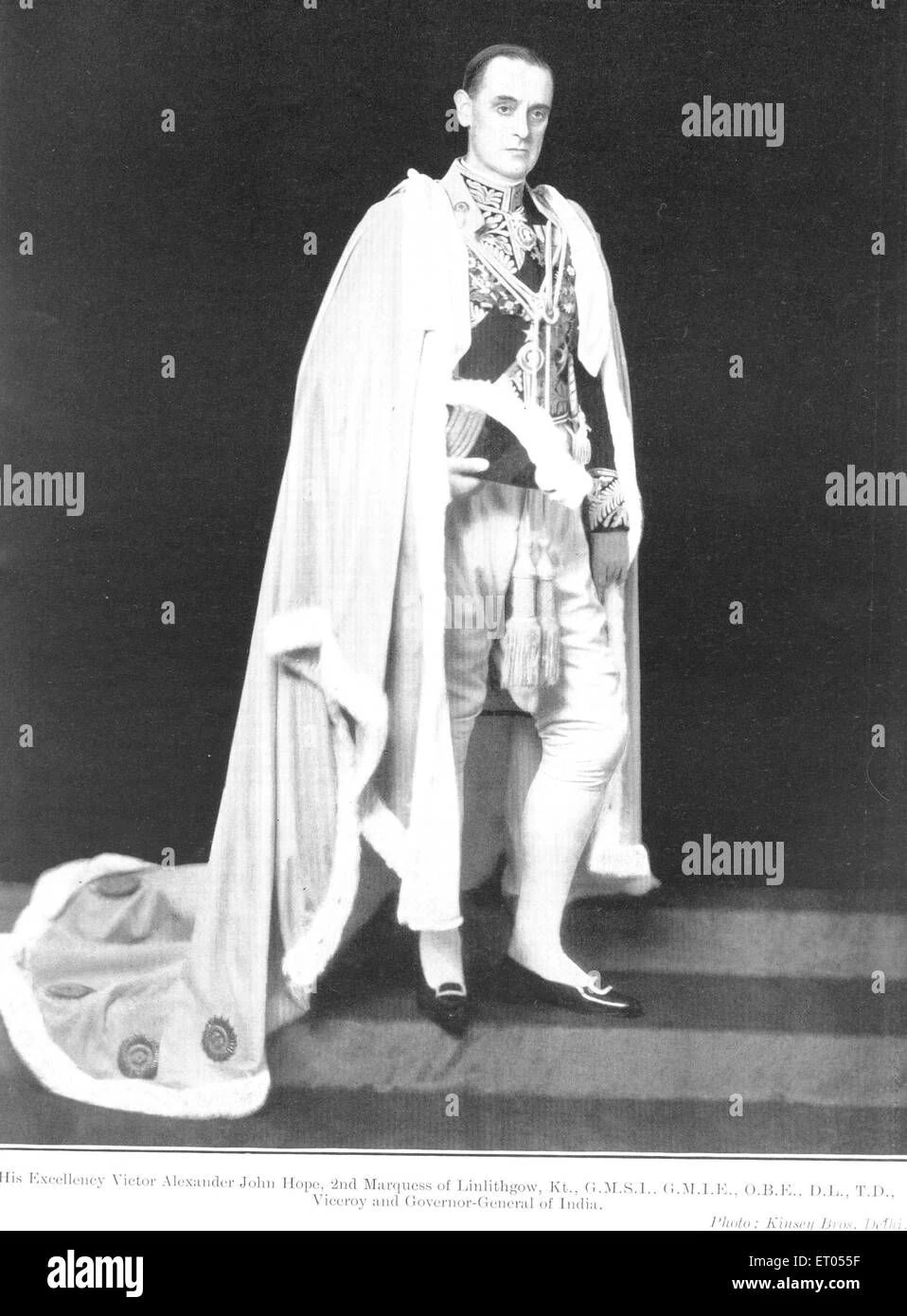
Victor Hope, 2nd Marquess of Linlithgow, governed British India from 1936 to 1943, the longest tenure of any Viceroy of India. His time in office brought the implementation of constitutional reforms, the Second World War and a deepening confrontation between British authority and Indian demands for a say in their own future. His record joins public service in Scotland and Britain to decisions made under colonial rule: among them, declaring India at war with Germany without consulting Indian politicians.
A Scottish heir and public servant
Hope was born at Hopetoun House, South Queensferry, in Linlithgowshire, on 24 September 1887. He was the eldest son of John Adrian Louis Hope, later the 1st Marquess of Linlithgow, and Hersey Everleigh-de-Moleyns. Educated at Ludgrove School and Eton College, he succeeded his father as the 2nd Marquess in 1908. In 1912, aged 25, he was elected a Fellow of the Royal Society of Edinburgh, an institution whose vice-presidency he later held.
During the First World War, Hope served on the Western Front. After transferring from the Lothians and Border Horse, he commanded a battalion of the Royal Scots. He was mentioned in dispatches, appointed an Officer of the Order of the British Empire and ended the war with the rank of colonel.
His subsequent public work ranged across politics, research and agriculture. In the 1920s he served as civil lord of the Admiralty, chaired the Unionist Party Organisation and was president of the Navy League from 1924 to 1931. He chaired the Medical Research Council and the governing body of Imperial College London. Until 1933, he was also president of the Edinburgh and East of Scotland College of Agriculture.
India before the viceroyalty
Hope’s engagement with Indian affairs began years before his appointment as Viceroy. In 1926 he chaired the Royal Commission on Agriculture in India, which published its findings in 1928. The commission’s remit reflected a concern that constitutional reform alone would not improve the lives of most of the population without economic and educational reform. The account of his career records that, as Viceroy, he later took a personal interest in nutrition and pressed for it to become a research priority.
From April 1933 to November 1934, he chaired the Parliamentary Joint Select Committee on Indian constitutional reform. The committee considered proposals for Indian self-government; its recommendations became the Government of India Act 1935. The Act was therefore in place before Hope became Viceroy. His role was to implement its plans for local self-government, not to enact the legislation.
Hope took office after declining earlier offers of the governorship of Madras and the governor-generalship of Australia. He arrived in Bombay with his family and staff in April 1936, succeeding Lord Willingdon. The 1935 Act led to provincial governments led by the Congress Party in five of British India’s eleven provinces. Its proposed federation did not come about: the princes’ resistance prevented elected governments from being established in most princely states. The provincial changes widened political participation, but they did not grant India independence.
Wartime decisions and political rupture
When the Second World War began, Congress sought a declaration that India would be able to determine its own future after the conflict. Hope rejected the request. In September 1939, he declared India at war with Germany without consulting Indian politicians. Congress ministries resigned, sharpening the division between the British administration and Congress.
In August 1940, Hope announced the British government’s offer of greater rights for Indians in the governance of their country. Known as the August Offer, it was rejected by most Indian politicians, including the Congress Party and the Muslim League. Disputes between the administration and Congress ultimately led to mass civil disobedience in the Quit India movement. The government suppressed the disturbances and arrested Congress leaders. The sequence matters: the 1939 declaration was followed by further political conflict; it did not, by itself, ignite the 1942 movement.
The Bengal famine of 1943 also falls within Hope’s final year as Viceroy. The account of his career notes that some historians have partly blamed him for the famine, in which three million people died. This is a qualified attribution, not an unqualified finding of individual responsibility. It nevertheless forms part of the record against which his administration has been assessed.
Departure and a contested record
Hope’s seven-year term ended on 1 October 1943, when Lord Wavell succeeded him. Indian assessments of the administration were sharply critical. V. P. Menon described the long period as conspicuous for its lack of positive achievement and said the country was more divided when Hope left than when he arrived. The account also quotes Sir Tej Bahadur Sapru expressing the view that India had become more divided during those seven years. These judgments register the political division associated with the period rather than a consensus on every aspect of Hope’s record.
In Britain, Hope served as Lord High Commissioner to the General Assembly of the Church of Scotland in 1944 and 1945. His other Scottish institutional roles included the chancellorship of the University of Edinburgh and the vice-presidency of the Royal Society of Edinburgh. He died at South Queensferry on 5 January 1952, aged 64.
Why Victor Hope deserves a place in British Legacy
Hope’s place in British history rests chiefly on the responsibilities he exercised as Viceroy. For seven years he represented British rule in India, implementing provincial arrangements under the Government of India Act 1935 while the central question of self-government remained unresolved. His earlier work on Indian agriculture and constitutional reform shows that this involvement preceded his appointment. The committee he chaired helped shape proposals that became the framework for the Act; during his viceroyalty, that framework enabled provincial governments led by Congress in five provinces, while the proposed federation failed to materialise.
His legacy also demands attention to what those reforms could not deliver and to the consequences of wartime decisions. Declaring India at war without consulting Indian politicians was followed by Congress ministries resigning. The August Offer failed to secure agreement, and the conflict with Congress culminated in civil disobedience, arrests and suppression. The famine of 1943 is part of the record too, alongside the qualified attribution of partial responsibility made by some historians. Hope’s career brings into view the dichotomies and conflicts of British imperial rule: constitutional reform alongside the retention of authority, and wider provincial participation alongside the refusal to let Indian politicians decide whether the country was at war. Remembering him is useful not as celebration of empire, but as a way to examine how British governance shaped political participation and India’s struggle for self-rule. His Scottish public roles make that history part of a wider British story, without diminishing the costs and divisions experienced in India.
Sources
Victor Hope, 2nd Marquess of Linlithgow — revision 1376384540
Adapted in part from Victor Hope, 2nd Marquess of Linlithgow by Wikipedia contributors, under CC BY-SA 4.0. Text has been edited and combined with the existing article; this adapted text is shared under the same licence. Contributor history.