Victoria Pendleton’s sprinting career brought her three Olympic medals, nine world titles and a place among Britain’s most successful track cyclists. She won gold in the sprint at Beijing in 2008, then took the keirin title at London in 2012. Her achievements were hard-won: the route from childhood races in Bedfordshire to the Olympic podium included setbacks, changes of coach and the challenge of competing in a sport with fewer Olympic events for women than for men.
First races in Bedfordshire
Born in Stotfold on 24 September 1980, Pendleton grew up riding with her twin brother and older sister. Her father, Max, was a keen amateur cyclist and former British National grass-track champion. When Victoria was nine, he took the twins to weekend races and arranged children’s events for them. She rode her first race, a 400-metre event, on a grass track at Fordham, Cambridgeshire, and joined Mildenhall Cycling Club.
At school, she played hockey as well as cycling. A turning point came at 16, when assistant national track coach Marshall Thomas invited her to a trial in Manchester. She rode in a velodrome for the first time and Thomas took over her coaching from her father. Pendleton later recalled that a lack of female role models meant she did not then picture cycling as a career.
She studied sports science at Northumbria University in Newcastle. In her final year she trained with British Cycling for one week each month; after graduating in 2002, she became a full-time cyclist. Her early international results were mixed. She finished fourth in the sprint at the 2002 Commonwealth Games and the 2003 World Championships, and placed sixth in the 500-metre time trial and ninth in the sprint at the 2004 Olympics.
Learning to win
From 2002 to 2004, Pendleton trained at the World Cycling Centre in Switzerland under Frédéric Magné. She later described that period as difficult for her wellbeing. British Cycling arranged for her to work with psychiatrist Steve Peters; Pendleton said his support helped her continue in the sport. After considering quitting following the 2004 Olympics, she won the keirin at a World Cup meeting in Los Angeles later that year.
In 2005, she claimed her first world title in the sprint at the championships in Los Angeles, becoming the first British woman to win a track-cycling world championship since Beryl Burton in 1966. She went on to win nine world titles: six in the individual sprint, including a record-equalling sixth in 2012, two in the team sprint and one in the keirin. The total reflects success across three disciplines, not nine titles in the sprint alone.
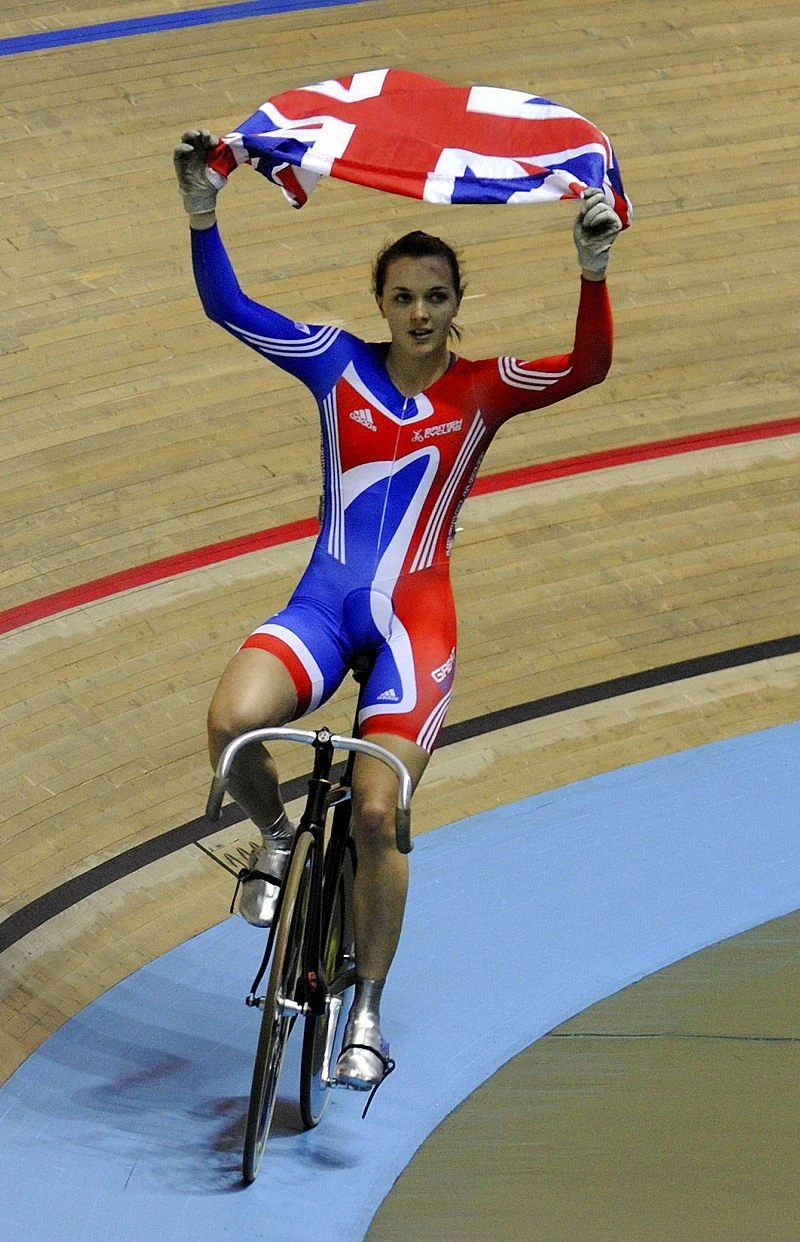
At the 2006 Commonwealth Games in Melbourne, she won the sprint and took silver in the 500-metre time trial. In 2007, she won world titles in the sprint, team sprint, alongside Shanaze Reade, and keirin. The next year she won the sprint and team sprint at the world championships before defeating Anna Meares for Olympic sprint gold in Beijing. Pendleton became the first British woman to win an Olympic gold medal in that event.
She also spoke out about the programme of Olympic track cycling. At Beijing, women had three medal events, against seven for men; Pendleton criticised the imbalance, noting that only one of the women’s events was a discipline she contested. Her success did not make her an uncritical observer of the sport’s opportunities.
London, retirement and a new sporting test
At the 2012 London Olympics, Pendleton and Reade broke the team-sprint world record in qualifying, but were disqualified in the semi-final for an illegal changeover. Pendleton recovered to win the keirin, becoming the first British woman to win an individual Olympic gold at successive Games. She also took sprint silver after losing the final to Meares. It was her last competitive cycling race; she retired after the Games.
Pendleton’s next sporting challenge was very different. In 2015 she began training as an amateur jockey with guidance from horse trainer Paul Nicholls. She made her racing debut that August and finished second at Ripon. In March 2016, riding Pacha Du Polder, she won at Wincanton and then finished fifth in the Foxhunter Chase at the Cheltenham Festival. She had set herself the goal of reaching that race, and described the result as probably the greatest achievement of her life.
She also took on television and writing. Pendleton appeared on Strictly Come Dancing in 2012 and published her autobiography, Between the Lines, that year. A BBC documentary, Victoria Pendleton: Cycling’s Golden Girl, followed her in the build-up to the London Olympics. These projects brought her sporting experiences to audiences beyond the velodrome.
Honours and public life
Pendleton was appointed MBE in 2009 for services to sport and CBE in 2013 for services to cycling. In 2014 she entered the British Cycling Hall of Fame. Her Olympic sprint victory was also marked at home: Royal Mail painted a postbox gold in Stotfold in 2012, and a commemorative Olympic stamp featured her keirin win.
Her account of life after elite cycling has included serious mental-health difficulties. In 2019, she spoke about severe depression and suicidal thoughts following an unsuccessful Everest expedition the previous year. She said surfing helped her recovery and became a patron of the Wave Project, which uses surfing as therapy. Her public discussion of these experiences added a personal dimension to her visibility as an athlete, without reducing her career to either medals or adversity.
Why Victoria Pendleton deserves a place in British Legacy
Pendleton’s record gives British Legacy a clear sporting story: three Olympic medals, nine world titles and success at European and Commonwealth level. Her Beijing sprint gold was a first for a British woman in that Olympic event. At London, she won keirin gold under home Games pressure and followed her Beijing triumph with a second individual Olympic title. The detail of her record matters: she excelled in the sprint, team sprint and keirin, and her six individual sprint world titles equalled a record. These are specific achievements, not simply a case for admiration.
Her career also shows how an athlete can influence the conditions around a sport. Pendleton drew attention to the unequal number of Olympic track-cycling events for women and men at Beijing, making the imbalance part of the public conversation. After retirement, her move into jockeying demonstrated the discipline’s reach beyond cycling, while her openness about mental health and support for the Wave Project connected her public profile with a practical cause. The honours and Hall of Fame recognition reflect her standing in British sport; her career’s lasting value also lies in the example it offers of achievement, scrutiny and change within women’s competition.
Sources
Adapted in part from Victoria Pendleton by Wikipedia contributors, under CC BY-SA 4.0. Text has been edited and combined with the existing article; this adapted text is shared under the same licence. Contributor history.