
Vivienne Westwood helped make punk’s confrontational style visible far beyond the London streets where it took shape. Her clothes challenged ideas about respectability, gender and construction; later collections drew on historical dress, while her activism made questions of consumption and climate change part of her public work. Her career was not a single leap from boutique to international fame, but a succession of experiments in how clothes could provoke, reinterpret the past and carry a point of view.
From teaching to the King’s Road
Born Vivienne Isabel Swire on 8 April 1941 in Hollingworth, Cheshire, Westwood grew up in nearby Tintwistle. Her family moved to Harrow in 1958. She briefly studied jewellery and silversmithing at Harrow Art School, then left, later explaining that she could not see how a working-class girl could earn a living in the art world. After factory work and teacher training, she became a primary-school teacher. She also made jewellery, which she sold at a Portobello Road stall.
In 1962 she married Derek Westwood; their son Benjamin was born the following year. She later met Malcolm McLaren, with whom she had a second son, Joseph Corré, born in 1967. Westwood continued teaching until 1971 and also created clothes McLaren designed. Their personal and creative partnership would become closely associated with the early punk scene, but their shop did not begin under the name SEX.
In 1971, Westwood and McLaren opened Let It Rock at 430 King’s Road. Its clothes and surroundings drew on 1950s youth styles, including Teddy Boy dress. The shop changed identity as their interests shifted: it became Too Fast To Live Too Young To Die in 1972, SEX in 1974 and Seditionaries in 1976. Each version provided a setting for new designs and a changing relationship with youth culture.
Making and remaking punk
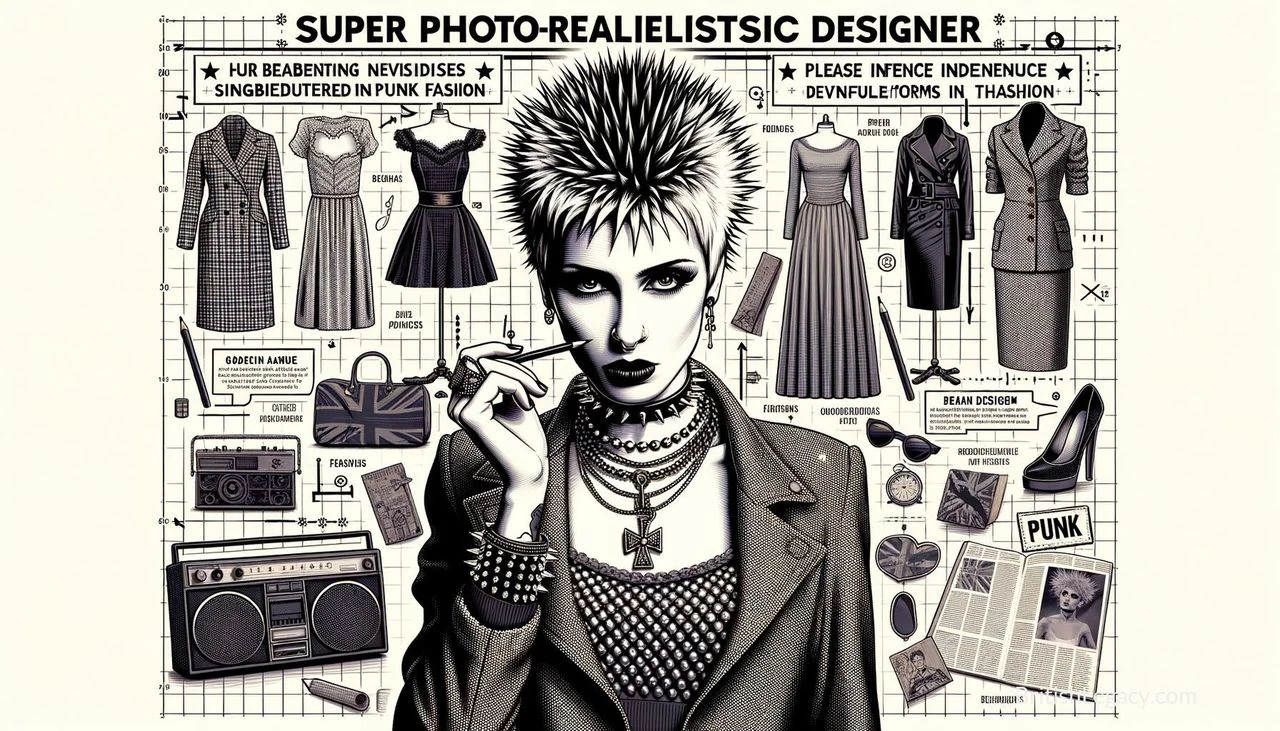
SEX became a meeting place for the London punk scene. Its deliberately provocative clothes drew on fetish and sado-masochistic imagery, with rubber garments, ripped fabric and conspicuous fastenings. At Seditionaries, Westwood developed pieces that became closely associated with punk: bondage trousers held by straps, loose-knit mohair jumpers and printed tops with exposed seams and unusual fastenings. Their disruption of conventional finish and dress codes made construction itself part of the statement.
Westwood and McLaren’s work intersected with music through the Sex Pistols, whom McLaren managed and whose members wore their designs. The clothes helped give punk a recognisable visual language at a moment when young people in Britain were developing a distinctive style and musical expression. Westwood later described her interest in punk as a way of seeing whether one could “put a spoke in the system”. That captures the challenge in the clothes without reducing their history to a single slogan or garment.
The shop’s names and designs changed, and Westwood’s work moved on too. After the partnership with McLaren ended, her inspirations shifted towards historical dress. The Pirate collection, shown to the media and international buyers, combined references to eighteenth- and nineteenth-century clothing, British history, textiles and African prints. Later collections included Savages, Buffalo/Nostalgia of Mud, Punkature and Witches. Historical research remained central as she reworked details such as corsets, neck ruffs, bustles and breeches rather than treating the past as a fixed style to copy.
Historical references and new silhouettes
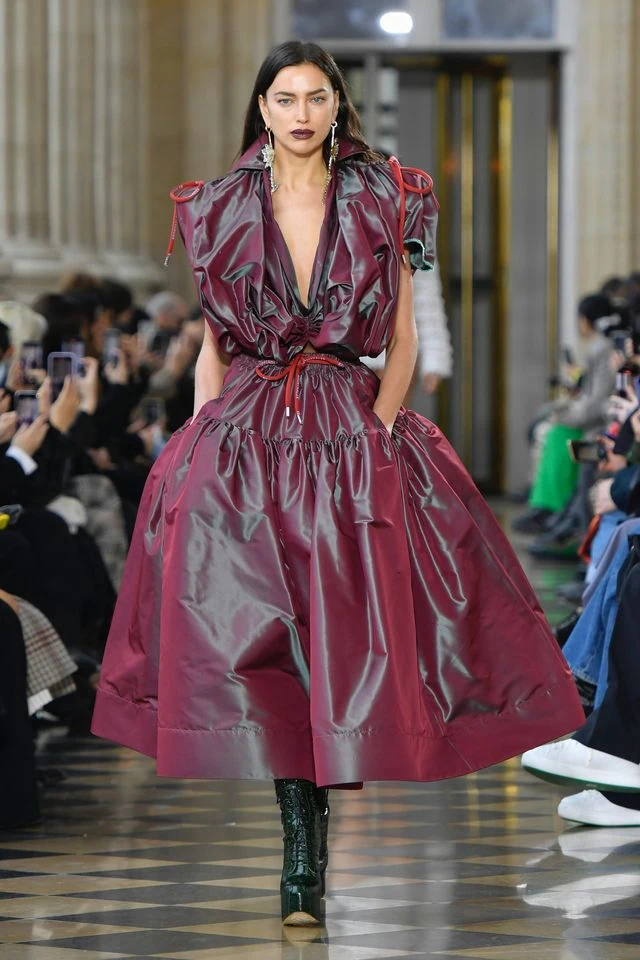
In the 1980s, Westwood’s work ranged well beyond the punk look. She described 1981–85 as her “New Romantic” period and 1988–91 as “The Pagan Years”. From 1985 to 1987, she explored the mini-crini: a short, bouffant form inspired by the Victorian crinoline and the miniskirt. The contrast brought together two different ideas about women’s clothing—restriction and liberation—and made the silhouette more than a decorative revival.
Her research drew on museum collections and historic art as well as clothing. The result could be theatrical, but its references were carefully assembled and recombined. In 1987, her Harris Tweed collection established a long-running relationship with the Scottish cloth and its authority. The collection helped bring Harris tweed back into fashion use. She also designed academic gowns for King’s College London, unveiled in 2008, adapting a traditional form to connect past, present and future. Her work with the college and her use of Scottish textiles show how her fashion could engage with institutions and makers as well as subculture.
Her designs also reached popular culture through commissions and appearances. She designed clothes for Duran Duran’s 1993 tour and for the 2008 film Sex and the City, in which a Westwood wedding dress became central to the story. She and her husband, Austrian designer Andreas Kronthaler, created outfits for Julian Assange’s 2022 wedding. These different settings demonstrate the breadth of her practice, from stage and screen to individual commissions.
Activism, business and recognition
Westwood used fashion and public appearances to engage with political causes. She supported civil liberties through a 2005 T-shirt campaign with Liberty, campaigned with the Campaign for Nuclear Disarmament and later backed the Green Party. Climate change and consumerism became recurring subjects in her statements and work. Her criticism of buying too much sat alongside a career in fashion, a tension she acknowledged rather than resolving with a simple claim to consistency. In 2009, she cut off her hair to draw attention to climate change and appeared in a PETA campaign addressing water use and vegetarianism.
Her business grew beyond its original London shop, with stores in Britain and abroad. In 2012, the company ended its long-standing UK franchise arrangement with Hervia after a legal dispute. The following year it cited pressure on margins amid wider retail conditions. Westwood subsequently said she would stop further business expansion as a way of addressing environmental and sustainability concerns. Her career therefore included both the reach of a global label and the question of how fashion businesses could respond to their environmental impact.
Westwood was appointed OBE in the 1992 Birthday Honours for services to fashion design and became a Dame Commander in 2006 for services to British fashion. She was named British Designer of the Year three times. In 2008, Heriot-Watt University awarded her an honorary degree, recognising her contribution to the industry and use of Scottish textiles. She died in Clapham, London, on 29 December 2022, aged 81.
Why Vivienne Westwood deserves a place in British Legacy
Westwood’s place in British Legacy rests first on the particular role she played in turning British punk into a visual language. Through the changing King’s Road shop and her work with Malcolm McLaren, she helped develop clothes that made rebellion legible in their cut, materials and finish. Rips, straps, exposed construction and provocative graphics disturbed expectations about what clothing should conceal or signify. Her work connected fashion to the music and disaffection of 1970s Britain, then carried its influence beyond that original scene.
Her achievement did not depend on repeating punk. Westwood built collections from close study of historical clothing, using the past to make new silhouettes and questions about dress, gender and tradition. Her work with Harris Tweed and King’s College London also shows a designer engaging with British institutions and textiles, not only with the street or the runway. Alongside these achievements, she used her platform to campaign on civil liberties, nuclear disarmament and environmental concerns. The record of her business complicates any easy account of sustainable fashion, but that tension makes her legacy more instructive: it shows how design, public argument and commercial practice can meet and conflict. Her influence lies in making those connections visible and widening the possibilities of what fashion could say.
Sources
Vivienne Westwood — Wikipedia revision
Adapted in part from Vivienne Westwood by Wikipedia contributors, under CC BY-SA 4.0. Text has been edited and combined with the existing article; this adapted text is shared under the same licence. Contributor history.

.jpg)