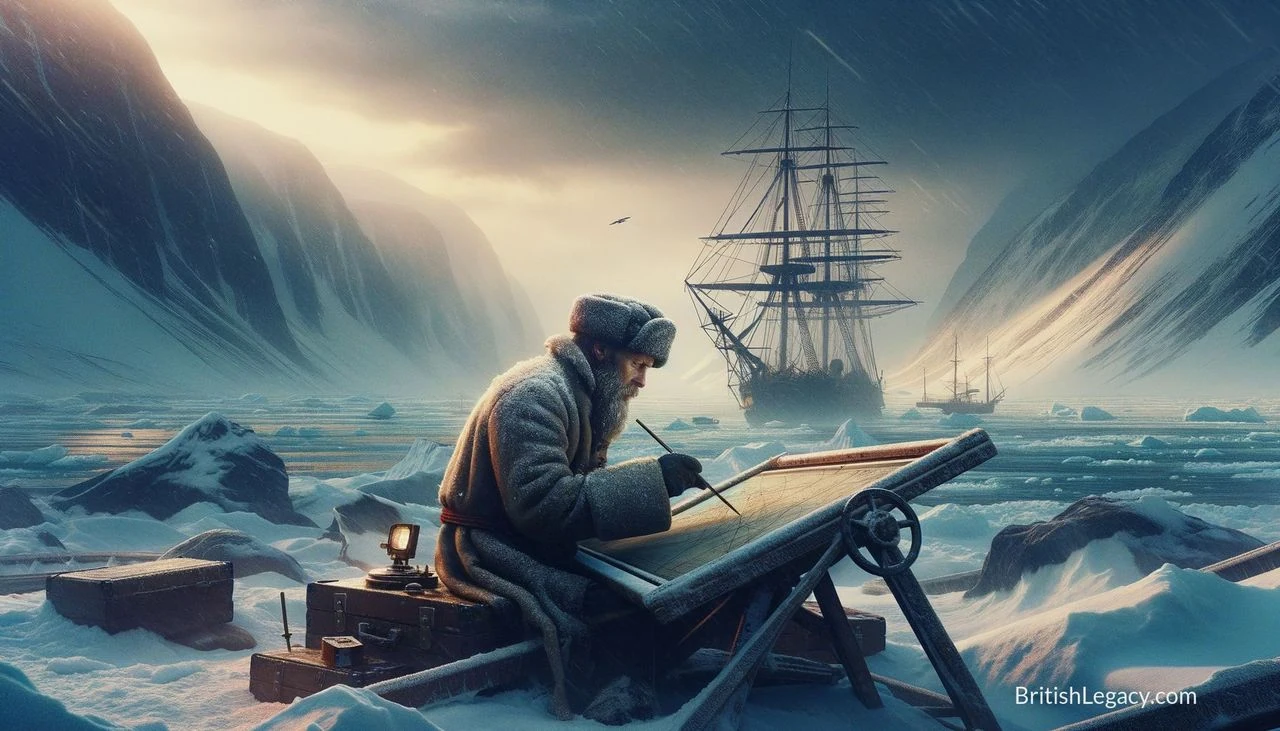
William Baffin’s Arctic voyages did not find the Northwest Passage, the hoped-for sea route between the Atlantic and Pacific. They did, however, take him farther north than any European explorer before him in that part of North America and produce observations whose accuracy was later confirmed by other navigators. The bay that bears his name is the most visible mark of his work, but his career also carried him from Greenland and the whaling grounds of Spitsbergen to the East India Company’s voyages in the Indian Ocean and Persian Gulf.
A life that begins in the records in 1612
Baffin’s early life is undocumented. The often-repeated birth estimate of about 1584 has no known documentary support; London has been suggested as his birthplace, but that too remains conjecture. The first known record of him is from 1612, when he served as chief pilot on Captain James Hall’s fourth expedition to Greenland. The voyage had been financed by English merchants after the Danish king withdrew support for Hall’s earlier efforts. Baffin returned to Hull after Hall was killed on Greenland’s west coast and Andrew Barker took command.
In the following two years, Baffin worked in the Muscovy Company’s whaling fleet off Spitsbergen. He served as a pilot on successive voyages, and in 1614 examined a considerable stretch of the coast before returning to London. Those years gave him experience in Arctic waters before he joined an English company formed to pursue the Northwest Passage.
Searching for a passage through the Arctic
In 1615 Baffin sailed as pilot of Discovery, under Captain Robert Bylot, to explore Hudson Strait. The expedition was looking for a route from the North Atlantic towards the Far East. Baffin’s careful tidal and astronomical observations proved sufficiently accurate that William Edward Parry was able to confirm them when he travelled over the same ground in 1821.
Baffin returned to the Arctic in 1616, again as pilot of Discovery. Sailing west of Greenland and up Davis Strait, the expedition reached the large bay now known as Baffin Bay. Baffin also named several sounds at its head after members of the Northwest Passage company: Lancaster, Smith and Jones. He sailed more than 300 statute miles farther north than John Davis had, reaching about 77° 45′ N. His progress offered little hope of an ice-free route to the Orient, and the area was not explored again for two centuries. His northern limit in North America remained unsurpassed until 1852.
The expedition’s achievement was not simply a matter of reaching a high latitude. Baffin recorded the coast and the waterways branching from the bay, providing information for subsequent navigators. The Northwest Passage remained undiscovered, but the voyage made the geography of a substantial Arctic region more legible to Europeans.
From Arctic pilot to East India Company navigator
After the passage project was abandoned, Baffin entered East India Company service. He sailed east in 1617 as master’s mate on Anne Royal, travelling with a fleet that reached southern Africa and Surat in India. His ship then made separate voyages to Mocha, Yemen, and other ports in the Red Sea and Persian Gulf. When he returned to London in September 1619, the company gave him special recognition for the valuable charts he had made during the voyage.
In 1620 Baffin sailed east again, this time as master of London, on an expedition under Captain Andrew Shilling. After reaching India, the fleet went in search of Portuguese and Dutch ships. Shilling was wounded in a battle in the Gulf of Oman in December and died in January 1621.
Baffin’s own final voyage took him to Qeshm, off the coast of Persia, in January 1622. The East India Company had joined Persian forces in an attack on Portuguese strongholds. On 23 January, Baffin went ashore with geometrical instruments to measure the height and distance of the walls of Fort Queixome, information intended to help the fleet’s gunners. A shot from the fort struck him in the abdomen and killed him. He died not while charting the Arctic, but during a military operation in the Persian Gulf.
Charts, observations and a name on the map
Baffin’s journals were the only surviving accounts of several of his voyages. Samuel Purchas printed extracts in 1625, but the charts and hydrographic observations were left out because printing them was too expensive. Almost all the charts were subsequently lost. As a result, Baffin’s discoveries came to be doubted until the explorer John Ross led an expedition in 1818 that confirmed his account in almost all particulars.
His reputation rests not only on the extent of his travels but on the care of his measurements. Baffin’s records included tidal, astronomical and magnetic observations, and he is credited with the first recorded reckoning of longitude at sea by lunar distances, on 26 April 1615. The ability to compare a ship’s position with observations of the Moon offered navigators a way to address a central challenge of determining longitude at sea. His work joined practical seamanship to systematic measurement.
Baffin Bay and Baffin Island were named in his honour, and he supplied names for several features around the bay. His name also survives in the William Baffin rose. These reminders of his reach sit alongside a more complicated record: some of his most valuable work was not preserved in the charts he produced, and the recognition of his Arctic discoveries depended on later voyages that tested his descriptions.
Why William Baffin deserves a place in British Legacy
William Baffin deserves a place in British Legacy for the quality and practical value of his navigation. On the 1615 and 1616 voyages, he recorded the tides and astronomical positions of Arctic waters, charted a bay and its branching sounds, and reached a latitude that no European explorer in that part of North America surpassed for more than two centuries. His observations could be checked against later journeys: Parry confirmed his measurements in Hudson Strait, while Ross’s 1818 expedition vindicated much of Baffin’s account after his charts had been lost and his discoveries questioned. That record shows how geographical knowledge is built not only by reaching unfamiliar places but by making observations precise enough for others to use.
His career also connects English exploration across very different settings. Baffin moved from Greenland and Spitsbergen to the East India Company’s routes through India, the Red Sea and the Persian Gulf. The same attention to measurement that served Arctic navigation was central to the task that took him ashore at Qeshm, where he was killed measuring a fort for the fleet’s gunners. His name remains attached to a major Arctic bay and island, but his wider legacy lies in the evidence he gathered, the routes he helped describe and the later explorers who were able to test his work. Those are specific contributions to navigation and geographical knowledge, not simply symbols of an abstract spirit of exploration.
Sources
William Baffin — Wikipedia, revision 1368649887 · William Baffin — Wikipedia
Adapted in part from William Baffin by Wikipedia contributors, under CC BY-SA 4.0. Text has been edited and combined with the existing article; this adapted text is shared under the same licence. Contributor history.