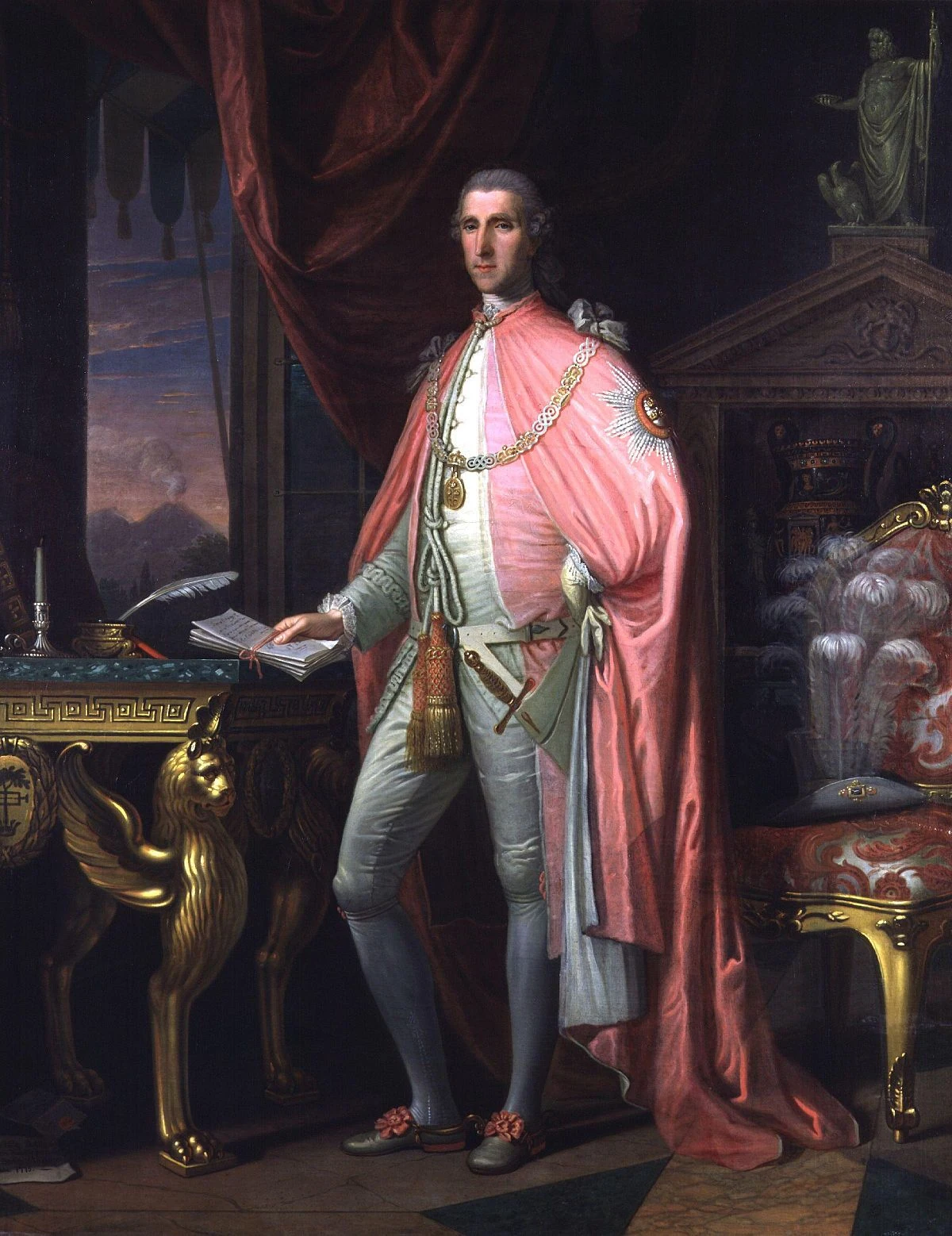
William Hamilton’s years as Britain’s ambassador in Naples placed him near two subjects that became central to his work beyond diplomacy: the volcanic activity of Mount Vesuvius and the remains of the classical world. He recorded volcanic phenomena and published accounts of volcanoes; he also collected Greek and Roman antiquities and presented them in print. His career connected these interests in Italy with British audiences and institutions.
A long diplomatic posting
Born on 12 January 1731, Hamilton was appointed British ambassador to the Kingdom of Naples in 1764. He remained in the post until 1800. Naples offered an unusual setting for a diplomat with interests in natural science and antiquity: Vesuvius was close at hand, while the surrounding region’s classical remains gave scope for collecting and study.
Hamilton’s diplomatic responsibilities and scholarly interests ran alongside one another. His posting provided continuity and proximity: he could observe activity around Vesuvius during his years in Naples and pursue antiquarian collecting in the same setting. The surviving account offers no particular negotiations or political episodes, so the clearest record of his time in office is its duration and the context in which his scientific and antiquarian work developed.
Recording volcanoes
During Hamilton’s tenure, Vesuvius erupted several times. He observed and documented volcanic phenomena at first hand, turning events in the landscape around Naples into material for study and publication. His work included Observations on Mount Vesuvius, Mount Etna, and Other Volcanoes, whose title indicates that his interest extended beyond the volcano nearest his post.
Observation and written record were central to this work. Hamilton did not simply encounter volcanoes as a striking feature of the Neapolitan landscape: he watched their activity and reported on it. His publications contributed to the period’s interest in natural science. They also show how his diplomatic residence in Naples gave him sustained access to phenomena that could be described and shared with readers elsewhere.
Antiquities gathered and published
Hamilton collected Greek and Roman antiquities, including vases and sculptures. He sought to bring these objects to wider attention, not merely to assemble them. His publication Collection of Etruscan, Greek, and Roman Antiquities from the Cabinet of the Honble. Wm. Hamilton presented material from his collection to readers through a printed account. In doing so, it offered a route for people beyond Naples to engage with ancient art.
Some of Hamilton’s collections were acquired by the British Museum, linking his collecting in Italy with a British public institution. The account also describes his publications as reaching a broader European readership. Taken together, collecting and publishing gave his antiquarian work two forms: the objects themselves, some of which entered the museum, and the printed presentation through which readers could encounter ancient material.
Marriage and reputation
Hamilton’s marriage to Emma, later known as Lady Hamilton, connected his biography with that of Admiral Horatio Nelson. Emma’s relationship with Nelson has often attracted attention, but it is distinct from William’s own record of diplomatic service, volcanic observation and antiquarian publication. Those activities give a separate account of his work and its significance.
Why William Hamilton deserves a place in British Legacy
Hamilton’s British significance is grounded in his diplomatic service and in the work he pursued from that position. As Britain’s ambassador in Naples from 1764 to 1800, he lived for decades close to Vesuvius and to classical antiquities. He observed volcanic activity, documented what he saw and published accounts that brought these subjects to readers beyond the city. His career shows how a diplomatic posting could become a base for sustained observation and scholarship, while remaining distinct from the political duties of the office.
His antiquarian work also made a tangible connection between Italy and Britain. Hamilton collected Greek and Roman objects, published a work presenting antiquities from his cabinet, and saw some of his collections acquired by the British Museum. That combination matters: objects could enter a British institution, while publication offered readers a way to encounter ancient art beyond the collection itself. Remembering Hamilton in British Legacy means recognising these specific contributions rather than relying on general praise. His story joins British diplomatic presence abroad with the recording of natural phenomena and the movement of classical material into British cultural life.