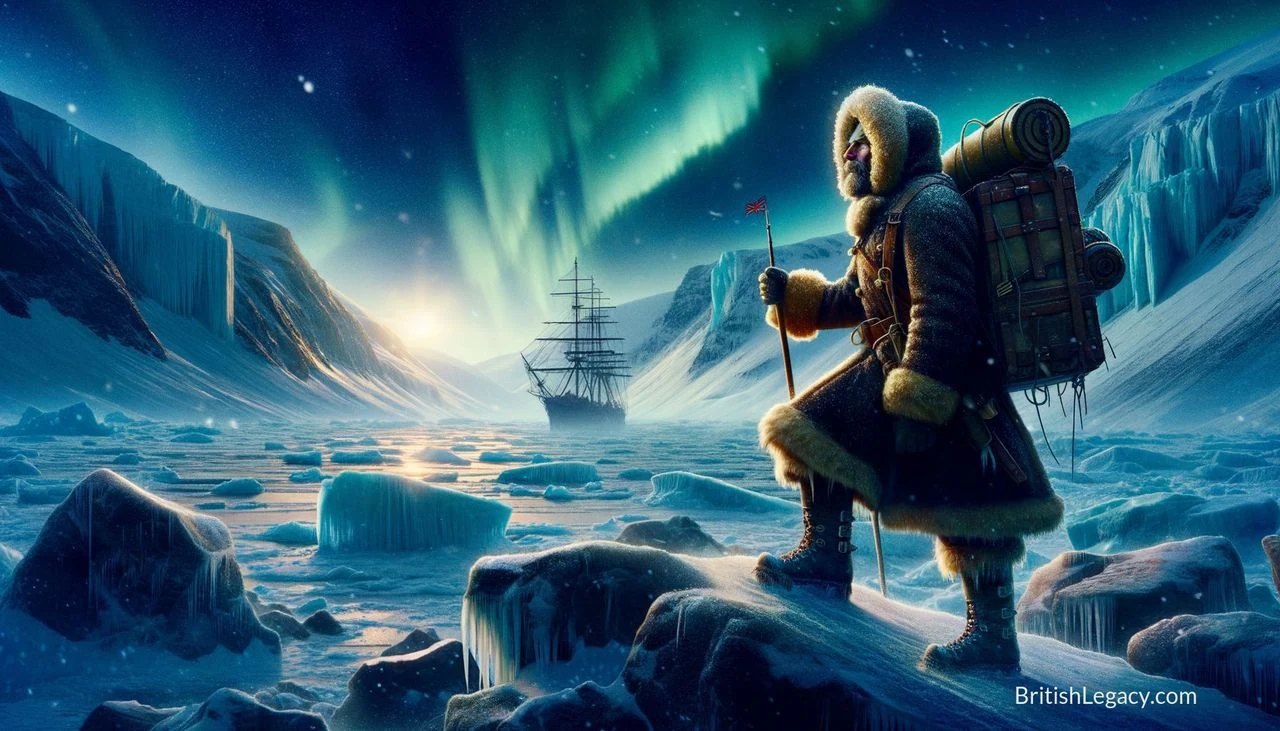
William Edward Parry’s Arctic expeditions combined a search for a navigable route with the practical demands of keeping a crew working through long polar winters. His 1819 voyage aboard HMS Hecla and HMS Griper pushed west through the archipelago to a record longitude, while his 1827 attempt to reach the North Pole set a northern record that stood for 50 years. The voyages were ventures of exploration, but also exercises in navigation, observation and life aboard ship in severe conditions.
A naval officer enters the Arctic
Parry was born in Bath, Somerset, on 19 December 1790. He joined the Royal Navy as a midshipman and first entered the Arctic in 1818, serving under Sir John Ross. At the time, British expeditions were searching for a Northwest Passage: a sea route linking the Atlantic and Pacific Oceans that might shorten journeys between them.
In 1819 Parry received his first independent command, leading HMS Hecla and HMS Griper into Baffin Bay and westwards in search of the passage. The expedition reached approximately 110 degrees west, then the furthest west longitude achieved in the archipelago. Its ships spent the winter in the Arctic, making the wellbeing and morale of the crew part of the work of exploration.
Parry’s approach included schooling, theatrical performances and a shipboard newspaper. The expedition also attended to diet and fresh provisions in efforts to prevent scurvy. These measures were not incidental to the voyage: a crew able to endure the winter and remain organised could continue the expedition’s work. The account of the voyage presents these routines alongside its geographical achievement, showing how exploration depended on preparation as well as navigation.
The 1827 attempt on the Pole
Parry’s best-known polar venture began in 1827, when he set out from the Svalbard Archipelago to reach the North Pole. The expedition travelled across drifting sea ice, which made progress difficult and at times reversed it. Parry and his crew reached latitude 82°45′ north, a record that remained unbroken for 50 years. They did not reach the Pole, but the attempt extended the known limit of northern travel.
His Arctic work also involved scientific observation. The account credits Parry’s expeditions with recording magnetic phenomena, flora, fauna, climate and celestial observations. Such work placed geographical exploration alongside the collection of information about the polar environment. It also gave the voyages a purpose beyond finding a route: observations made in the field could contribute to contemporary knowledge of the Arctic.
Recognition and the wider expeditionary legacy
Parry was knighted in 1829. His work is also associated with the Royal Geographical Society’s Gold Medal. The Arctic expeditions are described as an influence on later explorers, including Sir John Franklin and Roald Amundsen, though the account gives no further detail about the nature of that influence.
His career belongs to a period when British naval expeditions sought routes, mapped unfamiliar regions and gathered scientific observations. The Northwest Passage remained the motivating aim of the 1819 voyage, while the 1827 expedition pursued a different geographical limit. Together, the journeys connected naval command with the practical organisation of crews and the accumulation of knowledge about the polar regions.
Why William Parry deserves a place in British Legacy
Parry’s place in British Legacy rests on specific achievements rather than on a general image of heroic exploration. In 1819, his command of HMS Hecla and HMS Griper carried an expedition to approximately 110 degrees west, then a record for the archipelago. In 1827, he led a difficult journey over drifting ice to latitude 82°45′ north. Although the North Pole remained beyond reach, that latitude stood as a record for 50 years. The milestones show how far organised expeditions could travel into the Arctic before the limits of ice and distance turned them back.
The voyages also joined geographical ambition to the less dramatic work that made sustained exploration possible. Winter schooling, performances, a newspaper and attention to provisions were ways of maintaining a functioning crew in isolation; observations of the Arctic’s natural and magnetic features added a scientific dimension to the journeys. Parry’s British legacy therefore lies not only in the distances recorded, but in an expeditionary practice that combined navigation, crew management and observation. His story preserves both the scale of the undertaking and the methods by which people attempted it.