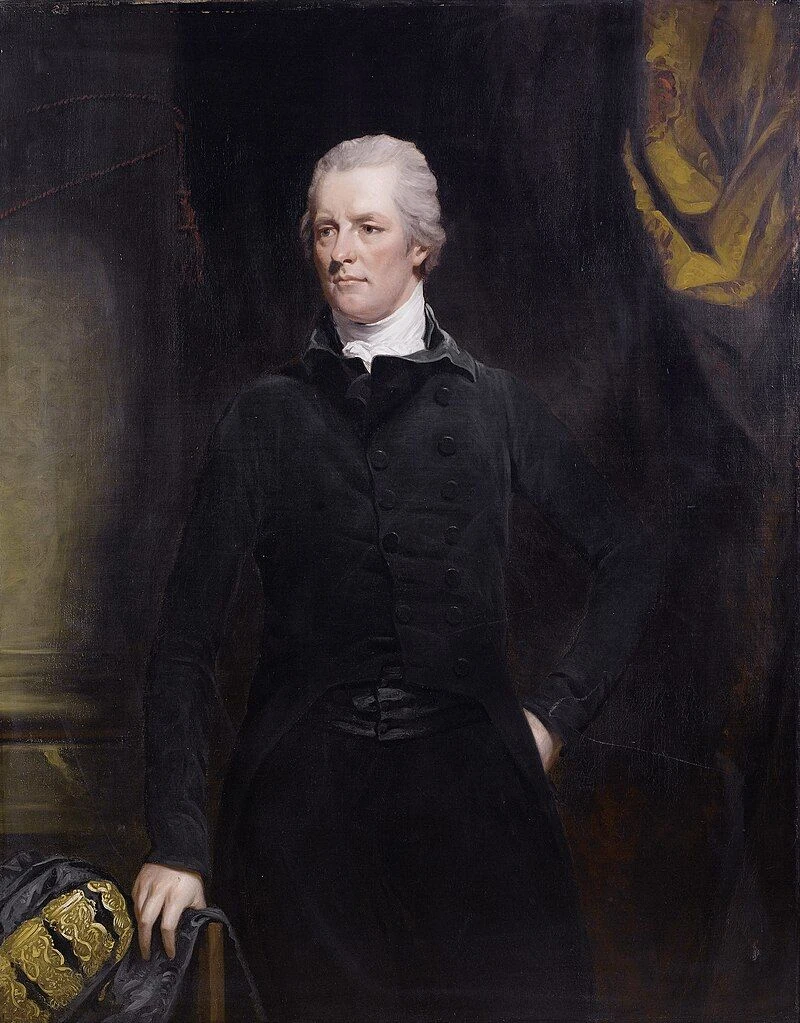
William Pitt the Younger became prime minister in 1783, aged 24, and spent much of the next two decades at the centre of British public life. His governments reworked the oversight of the East India Company, sought to improve the collection of revenue and took Britain through war with revolutionary and Napoleonic France. Pitt also helped bring about the union of Great Britain and Ireland. His career was marked not only by these changes but by failed efforts at parliamentary reform and Catholic emancipation, and by laws that restricted political activity during wartime.
A political education and an early start
Pitt was born at Hayes Place in Kent on 28 May 1759, the second son of William Pitt, Earl of Chatham, who had also served as prime minister. His mother, Hester Grenville, came from another political family. Plagued at times by poor health, the young Pitt was educated at home before entering Pembroke College, Cambridge, in 1773, aged 13. He studied classics, history, mathematics and political philosophy, among other subjects. At Cambridge he met William Wilberforce, who became a lifelong friend and political ally.
In 1780 Pitt unsuccessfully contested the University of Cambridge seat. He entered Parliament the following year as MP for Appleby, a constituency secured through the patronage of James Lowther. In the Commons, he opposed continuing the American War of Independence and supported proposals for parliamentary reform. He did not, however, advocate extending the franchise broadly. In 1782, after Lord North’s government fell, Pitt became Chancellor of the Exchequer in Lord Shelburne’s ministry.
When the Fox–North coalition collapsed in December 1783, George III appointed Pitt prime minister. His government initially faced a hostile majority in the Commons and lost a motion of no confidence. Pitt stayed in office, and the general election of 1784 gave his administration a majority. From that year until his death, he represented Cambridge University in Parliament. He also served as Chancellor of the Exchequer throughout his premierships.
Reform, revenue and trade
Pitt’s first administration sought to strengthen government oversight as well as address the public finances. The India Act of 1784 reorganised the supervision of the East India Company. It established a Board of Control and increased government authority over the company’s affairs, part of a wider effort to bring its administration under closer scrutiny.
The American war had sharply increased the national debt. In 1786 Pitt established a sinking fund, setting aside money intended to accumulate interest and help reduce that debt. His government also changed customs duties on goods including tea, wine, spirits and tobacco. By lowering tariffs on goods that were often smuggled, it aimed to encourage legal imports and improve revenue collection. In 1797, wartime pressure on the kingdom’s gold reserves led Pitt to suspend the exchange of banknotes for gold. He also introduced income tax, helping to offset a decline in indirect tax revenue as trade fell.
His economic policy included an interest in freer trade. The 1786 Eden Agreement with France sought to reduce tariffs and expand commercial exchange. War between the two countries later curtailed the agreement. Pitt also introduced a parliamentary reform bill in 1785, proposing changes to the representation of boroughs and a limited extension of the franchise. The bill failed, and he made no further reform proposal to Parliament. His financial and administrative changes were significant, but they did not amount to a wider settlement of the political questions he had confronted.
War and restrictions at home
The French Revolution changed the course of Pitt’s premiership. Britain went to war with revolutionary France in 1793, and Pitt sought European alliances to limit French influence. The first coalition against France failed; a second coalition also failed to defeat the French. Britain relied heavily on naval power and on financial support for its allies, while the conflict placed mounting demands on public resources.
The government’s response to political radicalism brought restrictions on civil liberties. Habeas corpus was suspended, and the Seditious Meetings Act of 1795 restricted public gatherings. The Combination Acts limited the formation of organisations advocating political reform. In 1794, the government tried three people for treason; the trials did not result in convictions. These measures formed part of a period in which ministers treated revolutionary ideas and domestic dissent as matters of security. They are an important counterweight to accounts of Pitt that focus only on administrative reform or wartime leadership.
War also brought military and political crises at home. In 1797, sailors at Spithead mutinied over pay; Pitt agreed to increases and the mutineers were pardoned. The later mutiny at the Nore, which took a more political form, was handled more repressively. The continuing conflict with France put pressure on the finances and exposed the limits of efforts to contain French power through coalitions.
Ireland, union and resignation
Ireland became both a political question and a security concern for Pitt’s government. The United Irishmen sought independence and republican government, while French expeditions attempted to support the movement. The Irish rebellion of 1798 reinforced Pitt’s conviction that the political relationship between Ireland and Great Britain should change. He pursued a legislative union, secured through the Acts of Union 1800, which took effect in 1801 and created the United Kingdom of Great Britain and Ireland.
Pitt wanted the union to be accompanied by concessions to Catholics, who faced political restrictions. George III opposed Catholic emancipation, and Pitt resigned in 1801. His successor was Henry Addington. Pitt’s failure to secure emancipation left unresolved one of the central questions attached to the new union. His earlier failure to pass parliamentary reform likewise meant that important changes to representation remained unrealised.
After leaving office, Pitt initially supported Addington’s administration. When war with France resumed after the Treaty of Amiens, he became increasingly critical of the government. Addington’s support weakened, and Pitt returned as prime minister on 10 May 1804. He hoped to form a broad coalition, but George III opposed including Charles James Fox. Pitt’s second ministry was consequently narrower than he had intended.
The second ministry and Pitt’s death
Pitt’s second premiership coincided with the War of the Third Coalition. Britain joined Austria, Russia and Sweden against Napoleonic France. In October 1805, Admiral Horatio Nelson’s victory at Trafalgar secured British naval supremacy. It did not, however, produce victory for the coalition as a whole: Austria’s defeats at Ulm and Austerlitz later that year contributed to its collapse. The naval success and the coalition’s failure formed part of the same unsettled wartime picture.
Pitt’s health had been poor from childhood. He died at Bowling Green House on Putney Heath on 23 January 1806, aged 46, while still prime minister. He was buried in Westminster Abbey. Parliament agreed to pay his debts and approved a public funeral and a monument. He had no children; his first cousin William Grenville succeeded him as prime minister.
Pitt’s record resists a simple verdict. His governments changed how the state supervised the East India Company and raised revenue, but the wars brought enormous financial pressure. He helped bring about the union with Ireland, yet did not secure Catholic emancipation. His government defended the state against what it saw as revolutionary danger, but did so partly through measures restricting civil liberties and political organisation. His contributions and failures belong together in any account of his public career.
Why William Pitt the Younger deserves a place in British Legacy
Pitt deserves a place in British Legacy because his long time in office connects practical changes to the machinery of government with the pressures that shaped Britain at the turn of the nineteenth century. He became prime minister at 24, served in that office across two premierships and was also Chancellor of the Exchequer throughout them. The India Act of 1784 increased government supervision of the East India Company; the sinking fund and changes to customs duties reflected attempts to manage debt and make revenue collection more effective. The Eden Agreement, meanwhile, shows that his programme included commercial exchange as well as finance, even though war curtailed that agreement.
His legacy also matters because it includes the consequences and limits of government power. Pitt’s administration helped create the United Kingdom through the union with Ireland, but Catholic emancipation remained unresolved. Its restrictions on meetings and political organisation, introduced amid fear of revolutionary upheaval, show how the protection of public order could come at a cost to civil liberties. Pitt failed to secure parliamentary reform, and war strained the public finances his governments had sought to repair. Remembering both the reforms and these costs gives a more useful account than treating him as either a flawless statesman or simply a wartime leader. His career brings together questions of administration, debt, representation, religion and security that shaped British political life beyond his own lifetime.
Sources
William Pitt the Younger — Wikipedia, revision 1379640969
Adapted in part from William Pitt the Younger by Wikipedia contributors, under CC BY-SA 4.0. Text has been edited and combined with the existing article; this adapted text is shared under the same licence. Contributor history.