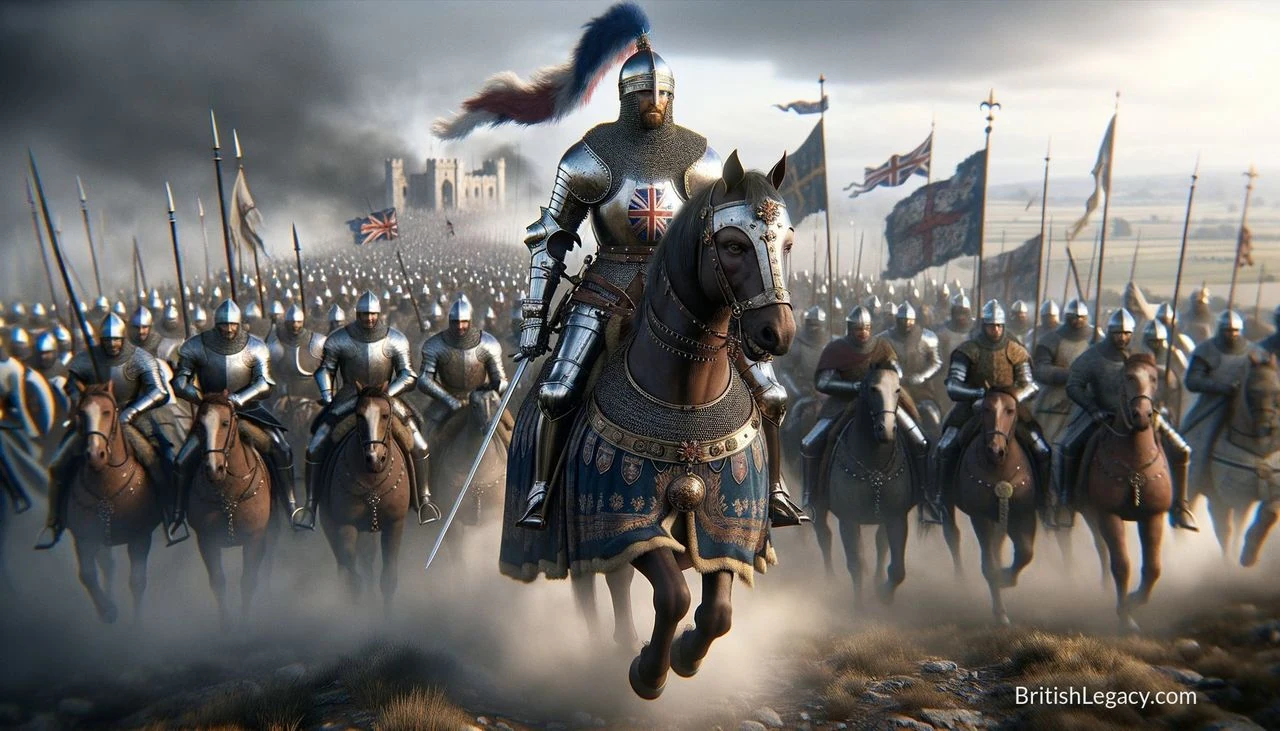
William’s victory at Hastings did not settle England’s future in a single day. After defeating and killing Harold Godwinson on 14 October 1066, the duke of Normandy still had to secure the kingdom, face resistance and build a government that could hold his new possession. His reign brought a new aristocracy and widespread castle-building, while the Domesday survey made land and obligation legible to royal authority. The changes were profound, though William did not merge England and Normandy into one state. His achievement was conquest followed by an often forceful, practical consolidation.
A duke whose authority had to be won
Born at Falaise around 1028, William was the son of Robert I, Duke of Normandy, and Herleva, who was not married to Robert. William was consequently sometimes called William the Bastard. He succeeded his father as duke in 1035, while still a child, and spent years negotiating the rivalries and rebellions that threatened his position. In 1047 he defeated a revolt at Val-ès-Dunes with support from King Henry I of France. His authority over Normandy was not fully secure until about 1060.
Marriage to Matilda of Flanders in the 1050s strengthened his standing and gave him a powerful ally. William also expanded his influence beyond Normandy, securing control of Maine by 1062. These years matter to the story of 1066: the invasion was not the first time he had assembled military and political power against determined opposition.
William’s claim to the English throne rested partly on his assertion that Edward the Confessor had promised him the succession. The claim was contested. On Edward’s death in January 1066, Harold Godwinson became king; he had been named by Edward on his deathbed, according to one account, and was chosen by English magnates. William also maintained that Harold had sworn to support his claim, though whether Harold made that journey and oath is uncertain. The competing accounts help explain why the invasion was framed by William as a claim to a crown, not simply an attempt to take one.
Hastings, the crown and continued resistance
William assembled an army and fleet in Normandy and landed at Pevensey on 28 September 1066. Harold had just marched south after defeating a Norwegian invasion force at Stamford Bridge. On 14 October, at the Battle of Hastings, the English army fought from a defensive position on a ridge. William’s forces included cavalry, infantry and archers; Harold’s was principally an infantry force. The battle lasted through the day. Its precise course is disputed in the surviving accounts, but Harold was killed and the English defence collapsed.
William was not crowned immediately after the battle. He secured positions including Dover and Canterbury, then advanced towards London. Edgar the Ætheling was nominated as king by some English leaders, but William’s forces reached the capital. William was crowned at Westminster Abbey on Christmas Day 1066.
Coronation did not end English resistance. Revolts followed, and in 1069 a Danish force joined rebels in the north. William responded with a campaign remembered as the Harrying of the North. His forces ravaged parts of the countryside; the scale and extent of the destruction remain matters of historical debate, but the campaign was violent and intended to break resistance. William also built castles as military strongholds and instruments of control. The White Tower, the central keep of the Tower of London, was among the fortifications associated with his reign. By 1075, his hold on England was largely secure.
Rule across two separate domains
William’s new kingdom needed administration as well as garrisons. He relied on a mixture of existing English arrangements and Norman personnel. England’s shires, sheriffs and established methods of collecting royal revenue continued, even as the upper ranks of landholding and the Church changed. By his death, most of the Anglo-Saxon aristocracy had been replaced by Norman and other continental magnates. Land grants and the military obligations expected of the new elite helped bind the kingdom to its conqueror.
It is misleading, however, to describe William’s territories as a single, unified state. He ruled England and Normandy separately, retaining their distinct administrative systems. He moved between them, leaving deputies to govern when he was absent. In England, he continued to collect danegeld, a land tax, and used his extensive royal holdings to reinforce his position. The result was not a uniform new system imposed everywhere, but a ruler adapting the government of each territory to his authority and needs.
At Christmas 1085, William ordered a survey of landholding in England. The resulting Domesday Book records property and its holders, including who held land before the Conquest, assessments of value and details of resources. The work was substantially complete by August 1086. It offered the Crown a systematic account of land and taxable wealth, and remains an unusually detailed record of England at the time. Its purpose is not entirely certain, but recording obligations and supporting taxation were likely among its uses.
Death and a disputed legacy
William’s last years included renewed conflict with his eldest son, Robert, who challenged his authority. In 1087 William campaigned in northern France against the French king’s territory. He became ill or was injured during the campaign and died at Rouen on 9 September 1087. He was buried at the abbey he had founded at Caen. Normandy went to Robert; England passed to William’s second surviving son, who became William II.
The conquest changed the composition of England’s ruling class and clergy and brought the kingdom into closer contact with France. Norman French contributed substantially to the English vocabulary over time, while the language of the majority remained rooted in English speech. The effects were neither immediate nor simple: linguistic change unfolded over generations, and historians have differed over how far the Conquest transformed existing institutions. William’s rule also did not create a straightforward path to a unified British state. Its importance lies in the lasting changes to England and in the contested process by which they were imposed.
Why William the Conqueror deserves a place in British Legacy
William belongs in British Legacy because his reign marks a defining turning point in the history of England, one of the constituent nations of modern Britain. The significance is concrete: a Norman duke defeated the English king at Hastings, took the crown, and then had to make military victory endure. Castle-building, the redistribution of land and the replacement of much of the existing aristocracy altered who held power and how that power was maintained. The Domesday survey offers another measure of his rule: a detailed record of land and resources that helped the Crown understand the kingdom it had conquered.
That legacy should not be reduced to a story of efficient reform or inevitable progress. William’s authority was secured through invasion and coercion, and the Harrying of the North shows the human cost of resistance and its suppression. Nor did he create a single state from his English and Norman territories. A useful British account can hold these facts together: the conquest had enduring consequences for England’s government, landholding, Church and language, but its effects were uneven and contested. Remembering William in this way explains why 1066 remains central to British historical memory without turning conquest into uncomplicated praise.
Sources
William the Conqueror — Wikipedia, revision 1378707595
Adapted in part from William the Conqueror by Wikipedia contributors, under CC BY-SA 4.0. Text has been edited and combined with the existing article; this adapted text is shared under the same licence. Contributor history.