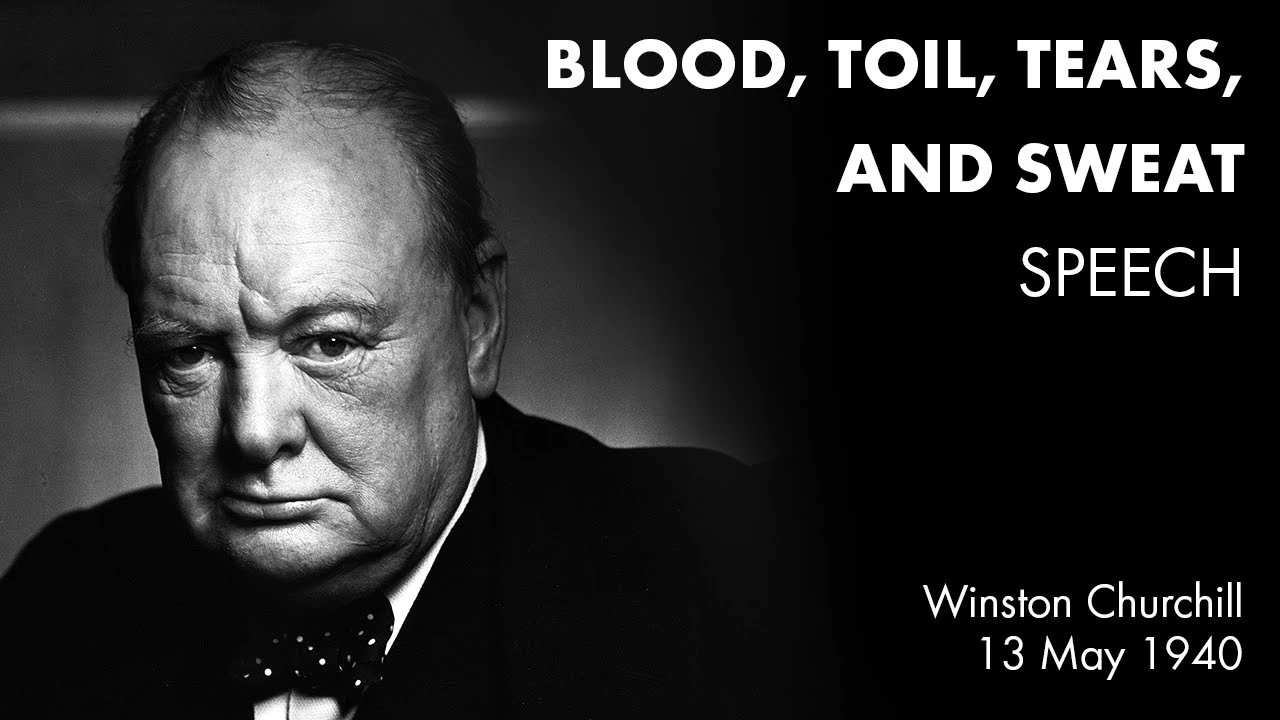
On 13 May 1940, Winston Churchill told the House of Commons that Britain faced “many, many long months of struggle and of suffering”. His first speech as Prime Minister offered no easy reassurance. Instead, he named the cost of the coming war, set out the government’s policy and defined its aim in a single word: “victory”. The speech’s force lies partly in that order: a new administration first explained the danger, then pledged itself to the task.
A new government in a widening war
Churchill became Prime Minister on 10 May 1940, succeeding Neville Chamberlain. The change came amid an immediate military crisis. German forces had invaded Belgium, Luxembourg and the Netherlands, while the Allied campaign in Norway had failed to prevent German occupation. In the Commons, a debate over the conduct of the war had weakened confidence in Chamberlain. Labour would not serve under him in a coalition, and Chamberlain advised the King to send for Churchill.
Churchill had been First Lord of the Admiralty since the outbreak of war in September 1939. His return to that post had given him a prominent role during the months of the so-called Phoney War, but becoming Prime Minister was a different responsibility. The new government had to command political support while directing a war whose dangers were already visible. Churchill formed a coalition administration, bringing together members of different parties. A war cabinet of five members was established, with other posts filled as rapidly as possible.
The first speech was therefore both a statement of purpose and an appeal to Parliament. Churchill asked the House to approve the steps already taken and to express confidence in the new government. The resolution put before it welcomed an administration representing “the united and inflexible resolve of the nation to prosecute the war with Germany to a victorious conclusion”. The speech joined that formal request to a frank account of the pressures on the country: fighting in Norway and the Netherlands, preparations in the Mediterranean, continuous air warfare and urgent work at home.
What Churchill promised—and what he did not
Churchill opened the speech by explaining that forming an administration of this scale was a serious undertaking, made harder by the war’s preliminary phase. He said he would not address the House at length. Then came the line that gave the speech its familiar name: “I say to the House as I said to those who have joined this Government: I have nothing to offer but blood, toil, tears, and sweat.”
It was not an offer of comfort or a forecast that victory would come quickly. Churchill described the ordeal as “of the most grievous kind” and warned of long months of struggle. His language made the scale of the commitment explicit: Britain would fight by sea, land and air, with all its strength, against what he called a “monstrous tyranny”. The policy was war; the aim was victory, however long or difficult the road.
The speech’s close widened the appeal beyond the immediate military crisis. Churchill argued that defeat would threaten not only the British Empire, but also what it represented and “the urge and impulse of the ages that mankind will move forward towards its goal”. He paired that argument with a personal statement of confidence, saying he took up the task with “buoyancy and hope”. His final appeal was collective: “come then, let us go forward together with our united strength.”
Those elements matter as much as the celebrated phrase. Churchill did not present himself as able to spare the country hardship. He presented a policy to Parliament, stated the danger plainly and asked for shared effort. The speech was not a detached account of the war’s progress: it was a new Prime Minister’s attempt to secure support for a government formed under the pressure of events.
The first address of a wartime premiership
Churchill’s first premiership lasted from 10 May 1940 until 26 July 1945. In the months immediately following the speech, the military position deteriorated sharply. The Allied evacuation from Dunkirk ended on 4 June. In a Commons speech that day, Churchill called it “a miracle of deliverance”, while making clear that the country would continue to fight. France fell later that month, and the prospect of a German attack on Britain became central to the crisis.
The May speech belongs to a sequence of wartime addresses, but it has a particular place in that sequence: it introduced Churchill’s premiership and its governing purpose before the most familiar phrases of later speeches. In June, he told the Commons, “We shall fight on the beaches”; in August, he praised the RAF airmen whose work was turning the tide. These later addresses drew on events as they unfolded. The first speech, by contrast, announced what the government intended to do before the outcome was known.
Churchill had built a public career as a politician and writer long before 1940. He entered the Commons in 1900 and served in a series of ministerial offices, including First Lord of the Admiralty during the First World War. His political record was not a simple march towards the premiership: he changed party affiliation, held offices under successive governments and spent much of the 1930s outside government. During those years, he warned against the growing threat posed by militarism in Nazi Germany and argued for rearmament.
That earlier record helps explain the authority he brought to the 1940 address, but it should not obscure the speech’s immediate setting. Churchill was speaking to a divided Parliament about a government still being assembled, while German advances threatened Britain’s allies. The address did not describe a settled victory or a completed national response. It made a case for unity and continued resistance at the beginning of a dangerous period.
Rhetoric, policy and the limits of a famous phrase
The best-known sentence is often remembered in isolation. In the Commons, however, “blood, toil, tears, and sweat” was part of a longer argument about administration, military fronts, policy and national survival. Churchill’s own words connect sacrifice to a clear objective: “without victory, there is no survival”. The phrase’s plainness gives it force, but the speech also shows him making an institutional appeal, asking elected representatives to approve the steps taken by the new government.
Its language was direct without pretending that words alone could settle the war. Churchill promised sustained effort, not an effortless triumph, and asked Parliament and the country to go forward together. That combination—an unvarnished account of the cost and an insistence on a defined aim—gave the speech its enduring form. Its rhetorical power rests not only in the memorable line, but in how that line sits within the argument.
There are limits to what this first address can stand for. Churchill’s long career included decisions and views that remain open to historical assessment; his wartime reputation should not be taken as a substitute for examining them. Nor does one speech, however well known, account for the work of the government, armed forces or public during the war. Its importance is more precise: it records how Churchill defined the task of his new administration and sought parliamentary backing for it at a moment of grave uncertainty.
Why Winston Churchill’s speech deserves a place in British Legacy
The speech deserves a place in British Legacy because it captures a consequential moment in the country’s political history with unusual clarity. Churchill became Prime Minister as Germany invaded western Europe and the conduct of the war was under parliamentary scrutiny. His address connected the formation of a coalition government to a public commitment: Britain would prosecute the war and pursue victory. The famous promise of “blood, toil, tears, and sweat” mattered because it rejected easy assurances and made the anticipated cost part of the case for continuing the struggle.
Its lasting value is also in the way it shows rhetoric working within democratic government. Churchill did not merely speak to an imagined national audience; he asked the House of Commons to approve the government’s actions and express confidence in its resolve. He described the military dangers, set out a policy and appealed for collective effort. That is a specific British connection: the address belongs to the Commons and to a constitutional transfer of power under wartime pressure, not simply to a general story of national character.
Remembering the speech alongside Churchill’s wider record allows a more complete account. He was a long-serving MP, held major offices before the war and warned during the 1930s about German militarism. His first address as Prime Minister brought those strands into a defining public statement at the start of his wartime leadership. It remains worth reading not as a complete history of the war, but as a precise record of the resolve his government asked Parliament to endorse.
Sources
Winston Churchill — Wikipedia, revision 1378790280
Adapted in part from Winston Churchill by Wikipedia contributors, under CC BY-SA 4.0. Text has been edited and combined with the existing article; this adapted text is shared under the same licence. Contributor history.