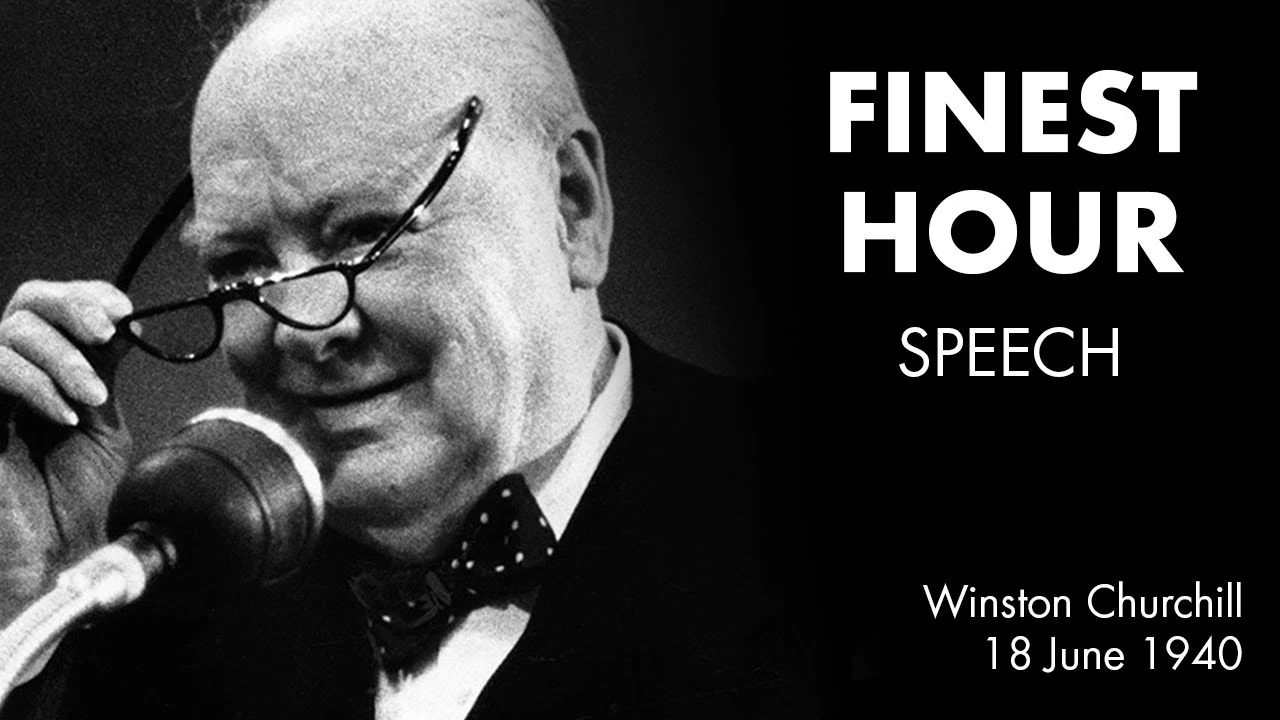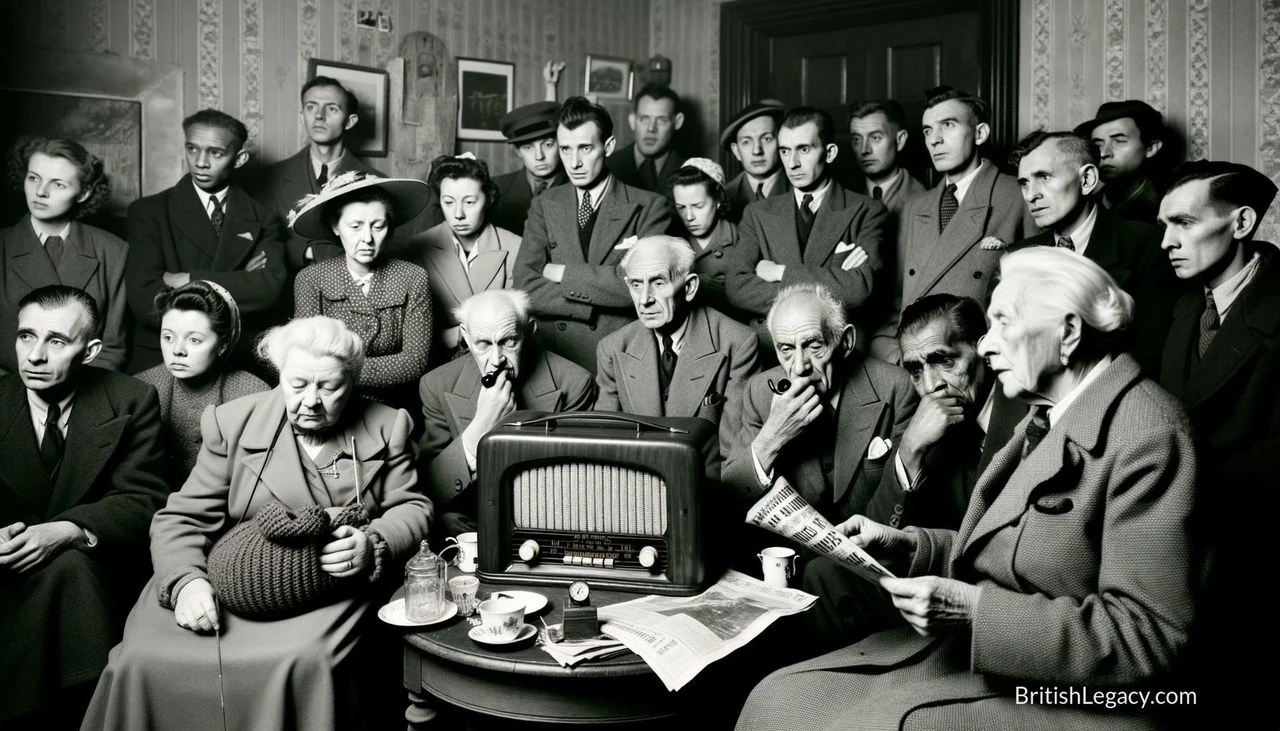
“I expect that the Battle of Britain is about to begin.” On 18 June 1940, Winston Churchill brought the House of Commons to the edge of the danger facing the country. His speech, remembered as “Their Finest Hour”, moved from the military reverses in France to a stark account of what Britain stood to lose. Its closing appeal—to brace for duty and act so that future generations would remember the moment—gave the address its name.
The speech was delivered two weeks after Churchill’s “We shall fight on the beaches” address of 4 June. The German conquest of France was not yet formally complete: Germany occupied Paris on 14 June, while the French armistice took effect on 25 June. Churchill spoke in the interval, with the defeat of Britain’s principal European ally imminent and an attack on Britain expected. The Battle of Britain followed in the summer of 1940.
A prime minister speaks to the danger
Churchill had become prime minister on 10 May 1940, succeeding Neville Chamberlain as German forces invaded Belgium, Luxembourg and the Netherlands. He formed a coalition government, bringing Labour leaders Clement Attlee and Arthur Greenwood into the war cabinet. In his first Commons speech as prime minister, on 13 May, he warned that the country faced a long struggle and set victory as its aim.
By 18 June, the British Expeditionary Force had been evacuated from Dunkirk, and France’s military position had collapsed. Churchill’s address looked beyond the immediate evacuation to the consequences of a British defeat. He described the coming contest as a test not only of Britain’s survival but of the wider prospects for Europe. His message was resolute, but not a promise of an easy or swift victory: he told the Commons to expect “many, many months of fighting and struggle”.
The speech’s structure carries that argument. Churchill began with the recent military disaster and the losses suffered by France and Belgium. He then turned to the British effort, naming “warriors, sailors and airmen”, before answering the questions he posed himself: what was the policy, and what was the aim? His answer—war by sea, land and air, and victory—made the stakes plain. The closing passage shifted from immediate danger to the judgement of posterity.
The argument in Churchill’s words
The passages below follow the supplied text of the address. Its claims about the fighting in France are presented as Churchill’s account to Parliament, rather than as an independent summary of events.
I spoke the other day of the colossal military disaster which occurred when the French High Command failed to withdraw the Northern Armies from Belgium at the moment when they knew that the French front was decisively broken at Sedan and on the Meuse. This delay entailed the loss of fifteen or sixteen French divisions and threw out of action for the critical period the whole of the French mobile reserve, at the moment when they were about to engage the main German offensive.
This delay was fatal. The French Army has been weakened, the Belgian Army has been lost, and the British Expeditionary Force has been evacuated. Only thirty thousand men were re-embarked from the whole French Army, most of them without their weapons, and they only have been able to do so because of the splendid efforts of the British Expeditionary Force in their rear guard actions, which hold the German advance for so long.
There has never been a period in all these long centuries, with any brave enterprise in the hand of the British, which has shown in such a small span of time the deeds and the doings of its warriors, sailors and airmen. We have before us an ordeal of the most grievous kind. We have before us many, many months of fighting and struggle.
You ask, what is our policy? It is to wage war, by sea, land, and air, with all our might and with all the strength that God can give us; to wage war against a monstrous tyranny, never surpassed in the dark, lamentable catalogue of human crime. That is our policy.
You ask, what is our aim? I can answer in one word. It is victory, victory at all costs, victory in spite of all terror, victory, however long and hard the road may be; for without victory, there is no survival.
Let that be realised; no survival for the British Empire, no survival for all that the British Empire has stood for, no survival for the urge, the impulse of the ages, that mankind will move forward towards its goal.
But I take up my task with buoyancy and hope. I feel sure that our cause will not be suffered to fail among men. I feel entitled at this juncture, at this time, to claim the aid of all, and I say, ‘Come then, let us go forward together with our united strength.’
What General Weygand has called [the] Battle of France is over. I expect that the Battle of Britain is about to begin. Upon this battle depends the survival of Christian civilization. Upon it depends our own British life, and the long continuity of our institutions and our Empire.
The whole fury and might of the enemy must very soon be turned on us. Hitler knows that he will have to break us in this Island or lose the war. If we can stand up to him, all Europe may be free and the life of the world may move forward into broad, sunlit uplands.
But if we fail, then the whole world, including the United States, including all that we have known and cared for, will sink into the abyss of a new Dark Age made more sinister, and perhaps more protracted, by the lights of perverted science.
Let us therefore brace ourselves to our duties, and so bear ourselves that if the British Empire and its Commonwealth last for a thousand years, men will still say, ‘This was their finest hour.’
From wartime rhetoric to a lasting phrase
Churchill’s position gave the address its immediate political weight. He was not a commentator looking back on a settled outcome: he was leading a coalition government as France fell and Britain prepared for attack. In August, during the Battle of Britain, he praised the RAF’s pilots in another Commons speech, declaring that “never in the field of human conflict was so much owed by so many to so few”. Together, the addresses show how he used Parliament to explain the danger, recognise the people doing the fighting and sustain the decision to resist.
His wartime leadership was one part of a long public career. Churchill was a Conservative MP from 1900, served in several ministerial offices before the war and returned to government as First Lord of the Admiralty when Britain declared war on Germany in September 1939. After leading Britain through the Second World War, he lost the 1945 election and became Leader of the Opposition. He returned as prime minister in 1951 and resigned in 1955. He was also a historian and writer, receiving the Nobel Prize in Literature in 1953. Those later chapters put the 1940 speech in perspective: it came at the start of his premiership, not as the summation of his entire career.
The most memorable line is also the speech’s clearest statement of purpose. Churchill invited listeners to see their conduct as part of a future historical judgement. That appeal did not establish what the outcome would be; rather, it framed the struggle and the responsibility of facing it. The famous closing sentence has since become a shorthand for Britain’s defiance in 1940, while the address as a whole records the uncertainty and urgency present at the time.
Why Winston Churchill’s ‘Their Finest Hour’ deserves a place in British Legacy
“Their Finest Hour” belongs in British Legacy because it captures a consequential moment in the country’s history through a particular, identifiable act of public leadership. Delivered in the Commons on 18 June 1940, it came as France’s defeat was unfolding and Churchill expected Britain to face the full force of German attack. The address did not conceal the length or difficulty of the struggle. Instead, it set out a policy of resistance and asked the country to understand the consequences of that choice. Its closing appeal remains memorable because it joined immediate responsibility with the prospect of future remembrance.
The speech also matters as an example of how parliamentary rhetoric can clarify a national crisis. Churchill moved from military events to policy, from policy to the stakes of defeat, and then to a direct call for collective effort. The later Battle of Britain and the wider Allied victory give the address a place in the story of wartime Britain, but should not obscure the uncertainty of the moment in which it was made. Preserving the speech alongside its chronology helps readers distinguish what Churchill feared and urged in June 1940 from what happened afterwards. That combination of words, setting and historical consequence gives this episode a specific British connection and enduring value.
Sources
Adapted in part from Winston Churchill by Wikipedia contributors, under CC BY-SA 4.0. Text has been edited and combined with the existing article; this adapted text is shared under the same licence. Contributor history.