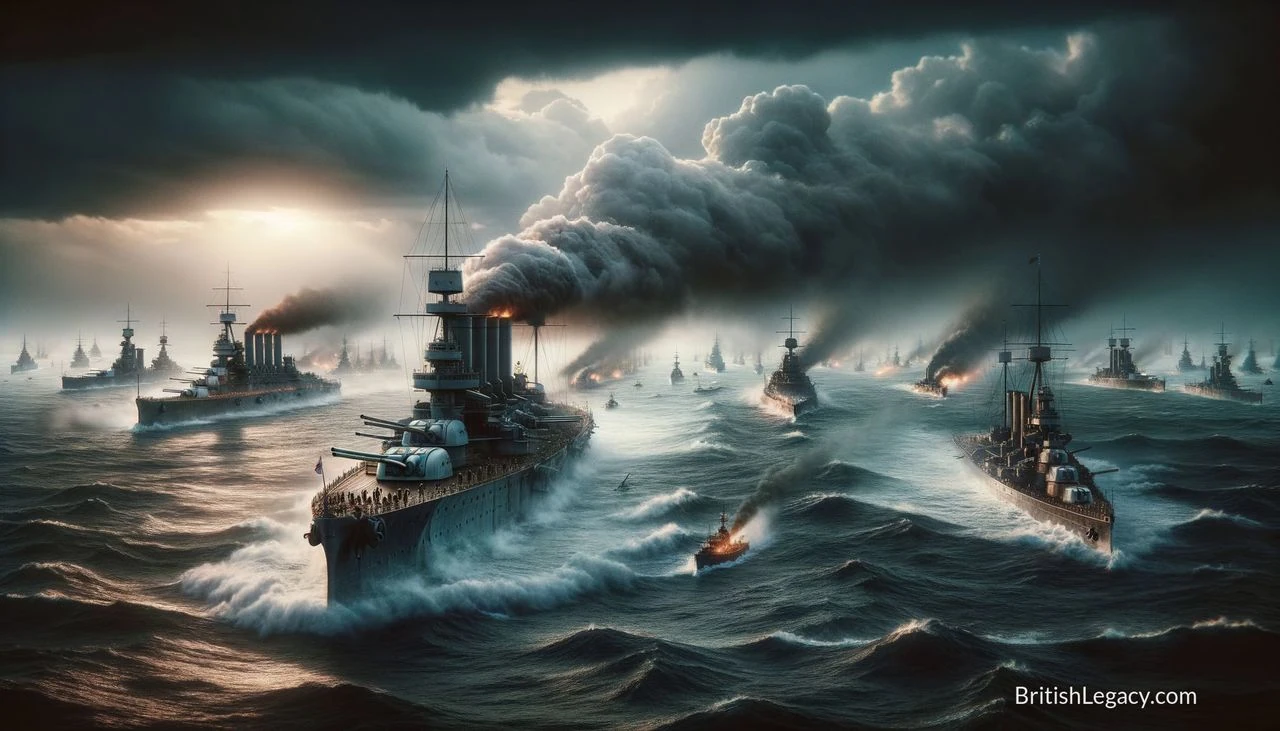
On 31 May 1916, British and German fleets met in the North Sea off Denmark’s Jutland Peninsula. The battle continued into the following day and became the largest naval confrontation of the First World War. It was costly for both sides and inconclusive as a tactical contest: neither navy achieved a decisive victory. But the German High Seas Fleet returned to port without breaking the British blockade, while the Royal Navy retained its position in the North Sea.
Two fleets, opposing aims
By 1916, control of the sea mattered to both sides. Britain’s Grand Fleet helped protect maritime supply lines and enforce a blockade of Germany. The German High Seas Fleet sought to challenge that position and break the blockade, which was restricting Germany’s access to resources.
British naval intelligence detected activity in the German fleet. The Grand Fleet, commanded by Admiral Sir John Jellicoe, went to sea alongside the Battlecruiser Fleet under Vice-Admiral Sir David Beatty. The German force was led by Vice-Admiral Reinhard Scheer, whose plan was to draw out and destroy part of the British fleet.
A battle in several engagements
Jutland unfolded as a series of engagements rather than one continuous clash. On the afternoon of 31 May, Beatty’s battlecruisers met the German scouting group commanded by Admiral Franz von Hipper. HMS Indefatigable and HMS Queen Mary were lost in the fighting, exposing the destructive force of modern naval guns.
As the Grand Fleet and High Seas Fleet came together, more than 250 ships, including battleships and destroyers, were involved. Jellicoe manoeuvred to bring the British fleet’s guns to bear across the German line, a position commonly described as “crossing the T”. Faced with the danger of being trapped, Scheer ordered his fleet to turn away. Fighting continued into the night.
Losses and an inconclusive result
The British lost 14 ships and more than 6,000 men; German losses were 11 ships and about 2,500 men. Neither side could claim a decisive victory. The German fleet withdrew to port, and the blockade remained in place. The Royal Navy continued to hold its dominant position in the North Sea.
The battle’s result was debated in Britain, where the lack of a clear victory drew criticism. Jellicoe’s caution was later viewed in light of the high stakes of commanding the Grand Fleet. Winston Churchill described him as “the only man who could lose the war in an afternoon”. Jutland also brought into focus the consequences of naval tactics and technology in a fleet action fought with modern artillery.
Why the Battle of Jutland deserves a place in British Legacy
Jutland belongs in British Legacy because it shows what Britain’s maritime position meant in practice during the First World War. The Grand Fleet’s encounter with the High Seas Fleet was not a clean victory, and British losses were severe. Yet the battle did not dislodge the Royal Navy from the North Sea or enable Germany to break the blockade. The outcome was strategically important precisely because it was inconclusive: the German fleet had challenged British sea power, but the existing balance remained.
The battle also gives a concrete account of the demands placed on naval commanders and crews. Jellicoe and Beatty led forces in a fast-changing engagement involving hundreds of ships, while the losses of Indefatigable and Queen Mary demonstrated the deadly cost of modern naval combat. Remembering Jutland means holding both parts of its history together: the Royal Navy maintained its position, but victory came neither quickly nor without heavy sacrifice. That record makes the battle a significant episode in Britain’s wartime naval history.