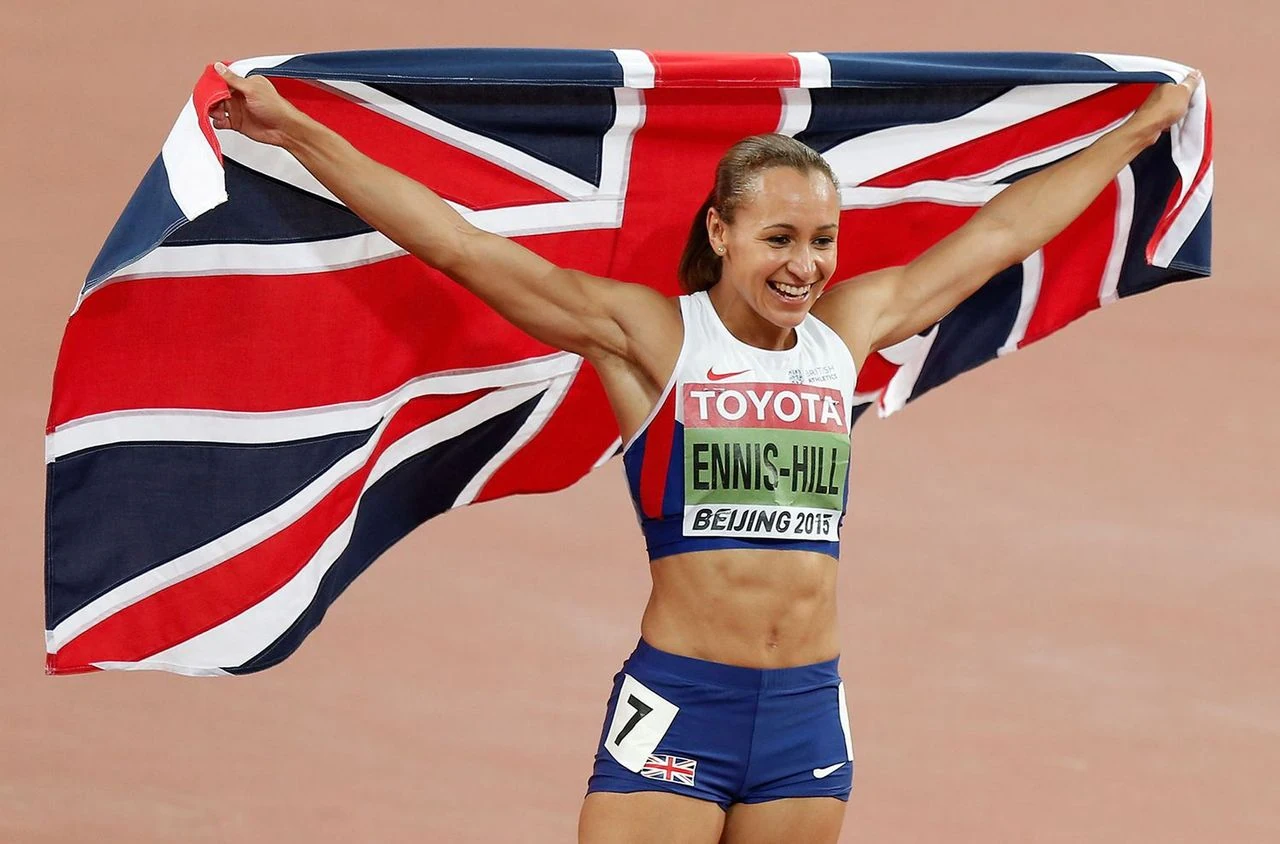
Jessica Ennis-Hill’s Olympic victory in London in 2012 brought a home crowd to its feet, but it was the culmination of years spent mastering seven very different events. Born and raised in Sheffield, she became a world champion before winning the heptathlon gold medal with a British and Commonwealth record score of 6,955 points. A foot injury had kept her out of the 2008 Beijing Olympics; after returning to the top, she went on to win another world title and an Olympic silver before retiring in 2016.
A Sheffield start
Born Jessica Ennis in Sheffield on 28 January 1986, she was introduced to athletics by her parents, Vinnie Ennis and Alison Powell. During the school summer holidays in 1996, they took her to a Start:Track event at Don Valley Stadium. She won a pair of trainers as her first athletics prize and met Toni Minichiello, who became her coach. The following year, aged 11, she joined City of Sheffield and Dearne Athletic Club.
Ennis attended Sharrow Primary School and King Ecgbert School in Dore. She went on to study psychology at the University of Sheffield, graduating in 2007. Her development began in individual events: as a junior she competed in the high jump, hurdles and pentathlon as well as the heptathlon. In 2005 she won the European junior heptathlon title with a British junior record of 5,891 points. That year she also won bronze in the heptathlon at the Universiade.
She made early progress at senior level, taking bronze for England at the 2006 Commonwealth Games in Melbourne with a personal best of 6,269 points. At the 2007 World Championships in Osaka she finished fourth. Those results marked a rise in competition, but a serious foot injury soon interrupted it: stress fractures in her right foot ruled her out of the 2008 season and the Beijing Olympics.
Back from injury, on to the world title
Ennis returned in 2009 after a year away from competition. She won the heptathlon at the World Championships in Berlin with a personal best of 6,731 points, securing her first senior world title. The following year she won the pentathlon at the World Indoor Championships in Doha, then took European heptathlon gold in Barcelona with 6,823 points. In 2011 she initially finished second at the World Championships in Daegu. After the original winner, Tatyana Chernova, was disqualified following a doping case, Ennis-Hill was awarded the gold medal retrospectively.
The build-up to London included another landmark performance. At the 2012 Hypo-Meeting in Götzis, she scored 6,906 points, breaking Denise Lewis’s British heptathlon record. In London that summer, Ennis-Hill improved again. She led from the first day, when personal bests in the 100 metres hurdles and 200 metres helped put her in front. A personal best in the javelin and a winning run in the final event, the 800 metres, completed a total of 6,955 points. It brought her the Olympic title and set British and Commonwealth records.
The achievement was celebrated in her home city as well as at the Games. Sheffield welcomed her back at a gathering in the city centre, and the council awarded her the Freedom of the City. A stand at Bramall Lane, home of her supported club Sheffield United, was named in her honour. Ennis-Hill’s links to Sheffield were central to how the victory was marked: the city where she had begun training was also where crowds gathered to celebrate her Olympic success.
Another return and a final Olympic medal
Injuries and pregnancy kept Ennis-Hill out of competition in 2013 and 2014. She returned in 2015 and won the heptathlon at the World Championships in Beijing with 6,669 points, her third world title. Her career’s closing season brought another major test. She won a heptathlon in Ratingen in 2016, then competed at the Rio Olympics as the defending champion. Belgium’s Nafissatou Thiam won; Ennis-Hill took silver.
She announced her retirement from athletics in October 2016. Her competition record also includes the 2010 European heptathlon title and the 2010 world indoor pentathlon title. She was appointed Commander of the Order of the British Empire in 2013 and Dame Commander in 2017, both for services to athletics.
Life after competition
After retiring, Ennis-Hill continued to work in athletics as a BBC commentator and studio pundit. She has also developed work beyond broadcasting. In 2019 she launched Jennis, an app-based training programme, with her co-founder and agent Jane Cowmeadow. In 2021, the programme added CycleMapping, which helps women map training to their menstrual cycle. The product later formed part of a partnership with the Ladies European Tour.
Ennis-Hill also co-wrote a children’s book series with author Elen Caldecott. The first of the seven Eve’s Magic Bracelet books, The Silver Unicorn, was published in 2017. These projects extend her public work beyond the competition arena, while her regular analysis of athletics gives her a continuing role in the sport she once dominated.
Why Jessica Ennis-Hill deserves a place in British Legacy
Ennis-Hill’s place in British sporting history rests on more than the emotional force of a home Olympic victory. She won Olympic gold in London, Olympic silver in Rio, three world heptathlon titles and the 2010 European title. She also won world indoor gold in the pentathlon. These achievements span different formats and championships, and followed a career in which injuries repeatedly interrupted her progress. Her return from the foot fractures that cost her the 2008 Olympics led to a world title in 2009; after pregnancy kept her out for a season, she returned to win another world title in 2015.
Her record is particularly significant for Sheffield. Ennis-Hill began training there as a child, studied at the city’s university, and returned to a public welcome after her Olympic triumph. The Freedom of the City and the Bramall Lane stand named in her honour are concrete marks of that connection. Her British and Commonwealth record at London 2012 made the achievement national as well as personal, while the retrospective award of her 2011 world gold added a further title to her career record. Since retiring, she has remained visible as a broadcaster and has developed training products focused on women’s health. Together, her sporting results, sustained connection to Sheffield and later work in athletics give her legacy a distinct shape: elite achievement rooted in a British city and carried forward into the sport’s public life.
Sources
Jessica Ennis-Hill — Wikipedia, revision 1370298279
Adapted in part from Jessica Ennis-Hill by Wikipedia contributors, under CC BY-SA 4.0. Text has been edited and combined with the existing article; this adapted text is shared under the same licence. Contributor history.