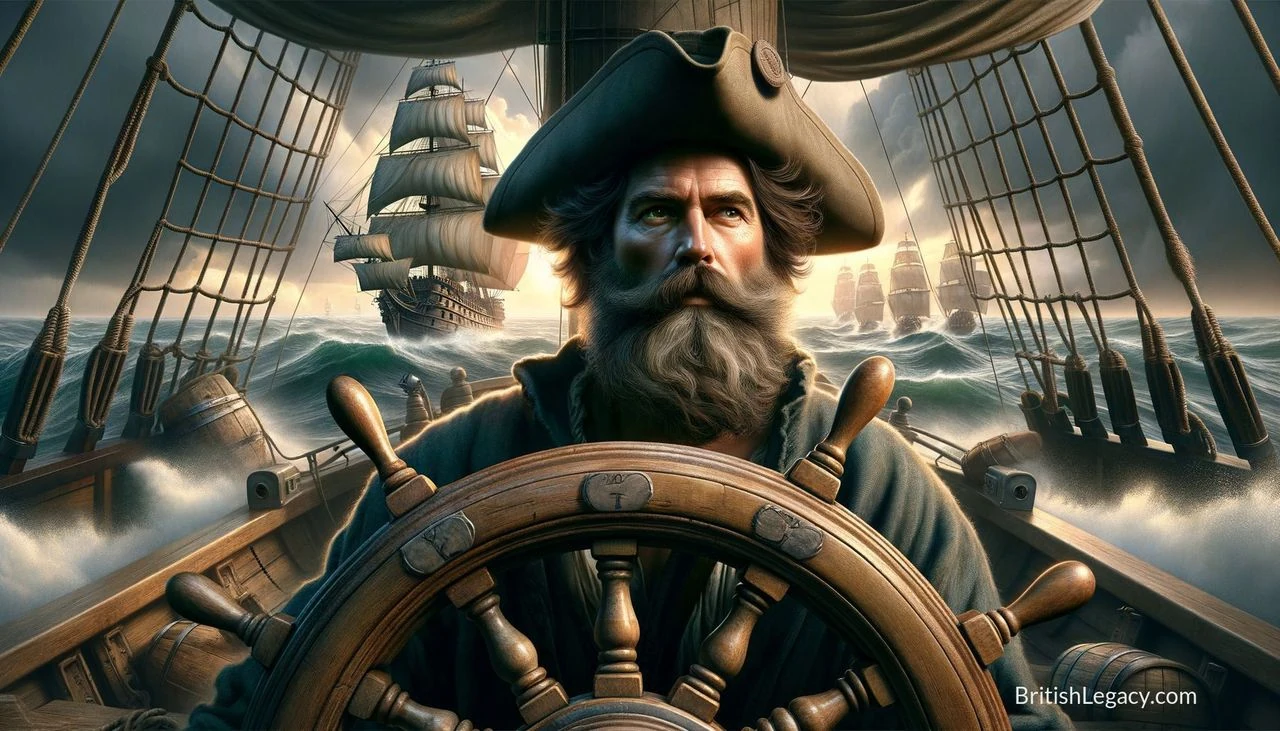
Francis Drake’s career cannot be reduced to a tale of English naval triumph. He became the first Englishman to lead an expedition around the world, served as vice-admiral in the fleet that fought the Spanish Armada, and rose from seaman to knight and Member of Parliament. His voyages also involved the slave trade, attacks on Spanish settlements and the violent seizure of wealth. Admired in England and branded a pirate by Spain, Drake remains a figure whose achievements and costs belong in the same account.
From Devon to the Spanish Main
Drake was born around 1540 at Crowndale Farm, near Tavistock in Devon. He was the eldest of twelve children of Edmund Drake, a Protestant farmer, and Mary Mylwaye. Religious persecution during the Prayer Book Rebellion of 1549 drove the family from Devon to Kent, where Edmund took work connected with the King’s Navy and became a clergyman. Francis entered the household of the Plymouth sea captain William Hawkins and trained as an apprentice on Hawkins’s boats. By 18, according to the chronicler Edmund Howes, he was serving as a purser.
Drake’s early maritime career was also tied to English participation in the Atlantic slave trade. He sailed with John Hawkins on voyages that seized Africans and sold them in Spanish colonies. The sources differ over precisely which early voyages Drake joined, but record evidence places him on at least some of Hawkins’s expeditions. In 1567, Drake accompanied Hawkins on the voyage that ended in the English defeat at San Juan de Ulúa, in present-day Mexico. Drake escaped aboard the Judith; Hawkins later accused him of desertion and of keeping treasure. Drake denied both charges. Their association with slaving ended, but it remains a significant part of his history.
In 1572, Drake began his first major independent venture, raiding Spanish possessions around the Isthmus of Panama. He and his men attacked Nombre de Dios and joined forces with Cimarrón allies—Africans who had escaped Spanish enslavement—to seize treasure carried overland. In 1573, Drake and his lieutenant John Oxenham climbed a tree in the mountains and saw the Pacific. The expedition made Drake wealthy and celebrated in England, while a temporary truce made official recognition politically awkward: the Spanish regarded his attacks as piracy.
A circumnavigation under uncertain authority
Drake’s expedition of 1577–80 was organised and financed by a private group that included prominent courtiers. Elizabeth I probably invested in it, but did not issue Drake a formal commission. Its purpose was to attack Spanish interests along the Pacific coast of the Americas, where Spain claimed exclusive influence. Drake sailed from Plymouth in December 1577 aboard the Pelican, later renamed the Golden Hind. Shipwreck, storms and the execution of his co-commander Thomas Doughty marked the voyage before Drake’s remaining ship entered the Pacific through the Strait of Magellan.
In the Pacific, Drake raided Spanish ports and ships, taking cargo and using captured charts. His most valuable prize was the treasure ship Nuestra Señora de la Concepción. In 1579, on the coast of what is now northern California, he claimed territory for Elizabeth as Nova Albion. The precise northern limit of his voyage remains disputed, but the expedition continued across the Pacific, through the Moluccas and around the Cape of Good Hope. The Golden Hind returned to Plymouth on 26 September 1580 with Drake and 59 surviving crew members.
This was the first English expedition to circumnavigate the globe, and the second such expedition to return with a ship intact. Elizabeth kept the voyage’s details secret to avoid provoking Spain. She knighted Drake aboard the Golden Hind at Deptford in 1581; the ceremony was performed by a French diplomat. Drake later received his own coat of arms after a dispute over his adoption of the arms of an older Devon family.
Raids, public office and the Armada
Drake’s attacks continued during the war with Spain. In 1585, he led an expedition against Spanish possessions in the Caribbean and the Americas. Its targets included Santo Domingo, Cartagena de Indias and St Augustine in Florida. The voyage brought English forces into direct conflict with Spanish colonial power, but it was not a simple sequence of victories: Drake’s operations were raids, intended to damage Spanish interests and acquire supplies and wealth.
In 1587, Drake attacked Cádiz, where Spanish ships and stores were being assembled. The raid destroyed or damaged vessels and provisions; accounts differ over the number of ships lost. Known as the “singeing of the King’s beard”, it delayed preparations for the invasion fleet, but did not cripple Spain’s naval capacity. The following year, Drake served as vice-admiral under Lord Howard of Effingham when the Spanish Armada reached the English coast. During the pursuit up the Channel, Drake captured the disabled Spanish galleon Nuestra Señora del Rosario and its commander. English commanders then launched fireships against the Armada at Calais. At Gravelines, Drake’s squadron joined the fighting, but the campaign was a collective naval effort, not the work of one man. The battered Spanish fleet failed to land in England and was forced to sail around the British Isles.
The familiar story that Drake was playing bowls on Plymouth Hoe when the Armada appeared has no known eyewitness account; its earliest printed version came decades later. It is better treated as legend than as a documented incident. Drake’s political life is less mythical: he sat in Parliament for Camelford, Bossiney and Plymouth, and served as Mayor of Plymouth. As mayor, he installed a compass on the Hoe and undertook a project to bring water from the River Meavy to the town.
Setbacks, death and the making of a reputation
Drake’s reputation was not built on uninterrupted success. In 1589, he and John Norris led the English Armada, an expedition intended to damage Spain’s remaining fleet and support a Portuguese revolt. It failed to achieve its main aims and suffered heavy losses. Drake was not given command of another naval expedition until 1595. In that year, he joined another campaign against Spanish America, which met further setbacks at Las Palmas, San Juan and Panama.
Drake died of dysentery on 28 January 1596, while his fleet was anchored off Portobelo, in present-day Panama. He was about 56. His body, dressed in armour, was placed in a lead-lined coffin and buried at sea. He had married Mary Newman in 1569; she died in the early 1580s. In 1585 he married Elizabeth Sydenham. Drake bought Buckland Abbey, near Yelverton in Devon, in 1580, and it remained in his family until 1946.
Later generations turned Drake into both a national hero and a figure of folklore. The story of Drake’s Drum, said to sound when England is in danger, inspired a poem by Henry Newbolt. Yet celebration has never erased the darker record: his participation in slaving voyages, his attacks on Spanish communities and ships, and his role in English campaigns in Ireland and the Americas. The ways he has been commemorated, including the removal or renaming of some landmarks in California, reflect continuing disagreement about what public honour should represent.
Why Sir Francis Drake deserves a place in British Legacy
Drake belongs in British Legacy because his life shows how England’s maritime power took shape through a mixture of private enterprise, royal interest and armed conflict. His circumnavigation was a major navigational achievement: the first English expedition to complete the journey, it returned with valuable cargo and brought Drake a knighthood. His later service as vice-admiral during the Armada campaign placed him within a defining episode of English history. His record in public office, including his work as mayor of Plymouth and his representation of three constituencies in Parliament, also connects his reputation to civic and political life at home.
That legacy is worth examining without turning it into uncomplicated celebration. Drake’s wealth and fame were built in part through attacks on Spanish shipping and settlements, and he took part in voyages that enslaved Africans. He was celebrated by the English crown while Spain called him a pirate; his later expeditions could fail as decisively as his earlier ones succeeded. Holding these facts together helps readers understand both the ambitions of Elizabethan England and the human consequences of its expansion. Drake’s place in British history is not a claim that every action deserves admiration. It is an opportunity to trace the reach of English seafaring, the making of national memory and the difficult questions that still accompany the honours given to historical figures.
Sources
Francis Drake — revision 1379079881 · Francis Drake
Adapted in part from Francis Drake by Wikipedia contributors, under CC BY-SA 4.0. Text has been edited and combined with the existing article; this adapted text is shared under the same licence. Contributor history.