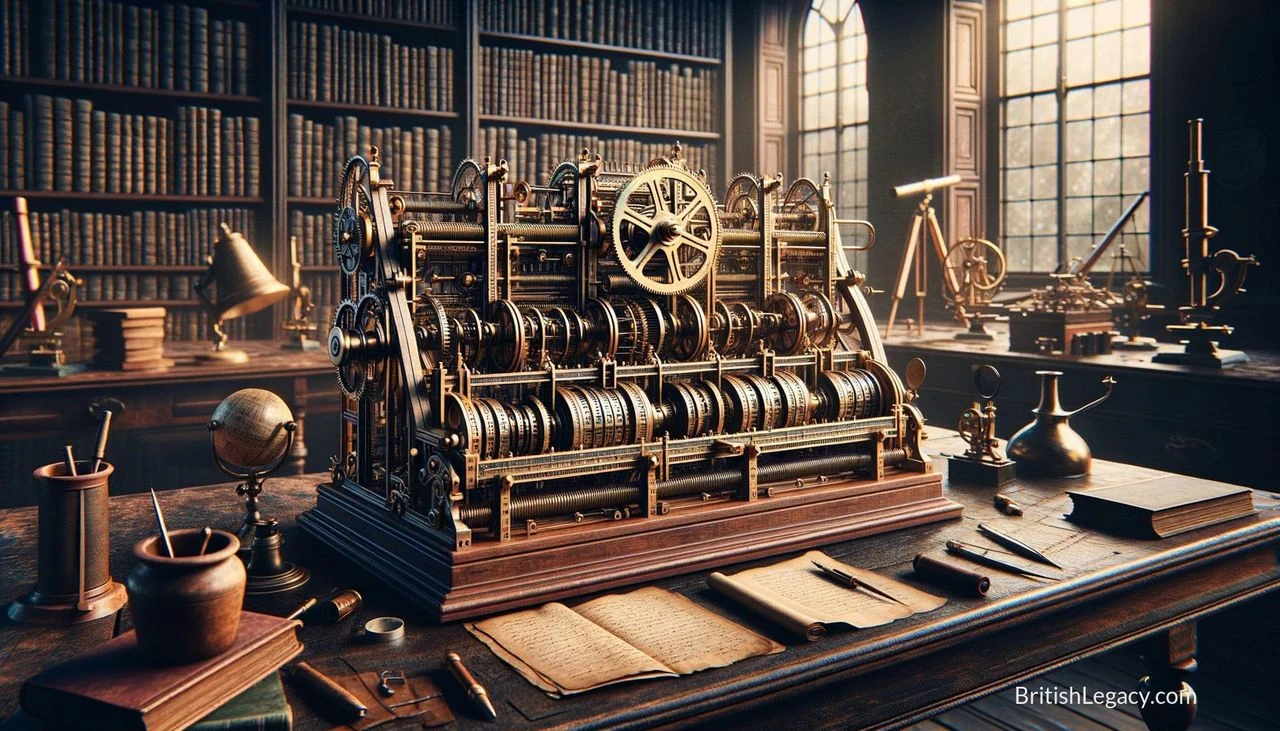
Charles Babbage wanted calculation to be more reliable than the printed tables on which navigation, engineering and science depended. His proposed machines would mechanise arithmetic, first for producing tables and later for a much wider range of operations. Neither of his major engines was completed in his lifetime, but the designs set out a strikingly modern idea: a machine could follow instructions, branch according to conditions and repeat operations. Babbage’s work was not confined to computing. He helped establish scientific institutions, studied factory production and argued about how British science should be organised.
A Cambridge mathematician with a reforming streak
Born in London on 26 December 1791, Babbage arrived at Trinity College, Cambridge, in October 1810. He had taught himself parts of contemporary mathematics and found the university’s instruction disappointing. In 1812, he and fellow students including John Herschel and George Peacock formed the Analytical Society. They promoted mathematical methods then used on the Continent, and their work helped bring new approaches to British mathematics. Babbage transferred to Peterhouse in 1812 and received a degree without examination in 1814.
His academic career did not follow a conventional path. He became Lucasian Professor of Mathematics at Cambridge in 1828, holding the post until 1839, but did not give a lecture there. He also sought changes to university education and campaigned for reform in scientific life. His 1830 book, Reflections on the Decline of Science and some of its Causes, attacked what he saw as weaknesses in British science. The British Association for the Advancement of Science was formed in 1831, in the wake of the debate to which his book contributed. Babbage was a founding figure in the Royal Astronomical Society, established in 1820, and received its Gold Medal in 1824 for his proposed calculating engine.
From tables to the Difference Engine
Printed tables were calculated by hand and could contain errors in calculation or transcription. Babbage saw an opportunity to use machinery to make this work faster and more consistent. From 1822 he developed the Difference Engine, designed to calculate values of polynomial functions through repeated addition. This method avoided the need for multiplication and division in producing a table.
Babbage employed the engineer Joseph Clement to build a prototype. Their arrangement broke down over costs, and the larger engine was never completed. The project had received government funding, but its expense, technical demands and disputes contributed to its failure to reach completion. Parts of the prototype survive, and the Science Museum in London holds the finished portion of the first engine. Babbage later drew up a more developed design, Difference Engine No. 2. It was built after his death, using his plans and manufacturing tolerances achievable in the nineteenth century; the Science Museum’s machine performed a calculation in 1991, returning a result to 31 digits. The later construction demonstrated that the design could work, without changing the fact that Babbage himself did not complete it.
He also designed a printer for the Difference Engine. The Science Museum completed a version of that printer in 2000. Such details matter to the history of computing: Babbage was considering not only how a machine might calculate, but how it could present its results.
The Analytical Engine: instructions, memory and control
Babbage’s more ambitious proposal was the Analytical Engine, developed through a succession of designs from 1837 onwards. Unlike the Difference Engine, which was intended for a particular class of calculation, the Analytical Engine was conceived as a general-purpose machine. Punched cards, drawing on the system used by the Jacquard loom, would direct its operations. The designs included sequential control, memory, conditional branching and loops: features that allow a machine to follow instructions, make a choice and repeat a process.
The Engine was never built as a complete machine. Babbage continued to refine its designs until his death, in 1871, and wrote programmes for it. Ada Lovelace, who worked with and corresponded with him, translated a paper about the Engine and added extensive notes. One of those notes contained an algorithm intended to calculate Bernoulli numbers. She is often described as the first computer programmer, although the history and extent of her contribution have been debated. Her writing helped explain how the machine’s punched cards could control a sequence of operations.
Babbage’s ideas were grounded in mechanical engineering, but their significance reaches beyond the machines he could build. The Analytical Engine’s planned control and programming features helped establish the concept of a programmable computer. Parts of his unfinished mechanisms are displayed in the Science Museum, where visitors can encounter the material remains as well as the designs that made the machines possible.
Factories, public science and other inventions
In On the Economy of Machinery and Manufactures (1832), Babbage examined industrial production, factory organisation and the division of labour. Drawing on observations of manufacturing, he considered how tasks could be divided among workers and how the organisation of production affected costs. The book became an influential early study of manufacturing and operational organisation. It also addressed the economics of publishing, including the trade’s practices and profitability.
His involvement in public science was practical as well as polemical. He helped establish the British Association for the Advancement of Science and served as the first chairman of its Statistical Section, formed in 1833. He held gatherings at his London home, where scientists, writers and members of the aristocracy met. Beyond mathematics and computing, he worked on cryptography, studied the requirements of a modern postal system and pursued precise measurement of physical constants. In 1838 he devised a metal frame, known as a pilot or cow-catcher, to clear obstacles from the front of a locomotive, and constructed a dynamometer car. These interests reflect a mind drawn to systems: how to measure them, improve them and make their operations more dependable.
Babbage married Georgiana Whitmore in 1814. They had eight children, four of whom survived childhood. After her death in 1827, Babbage continued his work in London and at Cambridge. He died in Marylebone on 18 October 1871, aged 79, and was buried at Kensal Green Cemetery. The Science Museum preserves parts of his machinery, while a British cultural-icons section of the passport introduced in 2015 included an image of him.
Why Charles Babbage deserves a place in British Legacy
Babbage deserves a place in British Legacy because he joined mathematical ambition to the practical problems of his age. The Difference Engine answered a clear need: tables used in science, navigation and engineering could be wrong, and mechanical calculation offered a way to reduce errors and produce results consistently. The Analytical Engine took that thinking further. Its proposed use of punched cards, memory, branching and loops was not simply a faster calculator; it set out how a machine might carry out a programme. Although neither major engine was completed in his lifetime, later construction of Difference Engine No. 2 from his plans showed that the design was mechanically achievable.
His contribution also belongs to a wider British history of science and industry. Babbage took part in founding the Royal Astronomical Society and the British Association for the Advancement of Science, and pressed for changes to the organisation of research and education. His study of manufacturing examined how production could be arranged and labour divided; his work on the Analytical Engine made the same concern with ordered processes relevant to computation. The machines in the Science Museum connect those ideas to their physical engineering, while his designs and writing explain their reach. His legacy is therefore not a claim that he built the modern computer. It is the more precise achievement of proposing, and working out in detail, a mechanical route towards programmable computation.
Sources
Charles Babbage (revision 1378706326)
Adapted in part from Charles Babbage by Wikipedia contributors, under CC BY-SA 4.0. Text has been edited and combined with the existing article; this adapted text is shared under the same licence. Contributor history.